
My December 2025 pieces show that both were legitimate candidates with different strengths. Cuellar impressed because she was an ER physician, studying law, focused on healthcare and women’s reproductive rights. Pulido impressed because his politics sounded culturally and economically at home in South Texas. I supported both. (M Barrera)
Then Democratic voters actually got to choose.
They chose Bobby Pulido. (San Antonio Express-News)
Ada Cuellar was not a bad candidate.
Quite the opposite.
She was a practicing emergency-room physician, studying to become a lawyer, a mother, a South Texan and an outspoken defender of women’s reproductive rights.
She could talk about healthcare from the emergency room rather than from a campaign briefing book. She had watched patients leave without treatment because they could not afford it.
On paper, Democrats had every reason to be excited about her.
Then there was Bobby Pulido.
A Tejano singer.
A businessman.
A political moderate.
A man who openly said South Texas Democrats were not the same Democrats found in progressive circles on the East and West coasts.
Two credible Democrats.
Same district.
Same voters.
Very different approaches.
South Texas Democrats chose Pulido.
Maybe Democrats should spend less time explaining that result and more time listening to it.
Because there is something happening among working-class Latino voters that national Democrats still seem determined to make more complicated than it is.
Rights matter.
Women’s rights matter.
Black rights matter.
Gay rights matter.
Immigrant rights matter.
A woman whose pregnancy threatens her health does not suddenly stop having rights because she became pregnant.
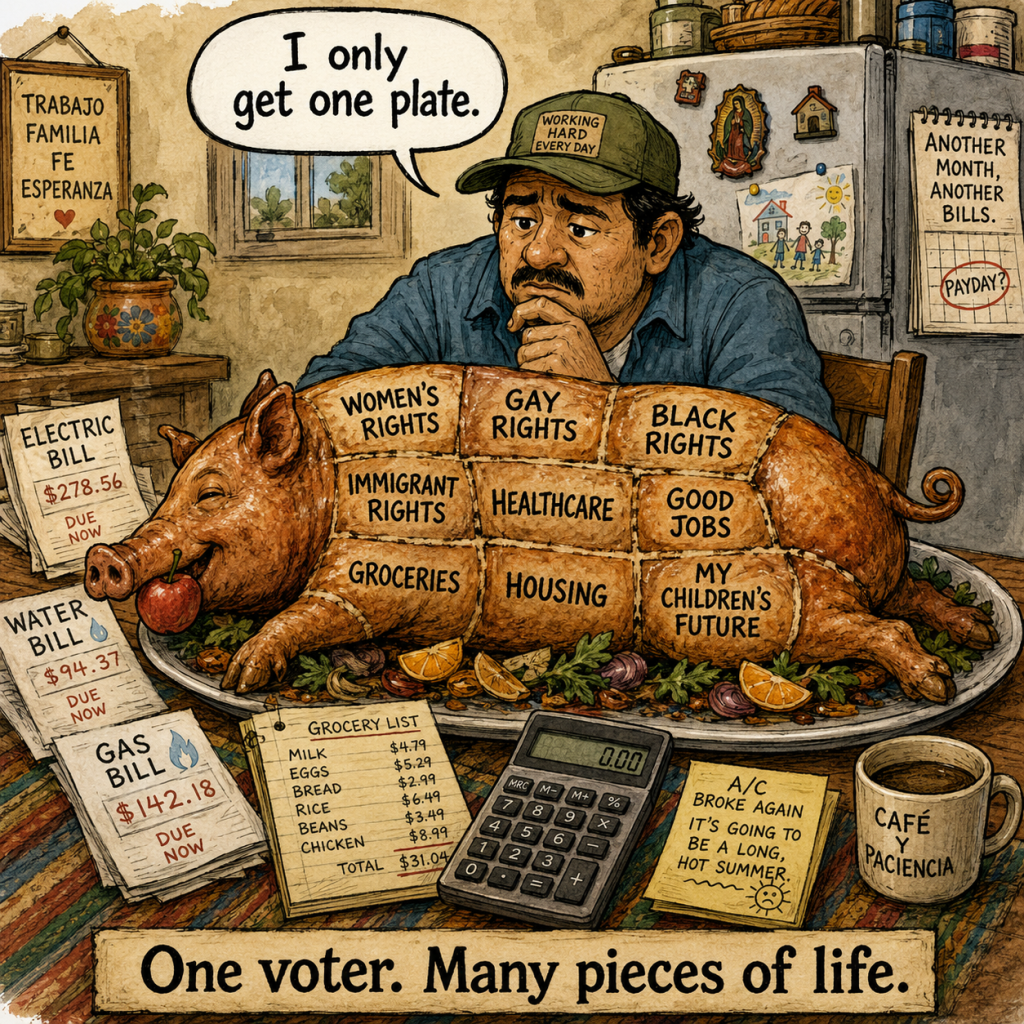
But somewhere in South Texas there is another voter sitting at a kitchen table.
The electric bill is there.
The water bill is there.
Maybe the car needs gasoline.
The air conditioner has been running nonstop because this is Texas.
And after all of those bills are paid, somebody still has to buy groceries.
That voter may care about women’s rights.
She may be a woman.
She may care about immigrant rights.
Her parents may have crossed that border.
She may care about discrimination because she has experienced it herself.
But tonight she is worried about whether there is enough money to make it to payday.
That doesn’t make her conservative.
It makes her human.
Bobby Pulido seems to understand that voter.
His politics do not fit comfortably into the national Democratic package.
He supports border security.
He talks about free enterprise.
He emphasizes healthcare costs and household economics.
He has criticized the progressive direction of the national Democratic Party.
And none of this should be particularly surprising considering the political history of South Texas.
Nor should Pulido’s family history be ignored.
His father, Tejano legend Roberto Pulido, was born into a family of migrant farmworkers in Edinburg.
Before the fame, before the music and before his son became a congressional candidate, there were people working the fields of South Texas.
That history does not prove Bobby Pulido grew up poor.
There is no reason to manufacture poverty for a candidate.
But it does mean that farm labor and working-class South Texas were only one generation removed from him.
Perhaps that matters when deciding which political language sounds natural and which sounds imported.
Ada Cuellar offered Democrats something important.
She made the case that women are losing fundamental control over their bodies in Texas.
She was right to make it.
Pulido offered something different.
He appeared to tell South Texas voters:
I know where I am running.
And they chose him.
That does not mean South Texas voters decided women’s rights don’t matter.
It does not mean they became hostile to minorities.
And it certainly does not mean every voter who chose Pulido agreed with him on abortion, guns, immigration or anything else.
Elections aren’t ideological examinations.
People vote for the whole person.
That may be where national Democrats keep getting Latino voters wrong.
They divide people into political categories.
Women.
Latinos.
Immigrants.
LGBTQ voters.
Working-class voters.
Catholics.
Union members.
Each gets an issue.
Real people don’t divide themselves that way.
The same South Texas woman can be Mexican American, Catholic, worried about abortion restrictions, angry about illegal immigration, worried about the price of groceries and terrified that her children will never be able to afford a house.
She doesn’t get six votes.
She gets one.
Two years ago, Latino voters moving toward Republicans in California were already sending the same warning.
Economic insecurity was competing with the issues Democrats believed should motivate Latino voters.
That did not mean those voters suddenly stopped caring about discrimination or immigration.
It meant something else was happening at the kitchen table.
Now South Texas Democrats were given an interesting little experiment.
Ada Cuellar offered impressive credentials, healthcare expertise and a strong defense of reproductive rights.
Bobby Pulido offered a more culturally conservative, economically focused version of Democratic politics.
They chose Pulido.
Democrats can dismiss that choice.
They can explain it away.
They can decide South Texas voters simply don’t understand what is in their own best interest.
Or they can ask the simplest question in politics:
Why?
Maybe Bobby Pulido knows the answer.
People want their rights protected.
But they also want to feed their families.
They want women protected from dangerous abortion laws.
But they also want the electricity to stay on.
They want immigrants treated like human beings.
But they also want jobs that pay enough to live.
Those things do not have to compete.
The political party that understands that may eventually win South Texas.
The one that insists voters choose between their rights and their refrigerator probably won’t.
Because rights matter.
But the refrigerator still gets a vote.
Ada didn’t lose the argument because she cared about rights. She becomes evidence that voters were offered a genuinely impressive rights-oriented candidate and nevertheless preferred Pulido’s broader political package.
That is a much more interesting question than “Are South Texas Latinos becoming conservative?”
__________


