
July 29, 2026
Houston may finally have discovered the secret to faster police response times: fewer people asking the police to respond.
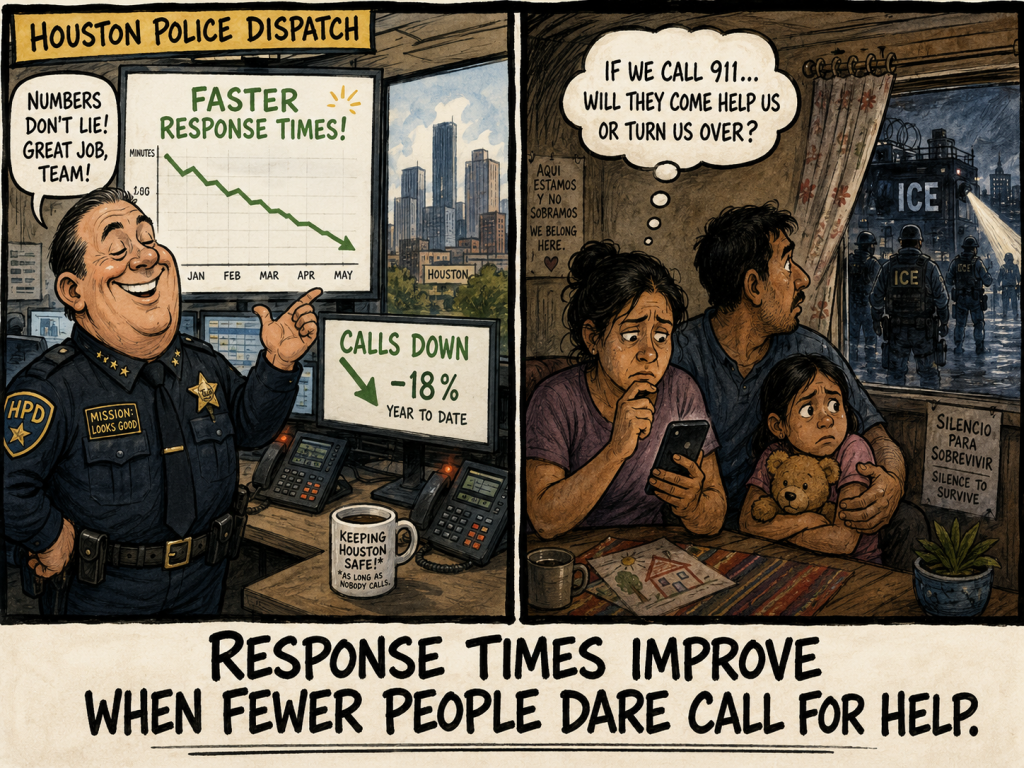
For years, city leaders struggled with long waits for officers. They hired consultants, studied staffing, blamed population growth, blamed traffic, blamed paperwork and occasionally blamed the people calling 911 for having emergencies at inconvenient times.
Then immigration enforcement came along and offered a simpler solution.
Make enough residents afraid that calling the police could bring ICE into their lives, and suddenly the phones become quieter. With fewer calls waiting, officers can reach the remaining emergencies faster. The statistics improve, the charts point downward, and everyone at City Hall gets to announce progress.
It is government efficiency through public fear.
Houston police received almost 61,000 fewer calls for service in 2025 than in 2024. The highest-priority calls also declined. Analysts have suggested that the lower call volume may explain much of the improvement in response times.
City officials can look at those numbers and conclude that Houston has become safer.
Another possibility is that some people have decided they are safer remaining silent.
Imagine a woman whose husband is beating her. She reaches for the phone, then remembers that someone in the household lacks legal status. Will the officer arrest the abuser, or will police contact expose the victim’s family to immigration authorities?
Imagine a worker who has been robbed. He knows who did it. He could help police catch the criminal, but he also knows that his brother, wife or child might be questioned if officers come to the house.
Imagine a mother hearing gunshots outside while her children sleep. She does not know whether calling 911 will bring help, trouble or both.
So she waits.
The criminal learns something too. He learns which neighborhoods are becoming quieter—not because crime disappeared, but because witnesses and victims have become afraid to report it.
That creates a remarkable public-safety achievement. Calls go down. Response times improve. Crime statistics may eventually decline because unreported crimes are wonderfully cooperative that way: they do not appear in official reports.
The city could take this strategy much further.
To reduce emergency-room waiting times, make uninsured patients afraid to enter hospitals.
To shorten lines at food banks, frighten hungry families away from applying.
To improve school attendance percentages, remove children who miss too many days from the enrollment count.
The possibilities are endless once government learns that the easiest way to solve a problem is to stop counting the people who still have it.
None of this proves that every decline in Houston police calls came from immigration fear. Crime may have fallen in some places. Residents may be using other methods to report incidents. Some changes may have nothing to do with ICE.
But Houston should not celebrate falling call volume without asking who stopped calling and why.
If immigrant neighborhoods account for a significant portion of the decline, improved response times may not represent better policing. They may represent a population retreating from the police.
That is not public safety.
It is silence dressed up as success.
Houston has not necessarily solved the problem of slow police response.
It may simply have taught some of the people who need help most that calling for help is too dangerous.