
The New York Times documented the injection wells and underground migration in an interactive map. Subscribers can share the article through a gift link.
Ohio Republicans Are Betting Other People’s Water
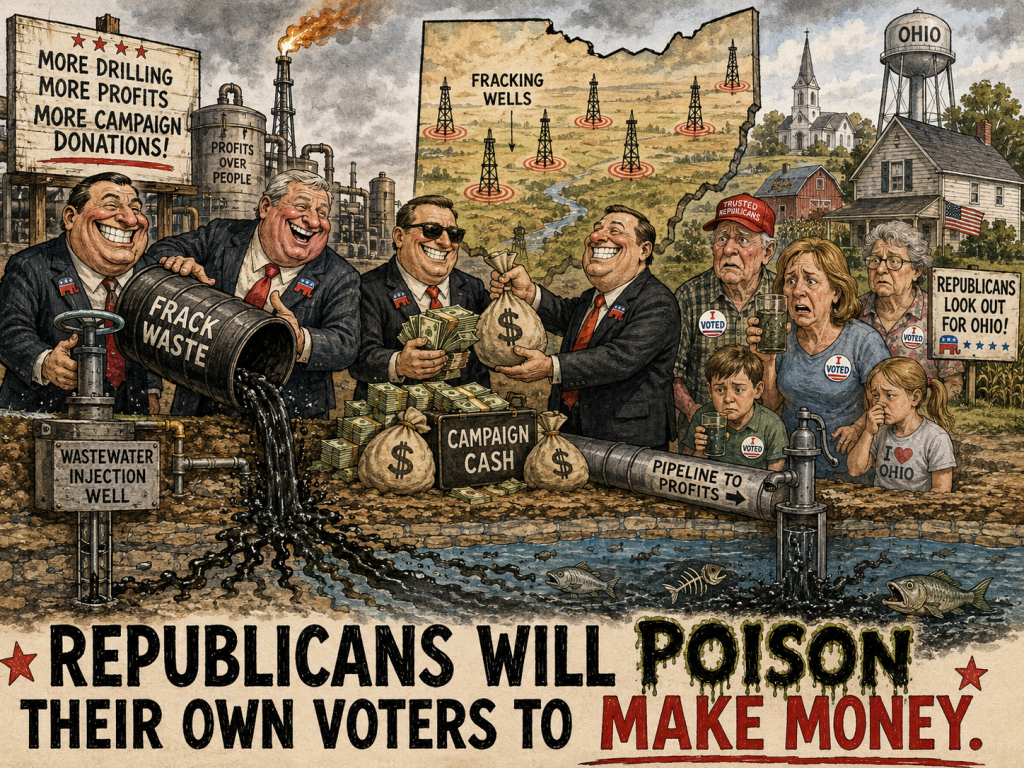
July 29, 2026
Republicans like to say government should get out of the way and let business work.
In Ohio, that philosophy has become something uglier: let the industry pump hundreds of millions of gallons of contaminated waste beneath other people’s homes, farms and drinking water, then wait until the damage becomes impossible to ignore.
Only then does the state reluctantly ask anyone to stop.
The Ohio Department of Natural Resources recently pressured the owners of four wastewater injection wells in Washington County to suspend operations. State inspectors had found fluid and rising pressure in nearby oil and gas wells—evidence that the waste may be escaping the underground formations where it was supposed to remain. (WOUB Public Media)
This was not an unforeseeable accident.
Ohio knew there was a problem years ago.
In 2020, a state investigation concluded that wastewater injected into the Redbird No. 4 disposal well had migrated into another underground formation and appeared in 28 nearby production wells. The investigation identified naturally occurring fissures through which the waste could travel. Some affected wells were miles away. (Cloudinary)
The state’s response was not to permanently close the well.
Ohio allowed it to resume operating after modifications intended to send the waste into a deeper formation.
Now the pressure is rising again.
One local producer says 50 of his 171 oil and gas wells no longer produce oil or gas because they have filled with disposal water. He says the wells cannot be repaired and his business has been ruined. Measurements at one well rose from 20 pounds per square inch in 2023 to more than 300 pounds this year. (The Allegheny Front)
This is where Republican promises about protecting businesses become selective.
When a large disposal company needs somewhere to put poisonous industrial waste, Ohio protects the industry.
When a smaller producer says that waste has destroyed his wells and livelihood, suddenly the state needs more studies.
When communities worry about their drinking water, officials assure them that the waste is deep underground.
But the waste did not stay where the state said it would stay.
That is already established.
Washington County water authorities say approximately 502 million gallons of liquid waste were injected beneath the county in only two years. Nine local water authorities have called for a temporary moratorium on injection wells near aquifers. Ohio nevertheless approved additional disposal wells within two miles of Marietta’s source-water protection area. (Signal Ohio)
That is not caution.
That is gambling.
The people making the wager will not necessarily be the people drinking the water.
Fracking wastewater is not harmless saltwater. It can contain drilling chemicals, heavy metals, and naturally occurring radioactive materials including radium, uranium, and thorium. The Environmental Protection Agency has found scientific evidence that parts of the hydraulic-fracturing water cycle can contaminate drinking-water resources. In documented cases, the damage has ranged from temporary changes in water quality to contamination that made private wells unusable. (The Allegheny Front)
Ohio officials say earlier testing did not find contamination in nearby private drinking-water wells. They are commissioning another study now. (The Allegheny Front)
That may sound reassuring until one asks the obvious question:
Why should families have to wait for poison to reach their faucets before the state acts decisively?
The absence of proven drinking-water contamination today does not erase the confirmed underground migration. It does not restore the ruined production wells. It does not explain why a disposal operation that failed once was permitted to resume. It does not make hundreds of millions of gallons of waste disappear.
And it does not excuse placing more injection wells near aquifers while the underground geology is already demonstrating that it does not obey political promises.
Ohio is governed by a Republican governor and Republican majorities in both legislative chambers. There is no Democratic administration to blame and no divided government preventing action. Republicans control the state, the regulatory agencies, and the laws under which these wells operate. (Ohio Governor’s Office)
They own this.
Should drinking water become contaminated, families may lose their homes because no buyer wants property served by poisoned wells. Farmers may lose land that has been in their families for generations. Small producers may lose their businesses. People may become sick from exposures whose full consequences emerge only years later.
And when that happens, politicians will call it tragic.
It will not be tragic.
A tragedy is something unavoidable.
This danger was reported. The underground migration was documented. Businesses complained. Geologists warned that fractures could provide pathways toward the surface. Water authorities demanded a moratorium. Residents asked the state not to permit more wells near their aquifers. (The Allegheny Front)
Ohio continued permitting and protecting the disposal system anyway.
Republicans often accuse environmental regulators of killing jobs and interfering with private property. Here, weak regulation has already damaged businesses and private property. The government supposedly protecting industry has chosen one part of the industry over everyone standing in its way.
There is nothing conservative about allowing corporations to endanger another person’s land, water, or livelihood.
There is nothing pro-business about destroying smaller businesses so larger operators can dispose of their waste cheaply.
And there is nothing responsible about waiting for someone to become sick before admitting that contaminated water moving through fractured rock might eventually reach the water people drink.
Ohio Republicans are not merely reducing regulation.
They are transferring the risk from the companies making money to families who may lose everything.
The companies keep the profits.
The public gets the waste.
And beneath Washington County, the bill is already moving underground.


