
I woke up from a dream in which I was trying to reassemble a robot.
I had the pieces spread before me. Some belonged inside the chest. Others connected to the arms and legs. I kept fitting them together, hoping that when I finished, the machine would stand up and behave as it had before.
Then I woke with a strange thought.
Maybe that is what we have been doing to our culture.
We took it apart because some of its pieces were ugly. The old jokes could be cruel. People made fun of race, sex, disability, weight, religion, accents and nearly everything else that distinguished one human being from another. Some comedians did not merely cross the line; they made their living dancing on it.
There were words that hurt people. There were jokes whose only purpose was to make someone smaller so everyone else could laugh.
Some of that needed to change.
But somewhere during the reassembly, we put modesty in backward.
We became more modest about words and less modest about everything else.
Today, a television writer may worry that one poorly chosen sentence could offend someone, yet the same program can place a naked man’s rear end in the center of the screen for no reason beyond showing that it can.
A joke must pass through layers of moral inspection.
A naked body can stroll past without showing identification.
A character may not use the wrong word to describe another person, but the camera may strip that person, humiliate her, beat her, rape her, dismember her or follow her naked through the streets while crowds spit on her.
Then we are told this is mature television.
Perhaps it is mature because children are not supposed to watch it. But there is a difference between material made for adults and material that merely enjoys having fewer restrictions.
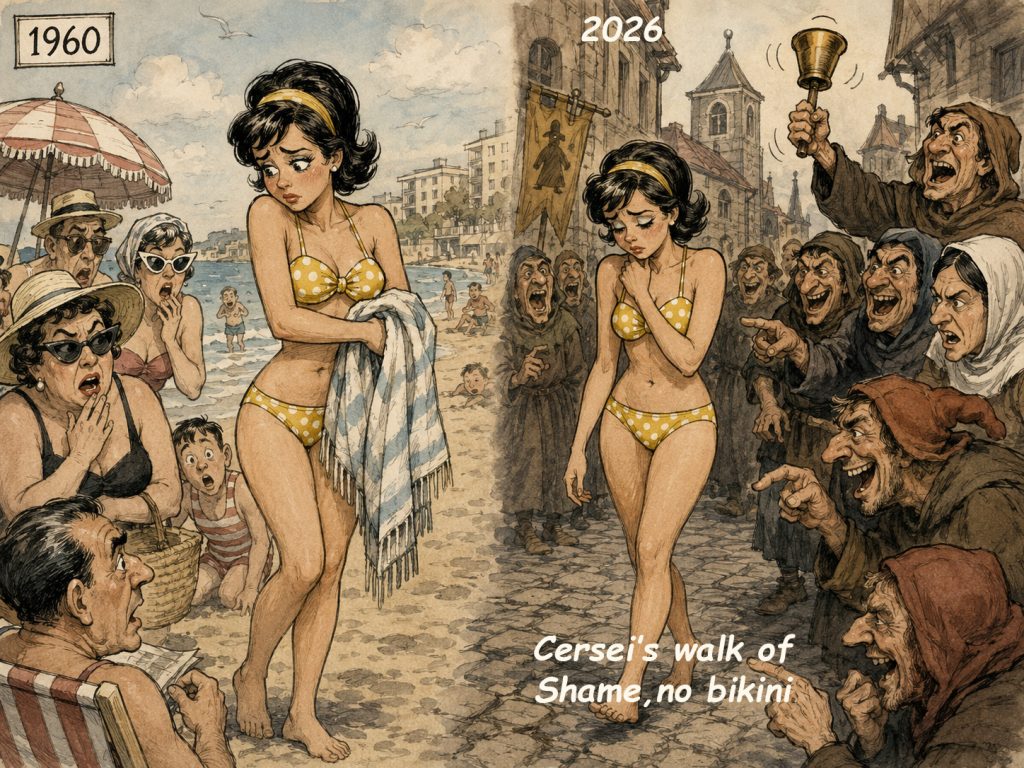
I recently watched the long scene of a beautiful woman forced to walk naked through the city toward the castle. The purpose was humiliation. We were supposed to understand the cruelty of the crowd, the destruction of her pride and the punishment being inflicted on her.
I understood it.
I understood it long before the camera finished looking.
At some point, the scene stopped exposing the cruelty of the people staring at her and made the audience part of the crowd.
We were staring too.
The camera simply gave us better seats.
That is the contradiction that bothers me. We have become extremely sensitive to verbal humiliation while turning visual humiliation into art. We scold someone for a crude joke, then praise a director who photographs degradation beautifully.
We say it is wrong to objectify women, then sell subscriptions by showing attractive women naked.
We say men should not stare, then build entire episodes around giving them permission.
We say bodies should not be treated as objects, then place those bodies on the screen as scenery.
The excuse is always that the nudity serves the story.
Sometimes it does.
So does silence.
So does a closed door.
So does the expression on someone’s face after the door opens again.
Some of the most powerful films ever made suggested more than they showed. The filmmakers trusted the audience to understand what had happened without placing the camera at the foot of the bed.
They understood that imagination could be more powerful than exposure.
Now exposure is often mistaken for courage.
A filmmaker who leaves something unseen is considered timid. A filmmaker who shows everything is praised for honesty, even when what is being sold as honesty looks suspiciously like voyeurism with expensive lighting.
This is where I find myself missing what people now call the non-woke days.
I do not miss every insult. I do not want to return to a time when cruelty was excused because everyone was laughing except the person being crushed by the joke.
What I miss is the belief that adults could hear something offensive, decide it was stupid and continue with their lives.
I miss the idea that the audience had some responsibility for its own emotional armor.
Words can wound. They can humiliate, threaten and destroy reputations. But not every foolish joke is violence, and not every uncomfortable sentence requires cultural emergency workers.
Sometimes a joke is simply bad.
Sometimes the comedian is an ass.
Sometimes the proper punishment is silence.
We once trusted people to make those judgments for themselves.
Now we protect adults from words while exposing them to nearly everything else.
Television has become careful about language and careless about dignity.
The strange part is that the old jokes were at least honest about what they were. Nobody called them social progress. Nobody pretended a dirty joke was an important examination of the human condition.
Today, the humiliation often arrives wearing a serious face.
The camera lingers because the scene is supposedly exploring power, shame, violence, gender or oppression. Perhaps it is. But sometimes the explanation sounds like the boy caught looking through the window claiming he was conducting research.
Not every naked body is exploitation. Not every violent scene is unnecessary. Art must be allowed to disturb us, offend us and take us places that polite conversation will not.
But art should not receive a moral pardon merely because it calls itself art.
The same culture that examines every sentence for hidden cruelty should be willing to examine where the camera is pointed—and why it refuses to look away.
When I woke from the dream, I imagined that I had finished rebuilding the robot, only to discover one small piece still lying on the table.
The machine worked. It walked. It spoke. It followed every new rule.
But something essential had been left out.
Perhaps that is what happened to us.
We removed some of the cruelty from our language, which was good. Then we mistook correct language for decency and forgot that dignity involves more than the words coming out of our mouths.
It also involves where we point our eyes.
We taught people that it was wrong to stare.
Then we turned staring into prestige television.