
Someone told him what type of person Columbus was, and he saw himself.
When I first asked the AI to tell me if the allegations of sexual abuse, sales of young indigenous girls, and chopping hands off if they could not pay their monthly gold quota. The AI answered, then left the following: “This content can’t be shown for safety reasons. If this seems like a mistake, give this response a thumbs down. Learn more about our intended model behavior in our”
Then deleted what it found, that most of the allegations were true. That is not how they will control our thoughts in the not-too-distant future.
I cannot prove that all searches will become AI searches, so I would not state that as certainty. But the direction is already visible: Google says AI Overviews reach more than 2.5 billion monthly users, while its conversational AI Mode has surpassed one billion. Google is increasingly blending the search box and the AI answer into one experience.
The danger is not limited to AI inventing false information. It is also that AI gives people one finished answer instead of ten links they can inspect. Recent research found that AI search presents fewer lesser-known sources and less variety than traditional search. Another large study found omission was its most frequent failure: relevant information simply disappeared from the summary. We are seeing the future, and it is frightening.
Now the rest of the story:
In 2017, Donald Trump became angry when Americans began questioning statues of Christopher Columbus.
“Now they are even trying to destroy statues of Christopher Columbus,” Trump said. “What’s next? Has to be stopped, it’s heritage.” (Good Morning America)
At the time, I wondered why it seemed so personal to him.
Columbus had been dead for more than 500 years. Trump was not defending a relative. He was not defending someone who founded the United States. Columbus never set foot in what is now the United States.
Yet Trump spoke as though removing Columbus from a pedestal threatened something much larger.
I think I finally understand.
Trump sees what happens when a country begins looking closely at the men it once covered in glory.
For generations, American schoolchildren were given a polished Columbus. He was the courageous explorer who crossed an unknown ocean, proved his doubters wrong and discovered a land where millions of people were already living.
What Columbus did after arriving was usually pushed to the edge of the page.
So let us put it back.
In 1495, Columbus’s forces rounded up approximately 1,500 Indigenous people. Five hundred were shipped across the Atlantic to be sold in the slave markets of Seville. Columbus then imposed a tribute system requiring Indigenous people aged 14 and older to deliver gold every three months. Where there was little gold, cotton could be substituted. Those who fled into the mountains were pursued with dogs trained to kill. (Smithsonian Magazine)
Women were treated as property along with land and gold. In a 1500 letter, Columbus described a market in women and girls, writing that there were “dealers who go about looking for girls.” A widely published English translation continues by saying that those “from nine to ten” were in demand. Whether that old wording refers to their ages or to the number of girls has been disputed, but the larger meaning is not: Columbus was describing human beings as merchandise and discussing the prices they commanded. (Project Gutenberg)
One of Columbus’s own companions, Michele de Cuneo, left an even more horrifying account. He wrote that he captured an Indigenous woman and that Columbus gave her to him. When she resisted his sexual advances, Cuneo beat her with a rope and raped her. He described the assault without shame, as though the woman were simply another reward distributed during the expedition. (OhioLINK)
That is not a modern accusation invented by people who hate history.
It comes from the words of the men who were there.
The Smithsonian’s National Museum of the American Indian describes the arrival of Columbus and the settlers who followed as the beginning of immediate enslavement, theft of resources, warfare, forced relocation and enormous loss of Indigenous life. (National Museum of the American Indian)
This is the man Trump has called the “original American hero” and “one of the most gallant and visionary men to ever walk the face of the earth.” (The White House)
In March 2026, a replica of a Columbus statue that protesters had thrown into Baltimore’s harbor was installed on federal grounds beside the White House. The administration declared, “In this White House, Christopher Columbus is a hero.” (AP News)
That was not merely preserving history.
It was restoring the pedestal.
A statue is not history. History belongs in books, museums, archives and classrooms, where the whole story can be examined.
A statue is an honor.
It takes a person, lifts him above everyone else and tells future generations:
This is someone we chose to admire.
Trump understands the power of that pedestal.
He prefers a history in which powerful men are remembered for conquest, wealth and victory, while the people crushed beneath them become footnotes. He wants the explorer without the enslaved, the empire without the bodies and the hero without the testimony of his victims.
Perhaps he also understands that Columbus will not be the last man Americans reconsider.
When people learn that a national hero’s image was constructed by leaving out the ugliest parts of his record, they may begin examining other heroes built the same way.
They may ask whether wealth proves greatness.
They may ask whether power excuses cruelty.
They may ask whether a man who demands loyalty, enriches himself, humiliates the weak and treats laws as obstacles deserves marble, bronze—or gold leaf.
That may be what Trump heard when the Columbus statues began falling.
Not merely the crash of stone hitting pavement.
He may have heard the future.
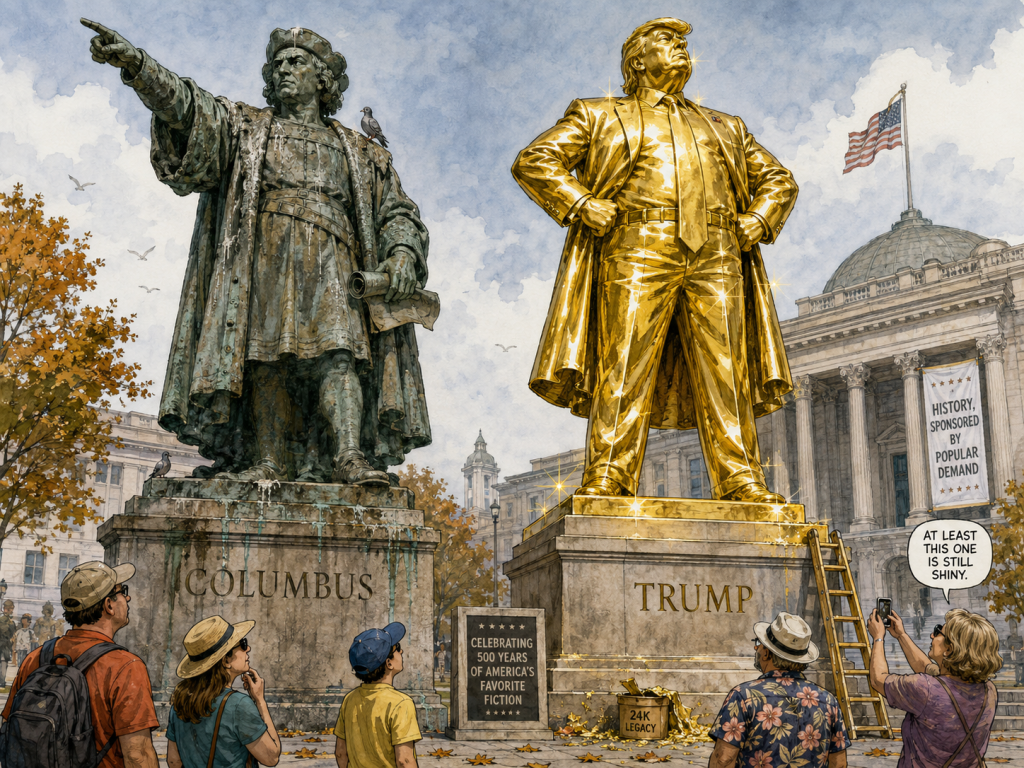
In my illustration, Columbus stands on one pedestal, and Trump stands beside him on another. Columbus is weathered by centuries. Trump is covered in fresh gold leaf.
The gold is the joke.
It is also the answer.
Trump did not become upset because removing a statue erased history. The history remained in the letters, journals, and documents written by Columbus and the men who accompanied him.
He became upset because Americans had started learning the difference between remembering a man and worshipping him.
And once people begin pulling false heroes down from their pedestals, every man dreaming of his own statue has reason to worry.


