
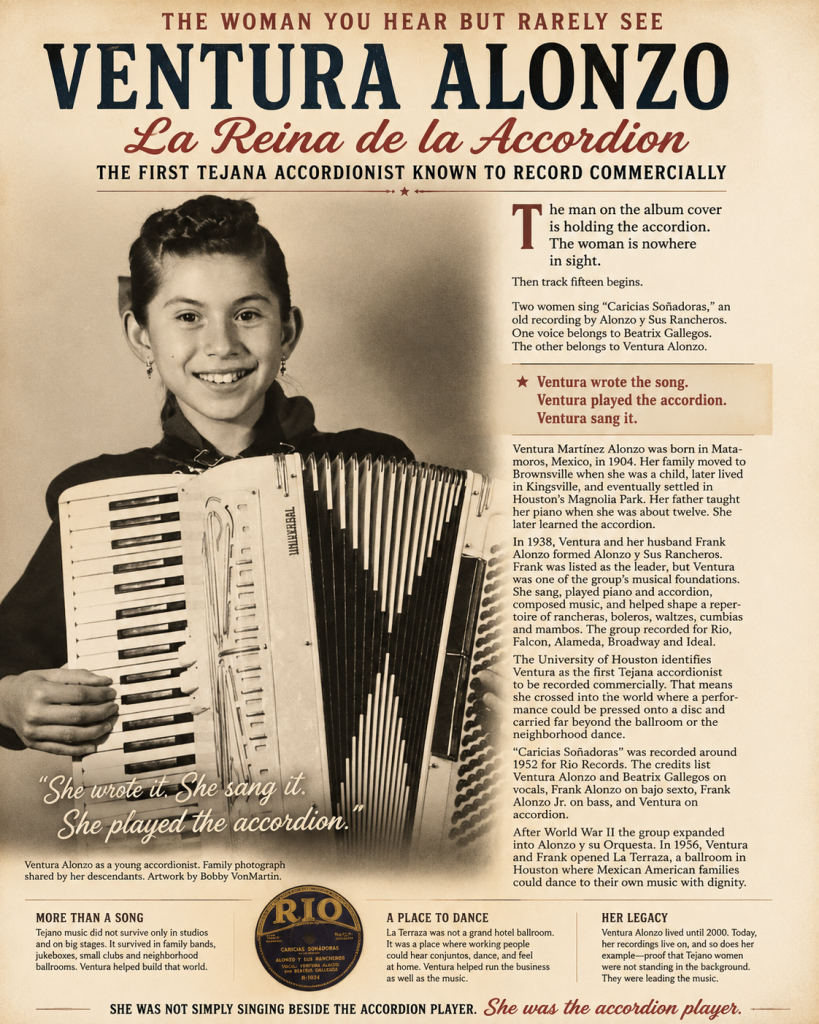
The man on the album cover is holding the accordion (YouTube video below). The woman is nowhere in sight.
Then track fifteen begins.
Two women sing “Caricias Soñadoras,” an old recording by Alonzo y Sus Rancheros. One voice belongs to Beatrix Gallegos. The other belongs to Ventura Alonzo.
Ventura was not merely a singer standing in front of someone else’s band. She wrote the song. She played the accordion on the recording. She also sang it.
The album cover had fooled me because the musicians pictured there belonged to Conjunto Alamo. The accordion player was Leandro Guerrero. But the mistake revealed something about the way Tejano history has often been presented: the man with the accordion is easy to see, while the woman playing one can disappear even when her music is still coming through the speaker.
Ventura Martínez Alonzo was born in Matamoros, Mexico, in 1904. Her family moved to Brownsville when she was a child, later lived in Kingsville, and eventually settled in Houston’s Magnolia Park. Her father taught her to play piano when she was about twelve years old. She later learned the accordion, an instrument that was becoming central to the music of Mexican American working-class communities across Texas. (Digital Collections)
She married Frank Alonzo, a self-taught guitarist and bajo sexto player, in 1931. In 1938 they formed Alonzo y Sus Rancheros. Frank was listed as the leader, but Ventura was one of the group’s musical foundations. She sang, played piano and accordion, composed music, and helped shape a repertoire that included rancheras, boleros, waltzes, cumbias and mambos. The group recorded for several labels, including Rio, Falcon, Alameda, Broadway and Ideal. (Digital Collections)
The University of Houston identifies Ventura as the first Tejana accordionist to be recorded. That wording matters. It does not mean that no Mexican American woman had ever played the accordion before her. Women made music in homes, family gatherings, neighborhood dances and other places that record companies never documented. It means Ventura crossed the line into the commercial recording world, where a performance could be pressed onto a disc and carried beyond the room where it was played. (Digital Collections)
“Caricias Soñadoras” was recorded around 1952 for Rio Records. The surviving credits identify Ventura Alonzo and Beatrix Gallegos as the vocal duet, Frank Alonzo on bajo sexto, Frank Alonzo Jr. on bass, and Ventura on accordion. Other musicians included Pepe Compean and performers whose names were not preserved.
Listen closely and the recording becomes more than an old love song. It is evidence.
At a time when the accordion was treated largely as a man’s instrument, Ventura was composing, singing and playing it on commercially released records. She was doing more than entering a male musical world. She was helping build the sound of Tejano Houston.
After World War II, the group expanded and became known as Alonzo y su Orquesta, adding elements associated with the big-band sound. Ventura and Frank also became part of Houston’s Mexican American dance-hall history. In 1956 they opened La Terraza, a ballroom that welcomed Mexican American patrons at a time when many public establishments did not treat them equally. Ventura helped manage the business as well as the music. (Digital Collections)
La Terraza was not one of Houston’s grand downtown ballrooms. It was a smaller place where conjuntos played and where working people could dance to their own music. Its history matters because Tejano music did not survive only through famous recording studios or large concert halls. It survived in neighborhood clubs, family bands, jukeboxes, record shops and places like La Terraza.
Ventura Alonzo lived until 2000. By then, Tejano music had produced international stars, major record labels and generations of celebrated male accordionists. Yet the woman who had played and recorded the instrument decades earlier remained unfamiliar to many listeners.
Perhaps that is why “Caricias Soñadoras” feels like a hidden gem. The song itself was never completely lost. It was preserved on records, reissued in collections and placed on YouTube, where anyone can hear it.
What was nearly lost was the meaning of the woman’s voice.
She was not simply singing beside the accordion player.
She was the accordion player.
.