History, politics, memory, and commentary from a Tejano point of view.
When one lives long enough, one remembers the past, and it was not always America the beautiful.
August 3, 2026
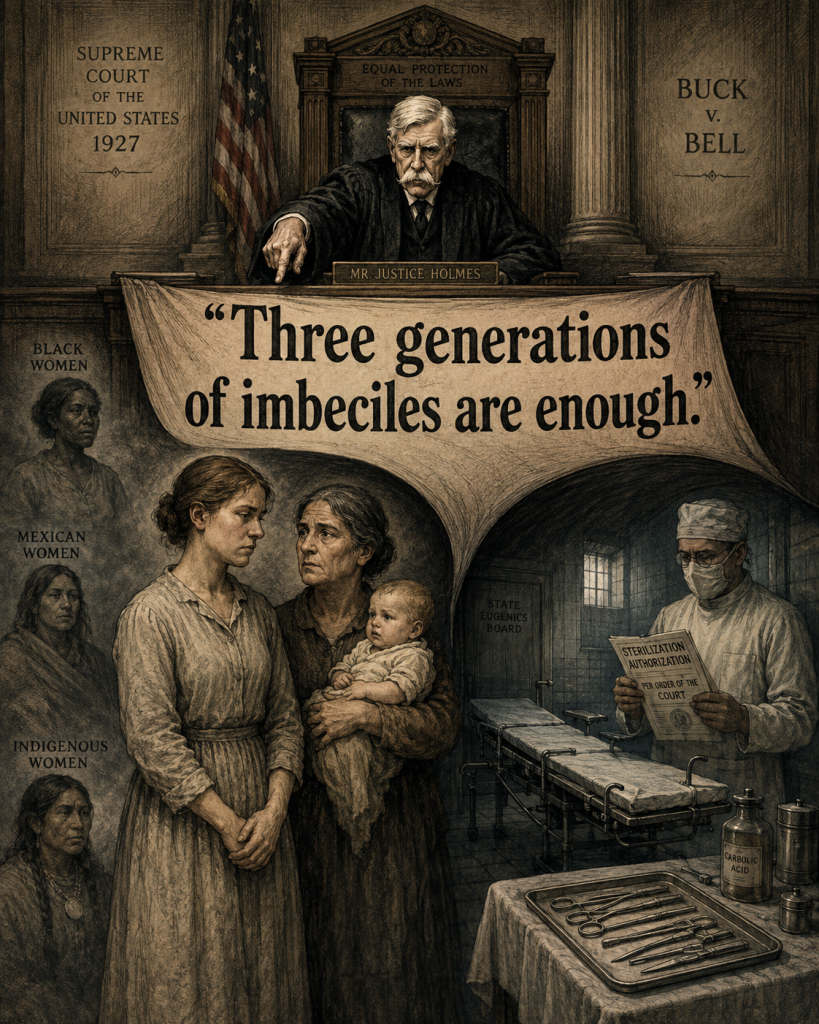
Indiana adopted the nation’s first eugenic sterilization law in 1907. Other states followed. In 1927, the United States Supreme Court upheld Virginia’s forced-sterilization law in Buck v. Bell. Justice Oliver Wendell Holmes Jr. dismissed Carrie Buck, her mother, and her infant daughter with five words that became one of the ugliest sentences in American law:
“Three generations of imbeciles are enough.”
First They Measured the Children. Then They Sterilized the Mothers.
They called one intelligence testing and the other eugenics. Both began with the same assumption: that powerful people had the right to rank human beings and decide what futures they deserved.
When I was in junior high school in South Texas, the school tested us and divided the students in each grade into Groups A, B, C, and D. The letters appeared harmless. Nobody wrote “superior” or “inferior” on the classroom doors. The school could say it was merely placing children according to ability so teachers could educate everyone at the proper speed.
But a letter could become a future.
The children in the higher groups received harder work and greater expectations. Those placed lower could be given less demanding material because the test had supposedly established what they were capable of learning. When they later performed poorly, the school could use their performance as proof that the original placement had been correct.
The test did not merely measure the child. It helped create the child the school expected to see.
Years later, I learned that the school had recorded an IQ score for me. But the number is not the point. The question is what happened to the children whose scores placed them in Groups C or D. Did the school help them overcome whatever difficulty the test supposedly identified, or did it use the score as permission to expect less from them?
A, B, C, and D were not necessarily four speeds through the same education. They could become four different educations inside the same grade.
The practice had roots in the early intelligence-testing movement. The first Binet test in France had been designed to identify children who needed additional help. Lewis Terman of Stanford adapted that work into the Stanford-Binet test, published in the United States in the 1910s. Terman did not view intelligence merely as a skill that could be developed. He treated it largely as an inherited quality that could be measured, ranked, and used to determine how society should invest in different people. (The Library of Congress)
Terman was also a eugenicist. He wrote that supposed mental deficiency was common among Mexican, Black, and Indigenous families and described those differences as racial or inherited. He wanted society to identify the children he considered naturally gifted and devote resources to developing them, while directing fewer resources toward those he labeled “feeble-minded.” (Eugenics at Stanford)
That was the crooked root.
Once a society accepts that human worth can be scientifically measured, it becomes easier to claim that some children deserve a richer education while others should be prepared only for labor. It becomes easier to say that poverty is evidence of inferior ability rather than the result of unequal opportunity. It becomes easier to turn the advantages of the powerful into proof of their superiority.
And once the government claims the authority to decide which people are intellectually fit, it is only one more step for it to decide which people are fit to reproduce.
Indiana adopted the nation’s first eugenic sterilization law in 1907. Other states followed. In 1927, the United States Supreme Court upheld Virginia’s forced-sterilization law in Buck v. Bell. Justice Oliver Wendell Holmes Jr. dismissed Carrie Buck, her mother, and her infant daughter with five words that became one of the ugliest sentences in American law:
“Three generations of imbeciles are enough.”
The Court allowed the state to sterilize Carrie Buck because officials had classified her as “feeble-minded.” The diagnosis was treated as science, the hearing was treated as due process, and the destruction of her ability to have children was treated as service to society. ({{meta.siteName}})
Approximately 60,000 people were sterilized under American eugenic laws between 1907 and the 1970s. The victims included people with disabilities, poor people, young women, institutionalized people, Black Americans, Latinos, Indigenous people, and immigrants. The government did not need to prove that they had committed a crime. It needed only to place them into a category called unfit. (RePORTER)
The words made the violence easier to perform.
They did not say they were taking a woman’s descendants from her. They said they were improving the population.
They did not say they were punishing poverty. They said they were preventing dependency.
They did not say that doctors and government officials had assumed ownership of a woman’s body. They said it was medicine.
Fannie Lou Hamer entered a Mississippi hospital in 1961 for minor surgery and was given a hysterectomy without her knowledge or consent. She later called the practice a “Mississippi appendectomy” because unwanted sterilizations of Black women were so common that the procedure had acquired a bitter nickname. Hamer said that women could enter the hospital for one reason and leave unable to bear children. (Bill Status)
Indigenous women encountered the same power through the federal health system. A 1976 Government Accountability Office investigation examined sterilizations in four Indian Health Service regions and found that those areas were generally failing to comply with the agency’s own rules. Consent forms were present, but most did not satisfy the requirements intended to ensure that patients understood and freely agreed to permanent sterilization. (GAO)
Mexican-origin women were targeted as well. California later formally acknowledged that between 1965 and 1975, at least 240 women who gave birth at Los Angeles County-USC Medical Center underwent nonconsensual postpartum tubal ligations. Some were not told they were being sterilized. Some were pressured to sign forms during labor. Others signed documents they could not understand because proper interpretation was not provided. (Leginfo)
The eugenics office could close, but the belief survived in the hospital: certain women had too many children, poor families were producing too many dependents, and doctors and public officials were better qualified than the women themselves to decide whether another child should be born.
The same belief survived in schools.
In the 1967 case Hobson v. Hansen, a federal court examined Washington, D.C.’s tracking system. Students were separated into different educational tracks using aptitude tests standardized primarily on white, middle-class children. Black and poor children were pushed disproportionately into the lower tracks, where they received a reduced curriculum designed for the “blue-collar” student. Movement out of those tracks was difficult, and children placed low could remain trapped there for years. (Justia Law)
The court recognized the circular cruelty. A disadvantaged child scored lower on a test shaped around experiences he had not been given. The school placed him in a lower track, taught him less, and then pointed to his later performance as proof that he had been placed correctly.
The system manufactured its own evidence.
Close to Corpus Christi, the Gregory-Portland school district had once operated separate “Mexican schools.” After those schools were closed, Anglo children were concentrated in the highest sections while most Mexican-American children were assigned to other classrooms. The district called it ability grouping, but a federal district judge found that no tests had even been administered before the assignments. Placement had depended on the subjective judgment of principals and teachers. The judge concluded that “ability grouping” had served as a pretext for continuing inside the classrooms the segregation previously accomplished through separate schools. (Justia Law)
They took down the sign that said Mexican School.
Then they placed letters on the classroom doors.
I do not yet have the records proving exactly how A, B, C and D operated in my school district. Memory can tell us that the groups existed, but the district’s old records must tell us how students were selected, whether they could move between groups and whether each group received the same curriculum.
But the larger machinery is no longer a matter of suspicion. It is documented history.
Testing could turn racial and economic advantage into a number. Tracking could turn the number into an education. Eugenics could turn the same judgment into a sterilization order.
The school official held the test.
The doctor held the scalpel.
The judge supplied the authority.
They were not always working in the same building, but they were acting from the same belief: that some people were born to make decisions and others were born to have decisions made for them.
This was not ignorance accidentally causing harm. The hierarchy was the purpose. The language of science allowed those responsible to perform cruelty while describing themselves as reformers. They gave prejudice a test score, inequality a curriculum, and reproductive violence a white coat.
First they measured the children.
Then they sterilized the mothers.
They did not discover that some human beings were worth less than others.
They decided it—and built instruments that appeared to prove them right.