
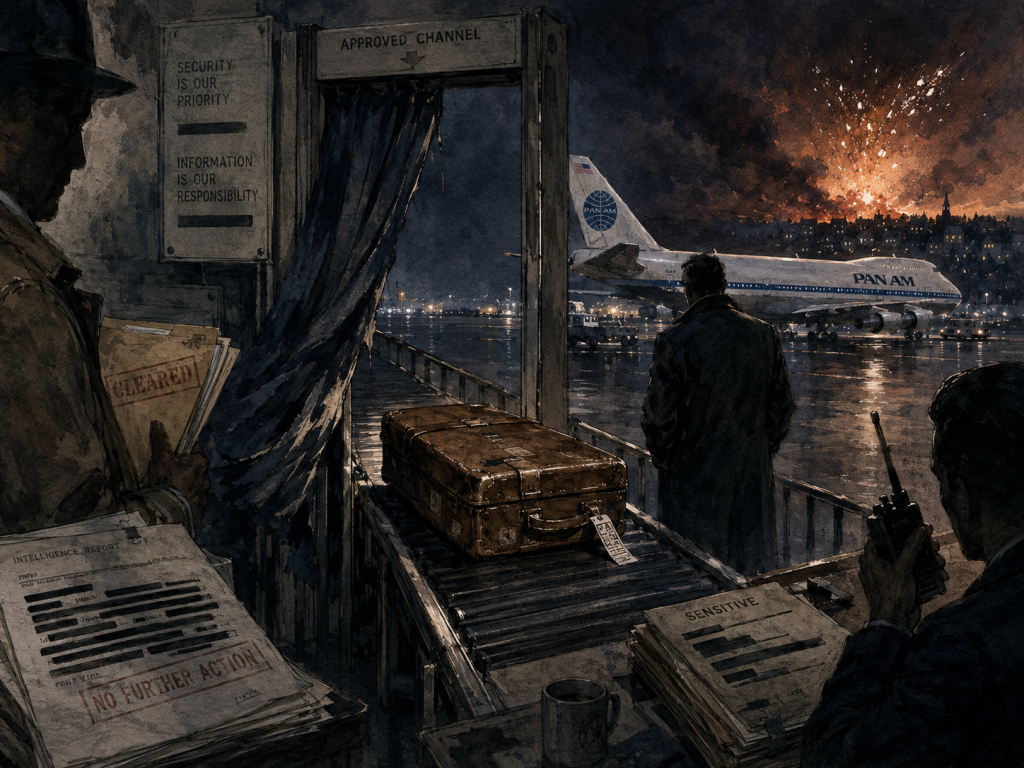
The Bombing of Pan Am 103 is presented as a six-part television drama rather than a documentary, but its most disturbing moments come when it moves beyond the search for the men who built the bomb and asks who may have made their work easier. The series follows the Scottish and American investigation into the destruction of Pan Am Flight 103 over Lockerbie, where 270 people died on December 21, 1988. (Netflix)
The official story gives the audience identifiable criminals: Libyan agents who planned the attack, constructed the bomb and placed it into the international baggage system. The series does not completely reject that story. Instead, it places another possibility beside it: that American intelligence operations, protected drug shipments and dangerously lax baggage inspections may have created a route through airport security that terrorists could exploit.
That does not mean the CIA planted the bomb. It does not even prove that the CIA knew a bomb was traveling through the system. The series makes a more careful—and perhaps more troubling—suggestion. What if an intelligence agency became so determined to protect a covert operation that it discouraged people from inspecting certain luggage? What if terrorists discovered that some suitcases were treated differently from others? What if the bomb reached the airplane not because the United States wanted the attack to happen, but because its own secret operation had created a hole in the security system?
That is where the series becomes more than another police procedural.
It would be easy to turn the CIA into the traditional movie villain: men in dark rooms ordering murders and destroying files. The Bombing of Pan Am 103 does something more effective. It portrays an agency whose representatives know more than they are willing to reveal, whose operations interfere with ordinary law enforcement and whose definition of national security may not include telling investigators the complete truth.
The audience is therefore left with a question that does not require belief in a grand conspiracy:
Was the United States negligent?
Negligence is not the same as deliberately killing 270 people. A government can be innocent of planning a crime while still bearing responsibility for creating the conditions that allowed it to happen. If American officials permitted drug luggage to pass with reduced inspection because the shipments were part of an intelligence operation, then the moral question becomes unavoidable. Who was protecting the passengers while the government was protecting its secrets?
The protected-drug-route theory has never been proved as the explanation for the bombing, and parts of it have been challenged or rejected for lack of evidence. But the allegation did not appear out of nowhere. It has circulated for decades and claims that intelligence agencies tolerated a controlled drug-smuggling route through European airports in exchange for information. (American Radio Works)
The series uses that history as a filmmaker should. It does not stop the story to deliver a courtroom verdict. It allows investigators to encounter contradictions, blocked information, and officials who appear more concerned with protecting operations than answering questions. The suggestion grows through what is withheld.
As an action thriller, the series understands that the most frightening weapon is not always the bomb. Sometimes it is the system surrounding it.
A suitcase moves from one airport to another. Security workers assume someone else has checked it. Intelligence officers possess information they cannot—or will not—share. Investigators follow one trail while political decisions quietly redirect them toward another. Every institution can claim that it followed its own rules, yet 270 people are still dead.
That creates a different kind of suspense from the usual race against a clock. We already know the airplane will explode. The tension comes from watching investigators search through the wreckage while governments decide how much truth they can afford to release.
The Scottish investigators are especially important because they give the story its human scale. They are not initially fighting geopolitics. They are standing in fields, entering destroyed homes, collecting fragments and trying to identify the dead. The enormous international mystery begins with ordinary people picking through the remains of other ordinary people.
That contrast gives the story its power. In Washington, London and other capitals, the bombing becomes intelligence, diplomacy and national interest. In Lockerbie, it remains 270 deaths.
The series cannot establish that the CIA knowingly permitted the bomb onto Pan Am 103, and it would be dishonest to claim that it does. What it establishes dramatically is that secrecy prevents certainty. Once an intelligence agency admits that it operates beyond normal scrutiny, every missing document, protected source and unexplained suitcase acquires a second meaning.
Perhaps the government was hiding nothing more than an embarrassing operation. Perhaps officials feared exposing informants. Perhaps the drug-route theory is wrong. But secrecy does not merely protect legitimate intelligence work. It also protects negligence from being discovered.
That is the idea the series leaves with the audience. The bombers may have murdered 270 people, but they did not operate in an empty world. They moved through airports managed by corporations, regulated by governments, and watched by intelligence agencies. Someone built the bomb, but other people may have left the door open.
The Bombing of Pan Am 103 does not prove that the CIA was complicit. It does something more responsible and, for the viewer, more unsettling: it presents enough secrecy, protected activity and institutional failure to justify asking whether the United States helped create the vulnerability that the bombers exploited.
We may never be able to prove what every official knew. We do know what happened when nobody looked closely enough at the luggage.
Title: Pan Am 103: The Bomb Was Terrorism, but Was the Opening American Negligence?
The Bombing of Pan Am 103 is presented as a six-part television drama rather than a documentary, but its most disturbing moments come when it moves beyond the search for the men who built the bomb and asks who may have made their work easier. The series follows the Scottish and American investigation into the destruction of Pan Am Flight 103 over Lockerbie, where 270 people died on December 21, 1988. (Netflix)
The official story gives the audience identifiable criminals: Libyan agents who planned the attack, constructed the bomb and placed it into the international baggage system. The series does not completely reject that story. Instead, it places another possibility beside it: that American intelligence operations, protected drug shipments and dangerously lax baggage inspections may have created a route through airport security that terrorists could exploit.
That does not mean the CIA planted the bomb. It does not even prove that the CIA knew a bomb was traveling through the system. The series makes a more careful—and perhaps more troubling—suggestion. What if an intelligence agency became so determined to protect a covert operation that it discouraged people from inspecting certain luggage? What if terrorists discovered that some suitcases were treated differently from others? What if the bomb reached the airplane not because the United States wanted the attack to happen, but because its own secret operation had created a hole in the security system?
That is where the series becomes more than another police procedural.
It would be easy to turn the CIA into the traditional movie villain: men in dark rooms ordering murders and destroying files. The Bombing of Pan Am 103 does something more effective. It portrays an agency whose representatives know more than they are willing to reveal, whose operations interfere with ordinary law enforcement, and whose definition of national security may not include telling investigators the complete truth.
The audience is therefore left with a question that does not require belief in a grand conspiracy:
Was the United States negligent?
Negligence is not the same as deliberately killing 270 people. A government can be innocent of planning a crime while still bearing responsibility for creating the conditions that allowed it to happen. If American officials permitted drug luggage to pass with reduced inspection because the shipments were part of an intelligence operation, then the moral question becomes unavoidable. Who was protecting the passengers while the government was protecting its secrets?
The protected-drug-route theory has never been proved as the explanation for the bombing, and parts of it have been challenged or rejected for lack of evidence. But the allegation did not appear out of nowhere. It has circulated for decades and claims that intelligence agencies tolerated a controlled drug-smuggling route through European airports in exchange for information. (American Radio Works)
The series uses that history as a filmmaker should. It does not stop the story to deliver a courtroom verdict. It allows investigators to encounter contradictions, blocked information, and officials who appear more concerned with protecting operations than answering questions. The suggestion grows through what is withheld.
As an action thriller, the series understands that the most frightening weapon is not always the bomb. Sometimes it is the system surrounding it.
A suitcase moves from one airport to another. Security workers assume someone else has checked it. Intelligence officers possess information they cannot—or will not—share. Investigators follow one trail while political decisions quietly redirect them toward another. Every institution can claim that it followed its own rules, yet 270 people are still dead.
That creates a different kind of suspense from the usual race against a clock. We already know the airplane will explode. The tension comes from watching investigators search through the wreckage while governments decide how much truth they can afford to release.
The Scottish investigators are especially important because they give the story its human scale. They are not initially fighting geopolitics. They are standing in fields, entering destroyed homes, collecting fragments and trying to identify the dead. The enormous international mystery begins with ordinary people picking through the remains of other ordinary people.
That contrast gives the story its power. In Washington, London and other capitals, the bombing becomes intelligence, diplomacy and national interest. In Lockerbie, it remains 270 deaths.
The series cannot establish that the CIA knowingly permitted the bomb onto Pan Am 103, and it would be dishonest to claim that it does. What it establishes dramatically is that secrecy prevents certainty. Once an intelligence agency admits that it operates beyond normal scrutiny, every missing document, protected source and unexplained suitcase acquires a second meaning.
Perhaps the government was hiding nothing more than an embarrassing operation. Perhaps officials feared exposing informants. Perhaps the drug-route theory is wrong. But secrecy does not merely protect legitimate intelligence work. It also protects negligence from being discovered.
That is the idea the series leaves with the audience. The bombers may have murdered 270 people, but they did not operate in an empty world. They moved through airports managed by corporations, regulated by governments, and watched by intelligence agencies. Someone built the bomb, but other people may have left the door open.
The Bombing of Pan Am 103 does not prove that the CIA was complicit. It does something more responsible and, for the viewer, more unsettling: it presents enough secrecy, protected activity and institutional failure to justify asking whether the United States helped create the vulnerability that the bombers exploited.
We may never be able to prove what every official knew. We do know what happened when nobody looked closely enough at the luggage.
The Bombing of Pan Am 103 is presented as a six-part television drama rather than a documentary, but its most disturbing moments come when it moves beyond the search for the men who built the bomb and asks who may have made their work easier. The series follows the Scottish and American investigation into the destruction of Pan Am Flight 103 over Lockerbie, where 270 people died on December 21, 1988. (Netflix)
The official story gives the audience identifiable criminals: Libyan agents who planned the attack, constructed the bomb and placed it into the international baggage system. The series does not completely reject that story. Instead, it places another possibility beside it: that American intelligence operations, protected drug shipments and dangerously lax baggage inspections may have created a route through airport security that terrorists could exploit.
That does not mean the CIA planted the bomb. It does not even prove that the CIA knew a bomb was traveling through the system. The series makes a more careful—and perhaps more troubling—suggestion. What if an intelligence agency became so determined to protect a covert operation that it discouraged people from inspecting certain luggage? What if terrorists discovered that some suitcases were treated differently from others? What if the bomb reached the airplane not because the United States wanted the attack to happen, but because its own secret operation had created a hole in the security system?
That is where the series becomes more than another police procedural.
It would be easy to turn the CIA into the traditional movie villain: men in dark rooms ordering murders and destroying files. The Bombing of Pan Am 103 does something more effective. It portrays an agency whose representatives know more than they are willing to reveal, whose operations interfere with ordinary law enforcement, and whose definition of national security may not include telling investigators the complete truth.
The audience is therefore left with a question that does not require belief in a grand conspiracy:
Was the United States negligent?
Negligence is not the same as deliberately killing 270 people. A government can be innocent of planning a crime while still bearing responsibility for creating the conditions that allowed it to happen. If American officials permitted drug luggage to pass with reduced inspection because the shipments were part of an intelligence operation, then the moral question becomes unavoidable. Who was protecting the passengers while the government was protecting its secrets?
The protected-drug-route theory has never been proved as the explanation for the bombing, and parts of it have been challenged or rejected for lack of evidence. But the allegation did not appear out of nowhere. It has circulated for decades and claims that intelligence agencies tolerated a controlled drug-smuggling route through European airports in exchange for information. (American Radio Works)
The series uses that history as a filmmaker should. It does not stop the story to deliver a courtroom verdict. It allows investigators to encounter contradictions, blocked information, and officials who appear more concerned with protecting operations than answering questions. The suggestion grows through what is withheld.
As an action thriller, the series understands that the most frightening weapon is not always the bomb. Sometimes it is the system surrounding it.
A suitcase moves from one airport to another. Security workers assume someone else has checked it. Intelligence officers possess information they cannot—or will not—share. Investigators follow one trail while political decisions quietly redirect them toward another. Every institution can claim that it followed its own rules, yet 270 people are still dead.
That creates a different kind of suspense from the usual race against a clock. We already know the airplane will explode. The tension comes from watching investigators search through the wreckage while governments decide how much truth they can afford to release.
The Scottish investigators are especially important because they give the story its human scale. They are not initially fighting geopolitics. They are standing in fields, entering destroyed homes, collecting fragments and trying to identify the dead. The enormous international mystery begins with ordinary people picking through the remains of other ordinary people.
That contrast gives the story its power. In Washington, London and other capitals, the bombing becomes intelligence, diplomacy and national interest. In Lockerbie, it remains 270 deaths.
The series cannot establish that the CIA knowingly permitted the bomb onto Pan Am 103, and it would be dishonest to claim that it does. What it establishes dramatically is that secrecy prevents certainty. Once an intelligence agency admits that it operates beyond normal scrutiny, every missing document, protected source and unexplained suitcase acquires a second meaning.
Perhaps the government was hiding nothing more than an embarrassing operation. Perhaps officials feared exposing informants. Perhaps the drug-route theory is wrong. But secrecy does not merely protect legitimate intelligence work. It also protects negligence from being discovered.
That is the idea the series leaves with the audience. The bombers may have murdered 270 people, but they did not operate in an empty world. They moved through airports managed by corporations, regulated by governments, and watched by intelligence agencies. Someone built the bomb, but other people may have left the door open.
The Bombing of Pan Am 103 does not prove that the CIA was complicit. It does something more responsible and, for the viewer, more unsettling: it presents enough secrecy, protected activity and institutional failure to justify asking whether the United States helped create the vulnerability that the bombers exploited.
We may never be able to prove what every official knew. We do know what happened when nobody looked closely enough at the luggage.
Lamin Khalifah Fhimah was tried alongside Abdelbaset al-Megrahi. The three Scottish judges acquitted Fhimah on January 31, 2001, finding that the prosecution had not proved his participation in the bombing. He was released immediately and returned to Libya the following day. Little reliable information about his later life has been made public.
Abdelbaset al-Megrahi was convicted of murdering all 270 victims and sentenced to life imprisonment. He continued to maintain his innocence. Scotland released him on compassionate grounds in August 2009 after he developed prostate cancer. He returned to Libya and died there in 2012.
Muammar Gaddafi remained Libya’s ruler until the 2011 civil war. On October 20, 2011, opposition fighters captured him near Sirte after NATO aircraft attacked his fleeing convoy. Videos showed him alive and being beaten after his capture, but the precise cause of his death was never conclusively established. He may have died from gunfire, shrapnel wounds or the violence inflicted upon him by his captors.
Abu Agila Mohammad Mas’ud, the man now accused of constructing the bomb, was brought to the United States in 2022 and pleaded not guilty. As of August 3, 2026, he had not been convicted. Jury selection for his federal trial in Washington was scheduled to begin on August 25, 2026. His lawyers argue that an alleged confession obtained in Libya was forced from him through threats and abuse.


