
My father and uncle left home for the Army the day after Pearl Harbor. Other members of my family served in Korea, Vietnam, and Iraq. My grandson wears the uniform today.
We were raised to believe that when America sends a soldier away, America accepts a responsibility for the family left behind. The government may not guarantee that nothing bad will happen, but it should not be the government causing the harm.
The Trump administration has turned that promise upside down.
An Associated Press investigation identified at least 51 parents and spouses of active-duty military members who have been detained by immigration authorities since Trump returned to office. At least six have been deported, and eight remained in federal custody when the investigation was published. Because the government does not track military-family detentions as a separate category, the true number is probably higher.
These are not merely names in an immigration database. They are the people caring for children while soldiers train, deploy, or serve far from home.
Army Staff Sgt. Alexis Jaramillo was supposed to be training soldiers at Fort Polk in Louisiana. Instead, he was placed on administrative leave to care for his five-year-old stepson after immigration officers detained his wife during what the family believed was a routine appointment to adjust her legal status.
Another active-duty soldier stopped an imminent deployment after ICE detained her husband, leaving no one to care for their young son. A judge eventually ordered the husband released.
In Texas, Army Sgt. Hedar Leonel Turcios Juarez was stationed at Fort Bliss when officers detained his wife outside an El Paso Walmart. Their six-year-old daughter watched it happen.
We like to say we support our troops. We put it on bumper stickers, campaign signs and football scoreboards.
Apparently, the support ends when the soldier goes home.
This was not an accident
For years, Democratic and Republican administrations generally treated the immediate families of military members differently from ordinary immigration cases. The purpose was not difficult to understand: Soldiers cannot concentrate on their missions while wondering whether the government is putting their spouses or parents into detention.
In April 2025, ICE implemented a new policy stating that military service alone does not exempt someone from the consequences of violating immigration law. The change reversed the previous practice of giving substantial consideration to the service of an immigrant’s spouse, parent or child.
The government is correct about one thing. Joining the military does not automatically make every relative a legal resident. Some of the people identified by the AP had old deportation orders, previous removals or criminal convictions. Every case is different, and military service should not erase a serious crime.
But that defense avoids the real issue.
Nobody is demanding that every military relative receive automatic citizenship. The question is whether the government should advertise an immigration process to military families and then arrest them when they appear at a government office trying to follow that process.
The recruiting promise
One of the benefits used to recruit immigrants and the children of immigrants is called military parole in place. It allows certain spouses, parents, sons and daughters of active-duty service members, reservists and veterans to request permission to remain in the United States while seeking legal status.
It is not automatic. It is discretionary and decided case by case. USCIS still publicly describes military parole in place as an option available to qualifying military families.
The Army and National Guard have continued promoting immigration benefits to prospective recruits. One Army recruiter wrote that service could help soldiers protect parents who had sacrificed everything for them.
But AP found military relatives being detained while they were applying for those benefits, sometimes during the very appointments intended to help them become legal. The average processing time for military parole in place has more than doubled to about 12 months, leaving families exposed while they wait. The Marine Corps stopped promoting enlistment as a way to protect immigrant relatives in June 2025, but Army and National Guard recruiters continued making the pitch.
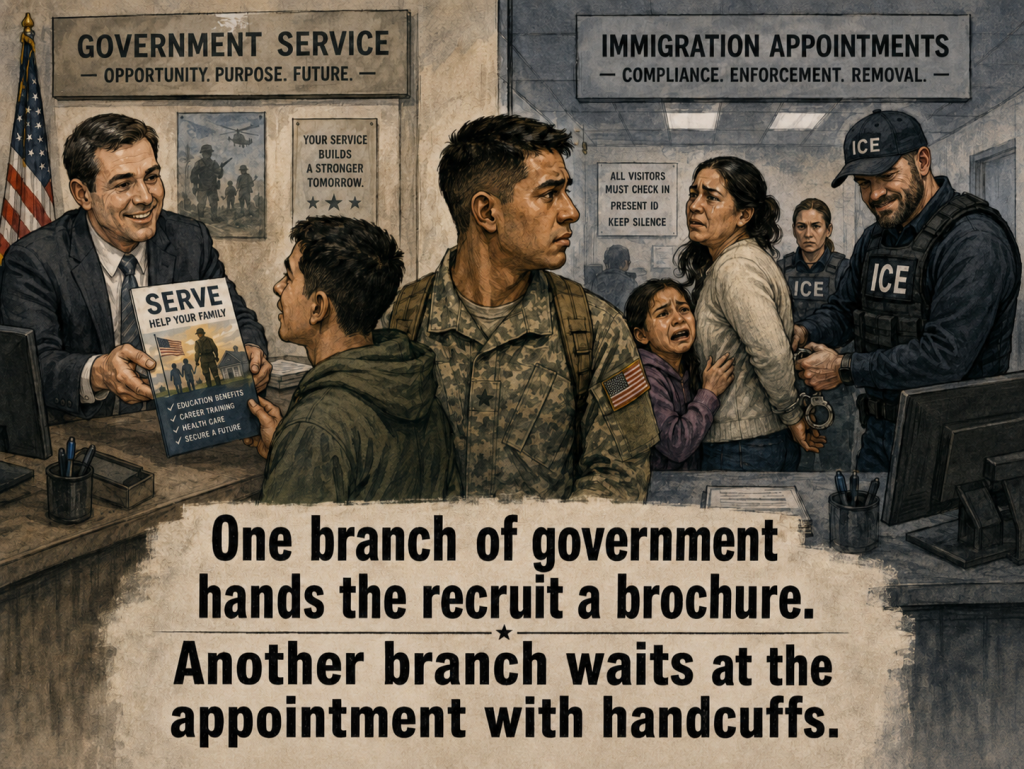
One branch of government hands the recruit a brochure. Another branch waits at the appointment with handcuffs.
ICE is taking soldiers off duty
This policy is not only hurting immigrant families. It is interfering with the military.
Soldiers have taken leave, delayed deployments, and lost the relatives who would care for their children if both parents were deployed. An Air Force technical sergeant whose father was deported told the AP that her mother might now return to Mexico, leaving no one to care for her children if she and her husband—also in the Air Force—were sent away.
DHS has also reported that ICE arrested 125 noncitizen military veterans between January 20, 2025, and January 26, 2026. Seventy-three were detained, 34 were placed into removal proceedings, and 46 had active criminal warrants at the time of arrest. The government also placed 282 veterans and immediate family members into removal proceedings and issued 113 notices to appear after denying military parole-in-place requests from relatives of former service members.
Those numbers do not tell us that every arrest was wrong. They do tell us that this is not an isolated mistake made by one overzealous ICE officer.
It is policy.
We cannot have it both ways
America cannot tell young people that military service may help protect their families and then pretend that promise was never made after they sign the enlistment papers.
Do not tell a Marine that serving honorably may help his mother, then deport her while he is wearing the uniform.
Do not ask a soldier to deploy overseas while ICE holds the person who was supposed to care for his child.
Do not assign a soldier to help patrol the border and then detain his own father.
The government can enforce immigration law without pretending that military sacrifice means nothing. It managed to do so under Republican and Democratic presidents for years. The country understood that protecting military families was not charity. It was part of maintaining a military whose members could perform their duties without fearing that their own government would destroy their homes while they were away.
America made a bargain with these soldiers. It may not have promised every relative a green card, but it told them their service would matter.
Now their service matters when America needs them.
When ICE sees their families, it suddenly does not.
That is not supporting the troops.
It is a bait-and-switch in uniform.