
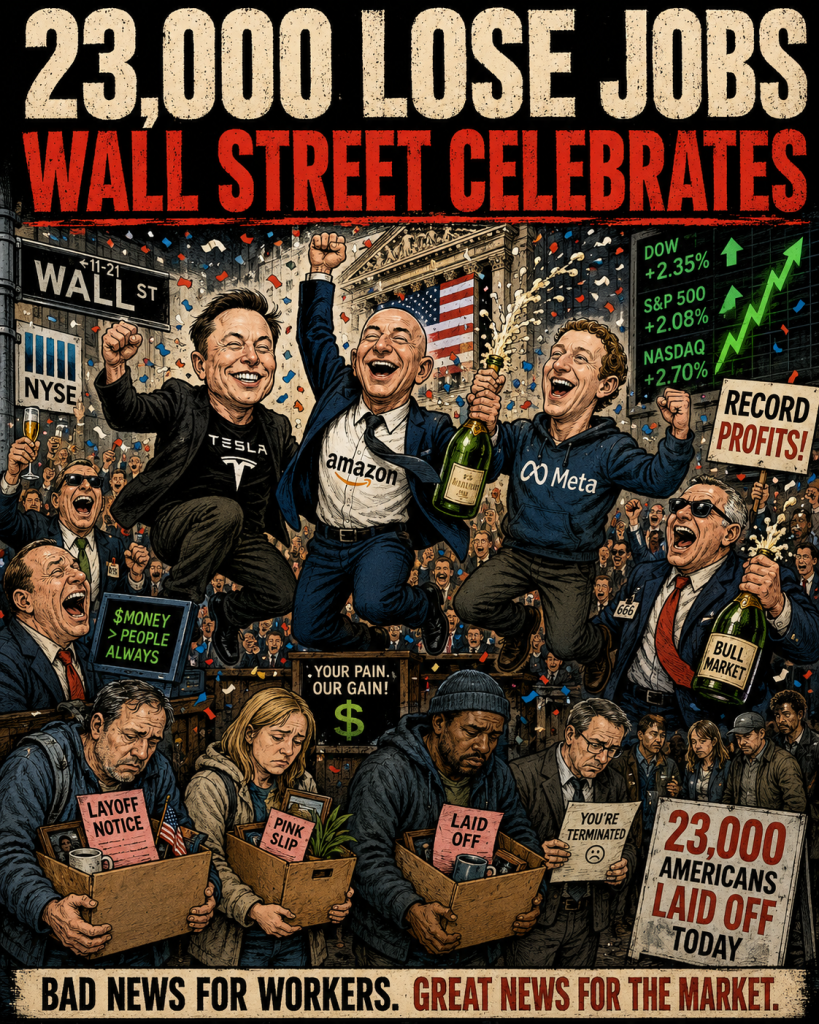
Twenty-three thousand jobs disappeared from U.S. payrolls in July.
Wall Street responded by setting a record.
The S&P 500 rose 0.62 percent Friday to a record high. The Nasdaq jumped 1.3 percent. The Dow gained 0.28 percent. Investors were reacting largely to what the bad employment report might mean for interest rates: a weaker labor market made another Federal Reserve rate increase look less likely. (Reuters)
There is nothing mysterious about the economics.
There is something revealing about it.
Bad News Can Be Good News
Economists had expected the country to add about 80,000 jobs in July. Instead, payroll employment fell by 23,000. Earlier estimates were also revised downward. (Reuters)
For someone looking for work, that is bad news.
For someone worried about losing a job, it is bad news.
For a family depending on a paycheck, it is bad news.
But Wall Street heard something else.
Investors heard that the economy might be weakening enough to keep the Federal Reserve from raising interest rates. Market expectations for a September rate hike dropped sharply after the jobs report. (Reuters)
Lower interest rates are good for stocks. Borrowing is cheaper. Money is easier. Future corporate profits become more valuable.
So stocks went up.
Nobody on Wall Street needed to hate the workers who lost their jobs.
They just needed to love money more.
What Does a Billionaire Want?
There is an old question worth updating.
What does a millionaire want?
Another million.
What does a billionaire want?
Another billion.
And someday, when the first trillionaire arrives, what will the trillionaire want?
Another trillion.
There is no finish line.
At some point money stops being about buying food, paying a mortgage or making sure the children are secure. Nobody needs a billion dollars to live comfortably.
At that level, money becomes something else.
It becomes scorekeeping.
Power.
Competition.
Control.
Winning.
That does not mean every wealthy person is cruel. It does not mean investors celebrate because somebody cannot make the mortgage payment.
It means the financial system measures success differently from the family sitting at the kitchen table.
Two Economies
For most Americans, the economy is personal.
Do I have a job?
Did my wages go up?
Can I afford groceries?
Can I pay the electric bill?
Can I buy a house?
Can my children find work?
Wall Street asks different questions.
What will the Federal Reserve do?
What will happen to interest rates?
What are corporate earnings?
What will happen to stock prices?
Those two economies often move together.
Sometimes they do not.
Friday was one of those days.
Workers received evidence that the labor market was weakening.
Investors received evidence that money might remain cheaper.
The same report produced anxiety in one America and celebration in another.
They Were Cheering Interest Rates
It would be unfair to say traders bought stocks Friday because they were happy that Americans were losing jobs.
They were primarily reacting to interest rates.
That distinction matters.
But it does not erase the contradiction.
A financial system has developed in which evidence that workers are having a harder time can make investors wealthier within hours.
The market does not have feelings. It does not care whether a worker is frightened, whether a family has health insurance, or whether someone carrying a cardboard box out of an office has three children waiting at home.
The market responds to money.
That is what it was built to do.
They Don’t Hate Workers
Perhaps that is the mistake we sometimes make when talking about the extremely wealthy.
We assume they must dislike working people.
They don’t have to.
Elon Musk does not have to hate the man on an assembly line.
Jeff Bezos does not have to hate the woman working in a warehouse.
Mark Zuckerberg does not have to hate the person whose retirement account rises and falls with the market.
Hatred isn’t necessary.
The interests simply have to collide.
And when they do, money usually has the louder voice.
That is why Friday’s market reaction deserves more attention than another record on the S&P 500.
Twenty-three thousand fewer jobs was bad news.
Wall Street rose anyway.
They don’t hate workers.
They just love money more.


