
How young Texans with little money and a lot of shoe leather built La Raza Unida — and what Texas Democrats might learn from them today
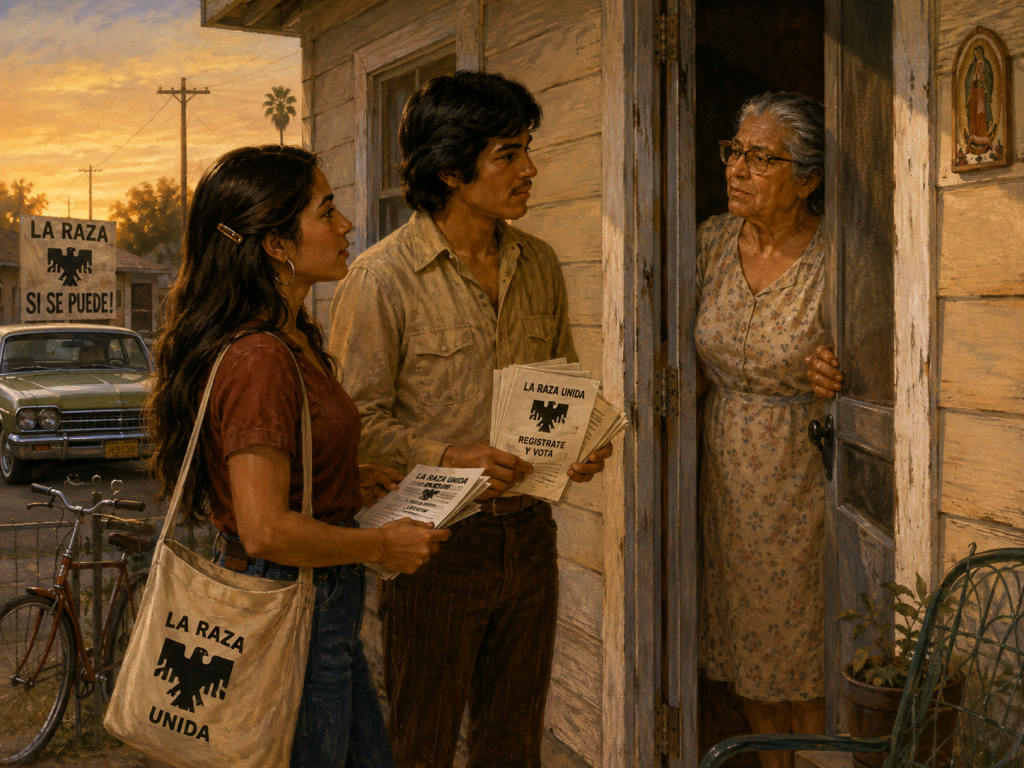
When I was a young man working with La Raza Unida, politics did not arrive on a television screen.
It arrived at somebody’s front door.
We did not have sophisticated polling, computers that could tell us which voter lived in which house, consultants studying every word we used, or millions of dollars for advertising. We had young people. We had neighborhoods. We had feet.
And we knocked on doors.
Sometimes the person who answered was interested. Sometimes he was suspicious. Sometimes she had never voted. Sometimes people had spent their entire lives believing that politics belonged to somebody else.
We kept knocking.
There was another message underneath the politics, at least for me.
Be proud to be brown.
That may sound ordinary today. It was not ordinary then.
For generations, Mexican Americans in Texas had been taught in a hundred different ways that advancement meant becoming less Mexican. Speak English. Change the pronunciation of your name. Do not make trouble. Accept the people who have always governed your town because that is simply how things are.
La Raza Unida challenged that.
It said our neighborhoods mattered. Our Spanish mattered. Our families mattered. Our history mattered.
And our votes mattered.
A Party Built by Young People
La Raza Unida was formally established in Crystal City in January 1970 at a meeting attended by about 300 Mexican Americans. Two of its principal organizers, José Ángel Gutiérrez and Mario Compean, had helped create the Mexican American Youth Organization, or MAYO, only a few years earlier. (Texas State Historical Association)
The word Youth in that name is important.
This was not primarily a movement created in corporate boardrooms or expensive campaign offices. Young Mexican Americans were challenging school systems, city governments and political organizations that often represented communities in which Mexican Americans were the majority while political power remained somewhere else.
And they began winning.
In the first local elections contested by La Raza Unida in Crystal City, Cotulla, and Carrizo Springs, its candidates won fifteen positions, including majorities on two city councils, two school boards, and two mayoralties. (Texas State Historical Association)
That was proof of something political professionals sometimes forget.
People who do not normally participate are not necessarily apathetic.
Sometimes nobody has asked them.
Sometimes nobody has convinced them that voting will change anything.
Sometimes nobody has knocked on their door.
Then They Tried Texas
In 1972, La Raza Unida decided to take the experiment statewide.
Its candidate for governor was Ramsey Muñiz, a young lawyer. Alma Canales, a former farmworker and journalism student, ran for lieutenant governor. She was only twenty-four — actually too young under the Texas Constitution to hold the office if elected. The Texas State Historical Association notes that Muñiz and Canales looked very much like the party itself: young, educated, and connected to the Chicano movement. (Texas State Historical Association)
Nobody seriously expected La Raza Unida to capture the governor’s mansion.
That was not the only measure of success.
On Election Day, roughly 214,000 Texans voted for Ramsey Muñiz — about 6 percent of the statewide vote. His support was particularly strong in parts of South Texas and significant enough to help produce the first Texas gubernatorial election of the twentieth century in which the winner failed to receive a majority of the vote. (Texas State Historical Association)
Think about that number.
Two hundred fourteen thousand people.
No giant campaign treasury.
No social media.
No television operation resembling what candidates have today.
A political organization heavily dependent on young people going into communities and talking to other human beings.
I was one of those young people.
What I remember is not some great political machine.
I remember pushing.
I remember knocking on doors.
That was the machine.
Six Percent Can Change Texas
Six percent sounds small until you look at a close election.
Nobody would describe a candidate receiving 6 percent as the winner. But move 6 percent of the electorate in a state divided almost evenly between two parties, and you can decide who governs it.
That is what makes the history of La Raza Unida suddenly relevant again.
A new Texas A&M Bush School/ReconMR Texas Pulse poll has Democrat James Talarico leading Republican Ken Paxton for the U.S. Senate, 47 percent to 43 percent. Gov. Greg Abbott leads Democrat Gina Hinojosa only 46 percent to 45 percent. Democrat Vikki Goodwin leads Lt. Gov. Dan Patrick 48 percent to 46 percent. All of those differences fall within the poll’s margin of error. (Politico)
Texas is not blue.
But those numbers say something almost as important:
Texas is movable.
And once again, much of the argument is about Mexican-American voters.
Democrats have spent years asking why Latino voters do not turn out in greater numbers and why Republicans have made gains among working-class Hispanics.
Perhaps they should ask another question.
How many doors have you knocked on?
Fifty-Four Years Later, Somebody Is Knocking Again
There was an almost eerie echo of La Raza Unida in the news this month.
Somos Votantes announced a $6 million effort aimed at Latino voters in Texas. Two million dollars is going toward statewide voter education, registration and — there it is again — door-to-door conversations. Another $4 million will go toward advertising in several South Texas congressional districts. (AP News)
They have considerably more money than we had.
But apparently, after all the technology accumulated over half a century, somebody has rediscovered one of the oldest political instruments ever invented:
A human being standing at another human being’s door.
There is a lesson in that.
Political campaigns today can know almost everything about a voter without knowing the voter.
They know what precinct you live in. They can estimate your income. They know whether you voted in the last election. They can purchase information about what you buy and build models predicting what issue might persuade you.
Then they send you a text message.
We did something more primitive.
We showed up.
The Part the Numbers Cannot Measure
La Raza Unida eventually disappeared as a statewide political party. Its electoral strength declined after the mid-1970s, although it had already transformed political life in parts of South Texas and trained a generation of Mexican-American political organizers. (Texas State Historical Association)
If all you study is election returns, you might therefore call it unsuccessful.
I would not.
Winning an election is one kind of victory.
Convincing somebody that he belongs in the political system is another.
Convincing a young Mexican-American kid that there is nothing inferior about his name, his parents, his neighborhood, or the color of his skin is another.
Be proud to be brown.
That was political too.
When people become proud of who they are, they begin asking uncomfortable questions.
Why does nobody on the school board look like us?
Why are our neighborhoods ignored?
Why does everybody come asking for our votes just before Election Day?
Why are decisions affecting us always made by somebody else?
And eventually:
Why aren’t we running the place ourselves?
That is how political power begins.
Not with a television commercial.
With somebody deciding that his voice counts.
Texas Democrats Have Seen This Movie Before
Texas Democrats today are searching for the voters who might finally make statewide elections competitive.
They may be looking too hard for something new.
Texas history already gave them an example.
More than fifty years ago, young Mexican Americans with very little money walked through neighborhoods and asked people to participate.
They organized.
They registered voters.
They knocked on doors.
And in 1972, more than 200,000 Texans walked into voting booths and chose the candidate of a young Chicano political party that the established political system had every reason to ignore.
La Raza Unida did not take the governor’s mansion.
But it proved those voters existed.
They still do.
The technology has changed. The campaigns have millions of dollars. The computers know which doors to knock on.
Someone still has to knock.
And when that door opens, perhaps the message does not have to be very complicated.
Your family matters.
Your neighborhood matters.
Your vote matters.
And there is nothing wrong with being proud to be brown.


