
It’s Easy to Spend Someone Else’s Money — Especially When It’s $2 Billion
When Houston Congressman Mickey Leland went to Washington and fought for money to feed hungry people, the conservative argument of the Reagan years was familiar: government was spending somebody else’s money.
Leland had a different way of looking at it.
“I grew up on a Christian ethic which says we are supposed to help the least of our brothers,” he once said. (History, Art & Archives)
In 1985, Leland helped push Congress to approve $800 million in famine relief for Africa. He chaired the House Select Committee on Hunger and spent much of his congressional career trying to make hunger—at home and abroad—something Washington could not ignore. (History, Art & Archives)
Eight hundred million dollars sounded like an enormous amount of government money in 1985.
It was.
Adjusted for inflation, that $800 million would be worth about $2.48 billion today. (Bureau of Labor Statistics)
Keep that number in mind.
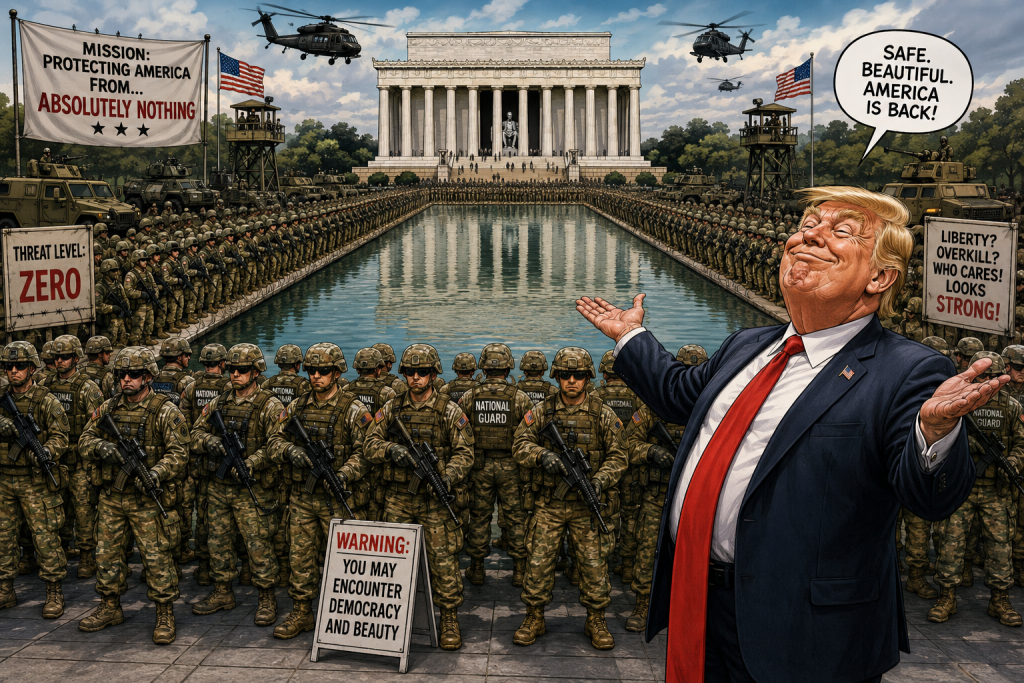
Because President Donald Trump’s decision to keep National Guard troops on the streets of Washington, D.C., through January 2029 is now projected to cost taxpayers more than $2 billion. (Roll Call)
Almost the same amount of money.
One was spent fighting famine.
The other is being spent keeping soldiers in the nation’s capital.
The $2 Billion Deployment
Trump ordered the National Guard into Washington on August 11, 2025, as part of what he called a crime emergency.
The Congressional Budget Office estimated that the Washington deployment had already cost $223 million by the end of 2025. CBO later estimated that maintaining the D.C. force was costing roughly $55 million a month. (Senator Elizabeth Warren)
Now the Pentagon says keeping an average of about 2,500 Guard members in Washington from October 2026 through January 2029 will require another $1.429 billion:
$605.1 million in fiscal 2027.
$625.8 million in fiscal 2028.
$198.3 million for the portion of fiscal 2029 ending with Trump’s term. (Senator Elizabeth Warren)
Add what has already been spent and what is projected to be spent, and the total comes to more than $2 billion. (Roll Call)
What does $2 billion actually mean?
Government numbers become so large that they sometimes stop meaning anything.
So turn the money into something people can see.
431 Million School Lunches
For the 2026–27 school year, the federal reimbursement for a free school lunch is about $4.87 at qualifying schools. (FDACS)
At that rate, $2.1 billion would pay for approximately 431 million school lunches.
That is enough to provide lunch every school day for an entire 180-day school year to roughly 2.4 million children.
Not one lunch.
Not one week.
A full school year for 2.4 million children.
Treatment for 14 Million Malnourished Children
UNICEF uses ready-to-use therapeutic food to treat young children suffering from severe wasting, one of the most dangerous forms of malnutrition.
A complete six- to eight-week treatment, including programming and logistics, costs about $150 per child. (unicef.org)
Two-point-one billion dollars could finance treatment for roughly:
14 million severely malnourished children.
UNICEF says severe wasting greatly increases a child’s risk of death, while treatment with therapeutic food has a recovery rate approaching 90 percent. (UNICEF)
That puts the Washington number in a very different light.
What About Lives?
There is no honest way to say that every $5,000 automatically saves a human life. Global health does not work like a vending machine.
But researchers do estimate the cost-effectiveness of proven programs.
GiveWell, which studies global health interventions, estimates that the highly effective programs it recommends can avert a death for roughly $5,000 on average, while stressing that such estimates are uncertain. (The GiveWell Blog)
Using that rough benchmark only to understand the size of the number:
$2.1 billion is the equivalent of roughly 420,000 lives saved.
That is not a proposal to transfer the Pentagon budget to a charity.
It is perspective.
It tells us what $2 billion can mean when dollars are measured against human beings.
And What Are the Soldiers Doing?
The administration says the Guard deployment has helped make Washington safer.
Crime has continued to fall. Through August 7, overall crime in Washington was down 20 percent compared with the same period last year, and homicides were down 32 percent. (AP News)
But there is an important fact that gets lost in that argument:
Crime was already falling before the National Guard arrived.
Even the Associated Press notes that there is a continuing debate over how much of the decline can be attributed to the federal deployment and how much resulted from local crime-fighting efforts already underway. (AP News)
Meanwhile, Guard members have done much more than fight crime.
They have patrolled tourist areas and neighborhoods where violent crime is rare. They have helped remove snow, performed beautification work, responded to medical emergencies and supported law-enforcement operations. (AP News)
Those may all be useful things.
But they raise a perfectly reasonable question:
Do we need the United States military spending more than $2 billion to do them?
Mickey Leland Understood the Question
There is an irony in returning to Mickey Leland.
His House hunger committee was not some wild partisan project. The House voted 309–78 to create it. His work attracted support from Republicans as well as Democrats. (History, Art & Archives)
But Leland lived during an era when Americans were constantly warned about government dependency, welfare spending and politicians being generous with taxpayers’ money.
He nevertheless kept asking Congress for money to feed people.
He helped obtain $800 million for African famine relief. He fought for food stamps, school meals, food banks, housing and health care for homeless Americans. (History, Art & Archives)
And in 1989, Mickey Leland died in a plane crash while traveling to an Ethiopian refugee camp on another humanitarian mission. (History, Art & Archives)
Forty years later, Washington is preparing to spend more than $2 billion keeping National Guard troops in the streets of the capital through the end of a president’s term.
That money could represent 431 million school lunches.
It could represent treatment for 14 million severely malnourished children.
Measured against some of the world’s most effective health programs, it is money on the scale of hundreds of thousands of human lives.
Perhaps the old warning was right.
It is easy to spend money when it belongs to someone else.
The more interesting question is why we seem to ask that question so much more often when the money is being spent on the poor.