
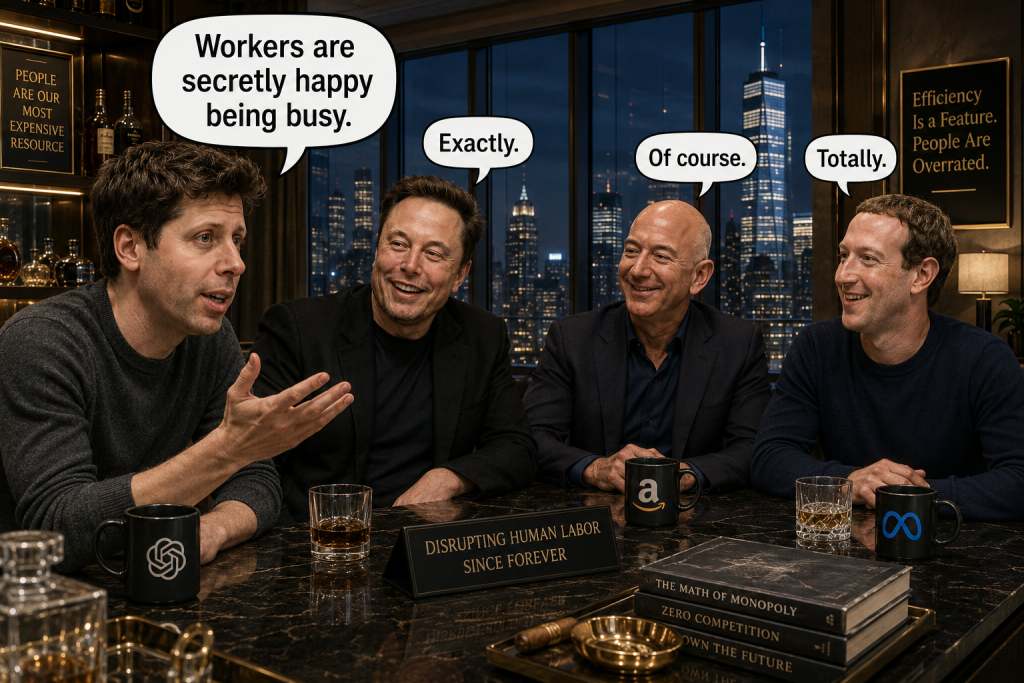
Sam Altman has an interesting theory about American workers.
Artificial intelligence may make people enormously more productive, he says, but don’t expect everyone to use that productivity to work fewer hours. People are competitive. They always want more. They will continue filling their days with work.
And although they may complain about being busy, Altman says, secretly they will be happy about it.
That is quite a statement.
Especially from a billionaire.
Has Anybody Asked the People Doing the Work?
Maybe Altman is right about some people. There are lawyers who work seventy hours because they love winning. Entrepreneurs who wake up thinking about their companies. Doctors who cannot imagine retiring. People who genuinely enjoy being busy.
But there are also nurses working twelve-hour shifts.
Warehouse employees whose schedules are dictated by an algorithm.
Teachers grading papers at home after spending the day in a classroom.
Construction workers whose knees and backs hurt by Friday.
Parents who leave before their children wake up and return after dinner.
People working two jobs because one doesn’t pay enough.
Are all of them secretly delighted?
Altman offered no survey showing that they are.
No study.
No polling.
No labor economist explaining that workers complain about long hours while privately wishing they had more of them.
It appears to be Sam Altman’s theory about what ordinary people want.
There Is an Easier Way to Find Out
Ask them.
This shouldn’t require artificial intelligence.
Walk into a Walmart break room and ask employees:
If you could earn the same paycheck working four days instead of five, which would you choose?
Ask a nurse.
Ask a truck driver.
Ask somebody roofing a house in Houston in August.
Ask the woman cleaning an office building at eleven at night.
Ask a father whether he would rather spend Saturday working overtime or watching his daughter play soccer if the paycheck were the same.
I have a suspicion about the answers.
Apparently Sam Altman has one too.
The difference is that he has decided what people secretly believe.
His Own Researchers Found Something Interesting
There is another reason Altman’s statement deserves scrutiny.
OpenResearch, the organization that grew out of a research project Altman helped fund, actually conducted a major experiment involving thousands of Americans.
Some participants received $1,000 a month for three years.
When people had a little more economic breathing room, they worked slightly less.
They didn’t abandon work.
They didn’t spend their days staring at the ceiling.
They gained a little more freedom to decide what kind of work they wanted and how work fit into the rest of their lives.
That distinction matters.
Most people probably don’t hate work.
They hate having no choice.
Who Gets the Productivity?
AI may create enormous increases in productivity.
Suppose one worker using AI can eventually accomplish in twenty hours what once required forty.
There are at least two obvious possibilities.
The worker could receive the same pay and get twenty hours of his life back.
Or the company could expect twice as much production from him.
Guess which one Sam Altman’s prediction assumes?
The history of American labor suggests workers don’t automatically receive productivity gains in the form of leisure. Somebody has to decide where the benefit goes.
It can become higher wages.
Shorter hours.
Lower prices.
Higher profits.
Or some combination of them.
Technology doesn’t make that decision.
People with power do.
A Very Convenient Theory
That is what makes Altman’s theory particularly convenient.
The people building artificial intelligence are telling us that AI will make workers dramatically more productive.
Then one of the most powerful people building that technology tells workers not to expect much more free time because, deep down, they actually enjoy being busy.
What an extraordinarily useful belief for employers.
The machine doubles your productivity.
The company keeps the extra production.
You keep working forty hours.
And if you complain?
Don’t worry.
Apparently you’re secretly happy.
Maybe AI Should Ask Us
The great promise of technology has always included freedom from unnecessary labor.
Machines replaced backbreaking agricultural work.
Washing machines eliminated hours of household labor.
Automation took over repetitive factory tasks.
Computers performed calculations that once occupied rooms full of people.
Now artificial intelligence is supposed to perform intellectual work at extraordinary speed.
If that revolution arrives and Americans discover that they are still working just as many hours—only producing twice as much for somebody else—we shouldn’t blame human nature.
And we shouldn’t be told we secretly wanted it that way.
Perhaps before Silicon Valley decides what ordinary Americans really desire, its billionaires might conduct one final experiment.
Talk to some ordinary Americans.


