
You won’t find it in our history books, but one reason—perhaps one of the major reasons—the United States invaded Mexico may have been slavery. Mexico had abolished slavery, and thousands of enslaved people fled south from Texas, Louisiana, and Mississippi because crossing into Mexico could mean freedom. Southern slaveholders wanted slavery to expand westward, not be surrounded and contained. They embraced Manifest Destiny because Mexican land offered room for more slave states. Under slave-owning President James K. Polk, the United States looked south and saw a weaker country where American “property” could cross a river and become free men and women. Mexico could be defeated.
Can I prove that this was Polk’s secret motive? No. Motives rarely come with signed confessions. But the evidence points in that direction. Americans at the time were already calling the Mexican War a war for the expansion of slavery.
James Russell Lowell called it “a national crime committed in behoof of slavery.”
America Wanted Mexico’s Land. Slaveholders Wanted Room to Grow.
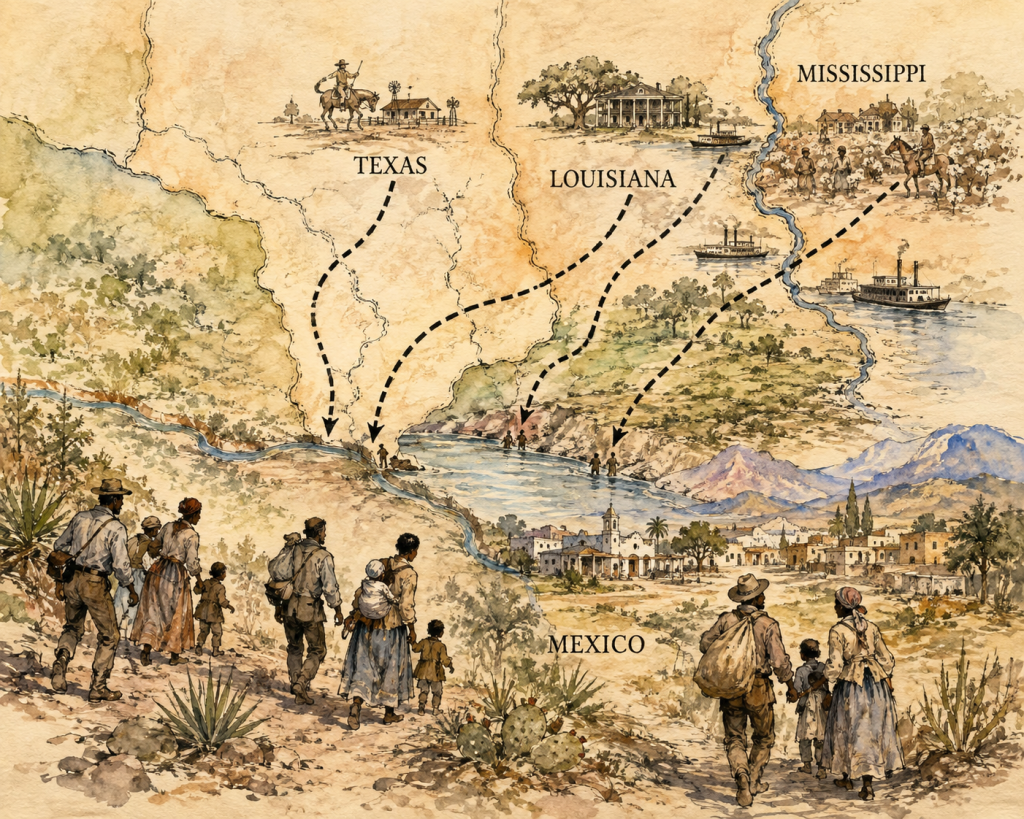
The usual story of the Mexican-American War is simple: the United States annexed Texas, Mexico disputed the border, fighting broke out, and President James K. Polk asked Congress for war.
But there was another force moving west with the American flag:
slavery.
Polk was not merely an expansionist president. He was a slave-owning Tennessee planter who continued buying and selling enslaved people while president. Yale historian David Blight describes him as an “expansionist slaveholding president.”
And Mexico presented slaveholders with a particularly dangerous neighbor.
Mexico had abolished slavery. Enslaved people in Texas learned that if they could make it south across the Rio Grande, they could become free. Thousands eventually followed what has become known as the southbound Underground Railroad.
Mexico generally refused to recognize those people as somebody else’s property.
To slaveholders, that meant valuable human property could walk across a river and become men and women whom they could no longer legally buy, sell, or command.
At the same time, Southern leaders were increasingly convinced that slavery could not remain confined where it already existed. Blight describes their fear of a “shrinking South” and their belief that slavery had to expand or eventually die.
Then look west.
California. New Mexico. Arizona. Vast stretches of Mexican territory where slavery was illegal.
For slaveholders, American conquest offered the possibility of changing that.
This was not an argument invented generations later. Americans were saying it while the war was being fought.
Abolitionist James Russell Lowell called the Mexican War “a national crime committed in behoof of slavery.” Blight notes that abolitionists opposed the conflict because they believed it was a war for the expansion of slavery.
America also wanted land. Polk wanted a nation stretching to the Pacific, and Mexico was a far weaker opponent than Britain, with whom the United States compromised over Oregon.
But history seldom has only one motive.
The United States under a slave-owning president invaded a neighboring country that had abolished slavery, took enormous stretches of its territory, and immediately began fighting over whether slavery would be permitted on the conquered land.
Before the war was even over, David Wilmot proposed that slavery be prohibited in any territory taken from Mexico. Southern legislatures condemned the idea. Northern legislatures overwhelmingly supported it.
The fight helped push the country toward the Civil War.
So perhaps slavery was not simply something America argued about after it conquered Mexico.
Perhaps it was also one of the reasons some powerful Americans were so eager to conquer Mexican land in the first place.
Mexico offered enslaved Americans freedom. Conquest offered American slaveholders room to expand.
Both facts were sitting on opposite sides of the same river.