
When do we lose the hyphen?
One of the Twenty-Seven
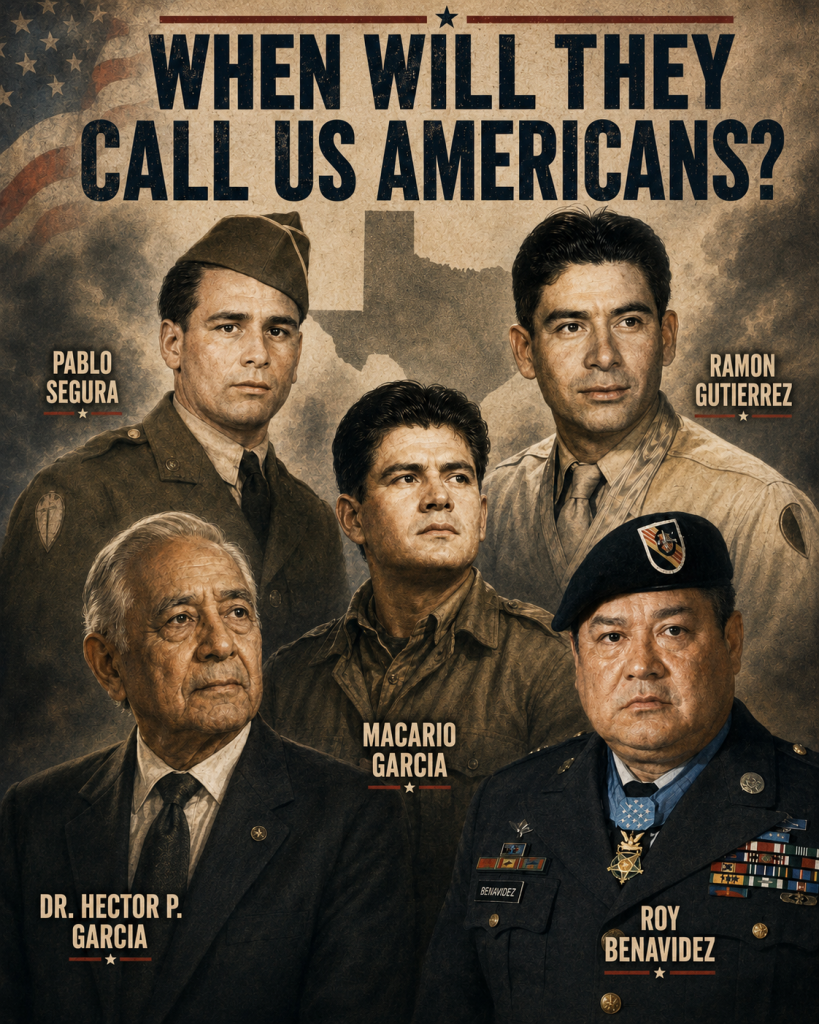
When the survivors of Company E answered roll call after the Rapido River disaster in January 1944, only 27 enlisted men were left.
One of them was Ramon Garza Gutierrez of Del Rio, Texas.
He had already survived Salerno, where he charged a German machine-gun position after his Browning Automatic Rifle was shot from his hands. Wounded and without the rifle, he continued forward, used a grenade against the position, and killed the remaining German soldier in hand-to-hand combat.
The Army awarded him the Silver Star.
A Soviet military observer learned what Gutierrez had done and recommended him for a Soviet decoration, the Order of the Patriotic War, Second Degree. (The National WWII Museum)
But before Gutierrez ever received that medal, he had to survive the rest of Italy.
And first he had to get back across the Rapido.
Captured at the Rapido
Gutierrez was among the Company E men who made it across the river.
Then the Germans captured him.
He was being marched toward the German rear in heavy fog when he kept stumbling over objects on the ground.
They were dead American soldiers.
At one point Gutierrez fell and simply stayed down.
The two Germans guarding him continued walking.
They apparently did not notice that their prisoner was no longer behind them.
Gutierrez remained on the German side of the river for about 24 hours before making his way back to the American lines.
He returned without his weapon.
But he returned. (The National WWII Museum)
Of the 154 Company E men who had gone into the Rapido operation, he was one of the 27 who came back.
From Private to Sergeant
The Rapido had destroyed so much of Company E that experienced soldiers suddenly became extremely valuable.
Gutierrez had been a private first class.
After the Rapido, the Army promoted him past corporal and made him a sergeant.
The reason was simple.
There were not many experienced men left. (The National WWII Museum)
Company E itself had to be rebuilt with replacements.
The Mexican-American National Guardsmen who had trained together in Texas were disappearing from the ranks through death, wounds, and capture.
But the Army kept moving north.
So did Company E.
Monte Cassino
After the Rapido, the survivors found themselves beneath Monte Cassino.
Company E was dug in on the slopes of Mount Castellone when Allied aircraft destroyed the ancient Benedictine abbey on February 15, 1944.
The bombing remains one of the most controversial episodes of the Italian campaign. Allied commanders believed the Germans were using the commanding height for observation, though the Germans had not occupied the abbey itself before its destruction. (The National WWII Museum)
For the remaining men of Company E, the larger historical argument probably mattered less than the artillery landing around them.
They were still in Italy.
They were still fighting.
And Ramon Gutierrez was about to be captured again.
Captured a Second Time
By late May 1944, Gutierrez was a sergeant leading an advance squad during the fighting south of Rome.
The Germans overran his position.
This time they knew from the stripes on his uniform that he was a sergeant.
They separated him from the others.
According to the account preserved by his cousin and historian Dave Gutierrez, the Germans beat him while demanding information and stabbed him in the back with bayonets. He carried the scars for the rest of his life. (The National WWII Museum)
He remained a prisoner for days.
Then an Allied bomb or artillery round hit the building where he was being held.
A hole opened in the structure.
Gutierrez escaped.
Again.
But this time he could not simply walk back to American lines.
The Italians Who Hid Him
Italian civilians found the wounded American soldier.
They hid him.
That decision placed them in danger too. German forces were still nearby, and civilians caught helping an escaped American prisoner could face severe punishment.
They kept Gutierrez hidden until American troops reached the area.
He was then sent to a hospital.
He had now been captured twice by the German Army and escaped twice. (The National WWII Museum)
After months of treatment, Gutierrez expected to return to Company E.
The Army had other orders for him.
He was going home.
A Medal From the Soviet Union
The reason was unusual.
The Soviet Union wanted to decorate him.
The story went back to Salerno.
A Soviet officer observing the Allied operations had learned of the Mexican-American private from Del Rio who had charged the German machine-gun nest after losing his rifle.
The Soviets considered the action worthy of the Order of the Patriotic War, Second Degree. (The National WWII Museum)
When Gutierrez returned from Italy, he went to Washington.
The Soviet decoration had been transmitted through diplomatic channels to the United States, and Gutierrez received it in Washington. (KWMC 1490AM)
Consider the journey.
He had grown up in Del Rio’s Mexican-American community.
Texas placed him in a Mexican-American company.
At Salerno, he charged a German machine gun.
At the Rapido, he was captured and escaped.
He was promoted to sergeant.
He was captured again, tortured, and escaped again.
Italian civilians hid him.
And then the Soviet Union gave this young Mexican-American Texan a medal for bravery.
It would have made quite a homecoming story.
Except that home had not changed very much.
They Came Home to the Same Texas
Dave Gutierrez put the problem plainly when discussing what happened after the war.
The returning men discovered that not much had changed for Mexican Americans in South Texas.
The same kind of signs were still there.
The same discrimination was still there.
The same restaurants could still decide that a Mexican-American veteran was Mexican first and an American second. (The National WWII Museum)
These were men who had fought at Salerno.
Some had crossed the Rapido.
Some had been wounded.
Some had been prisoners.
Some had watched friends die.
Then they came home to a Texas where a business could still tell them:
No Mexicans.
The war had changed them.
Texas had not changed nearly enough.
This Was Never Just an El Paso Story
Company E began in El Paso, and the original National Guardsmen came largely from El Paso’s barrios.
But once the 36th Division mobilized, Mexican-American soldiers from elsewhere in Texas were deliberately placed into the company.
That changed its character.
Company E became a Texas Mexican-American unit.
The men came from Del Rio, Uvalde, Sonora, Kingsville, El Paso, and other Texas communities. (The National WWII Museum)
Ramon Gutierrez was from Del Rio.
Pedro T. Soto of Kingsville was killed during the fighting at Monte Rotondo. (The National WWII Museum)
Guillermo “Willie” De Leon, who grew up in Uvalde, served with the 36th Division and Company E. He fought at Salerno and the Rapido and returned home decorated with the Silver Star, Bronze Star, and Purple Heart. Uvalde later named its civic center for him. (Texas Legislature)
These were not men from some distant Mexican-American history.
They were Texans from towns still sitting along the highways of South Texas.
Their families remained there.
The Sons Came Home Different
There is another part of this history that rarely appears on a military map.
Many veterans did not come home and tell their families everything that had happened.
Some barely talked about it.
That silence can make family history deceptive.
A child knows that Dad fought in Italy.
An uncle says he was in the Army.
A photograph shows a young man in uniform.
A box contains some medals.
Ask what happened and the answer might be only a few words.
But behind those few words could be Salerno.
The Rapido.
A dead friend.
A German prison.
A wound.
The men had returned.
Part of the war often remained with them.
Dave Gutierrez said Ramon suffered from what today would be called PTSD for the rest of his life. Ramon married Consuelo “Connie” Sanchez, herself a wartime Navy WAVE, raised a family, and lived for many years in Wichita Falls. (The National WWII Museum)
He had survived the war.
That did not mean the war had disappeared.
Mexican-American Veterans Had Had Enough
Something important happened when thousands of Mexican-American veterans came home.
They had served as Americans.
They had fought as Americans.
They had been wounded as Americans.
And many were no longer willing to quietly accept being treated as something less.
In Corpus Christi on March 26, 1948, about 700 Mexican-American veterans, led by another World War II veteran, Dr. Héctor P. García, gathered and organized the American G.I. Forum.
Its first major concern was remarkably basic: Mexican-American veterans were having difficulty receiving benefits they had earned under the G.I. Bill.
The Forum demanded those benefits.
Then it expanded into hospital care, education, voting rights, school segregation, and other civil-rights battles. (The Library of Congress)
The connection to men like those of Company E is hard to miss.
Before the war, they had been told they needed to be “Americanized.”
During the war, the country asked them to fight.
After the war, they began demanding that America live up to its side of the bargain.
Then Came Felix Longoria
The contradiction became impossible to ignore in 1949.
Felix Longoria, a Mexican-American soldier from Three Rivers, Texas, had been killed in the Philippines.
When his body was finally returned home, the local funeral director refused his family the use of the funeral chapel. The cemetery itself had a separate Mexican section divided by barbed wire.
Dr. García and the G.I. Forum protested.
The controversy became national news.
Senator Lyndon B. Johnson arranged for Longoria to be buried with full military honors at Arlington National Cemetery. (Texas State Historical Association)
Longoria had died for the United States.
Yet his family had to fight over where Mexican Americans could mourn him.
Company E’s Brownwood hamburger restaurant suddenly no longer seemed like an isolated incident.
It was part of something much larger.
Ramon Came Home
Ramon Gutierrez returned to Texas.
He lived in Sonora for a time and later settled in Wichita Falls with Connie and their family.
He continued serving in the Texas State Guard Reserve and, in 1955, was commissioned as a second lieutenant.
He died in 1993 at age 70. (Texas Legislature)
There is a bit of historical justice in that commission.
Gabriel Navarrete had once been told his accent made him unsuitable to be an officer.
Pablo Segura had heard virtually the same thing.
Ramon Gutierrez, another Mexican-American soldier from Company E, eventually wore an officer’s bars too.
The institution changed.
Slowly.
The Story Almost Disappeared
For decades, Company E was not remembered nationally the way some other famous World War II units were.
There were monuments.
There were veterans.
There were photographs and medals.
There were family stories.
But there was no widely known national story.
Dave Gutierrez grew up hearing fragments about his cousin Ramon.
He began researching one man.
Then he discovered the company.
That research eventually connected him with more than 60 Company E families and became Patriots from the Barrio. (AUSA)
That tells us something about how history disappears.
Sometimes records are destroyed.
Sometimes people deliberately hide the past.
And sometimes everybody simply assumes somebody else will remember.
The veteran dies.
His wife dies.
The children remember only pieces.
The medals go into a drawer.
A photograph loses its names.
Then somebody finally asks:
Who were these men?
Texas Still Has Not Finished With Ramon Gutierrez
The story has one more chapter.
In 2025, more than thirty years after Ramon Gutierrez died, Texas State Representative Wes Virdell introduced House Concurrent Resolution 115.
It asked Texas to posthumously award Gutierrez the Texas Legislative Medal of Honor, the state’s highest military decoration.
The resolution recounted his actions at Salerno, his capture and escape at the Rapido, his second capture, his wounds, and the Soviet decoration. (Texas Legislature)
But the resolution did not make it through the Legislature.
Official Texas legislative records show its last action on March 19, 2025:
It was referred to a subcommittee on Defense and Veterans’ Affairs.
There it stopped. (Texas Legislature)
More than eighty years after Salerno, Texas was still deciding how to recognize Ramon Gutierrez.
They Were Already Americans
That brings us back to where the Company E story began.
Texas created a Mexican-American National Guard company and spoke about “Americanizing” its young men.
Those men became some of the best riflemen in the regiment.
They were refused hamburgers because they were Mexican.
They crossed the Atlantic.
They landed at Salerno.
They fought through Italy.
At the Rapido, Company E went from 154 men to 27.
John Chapin died with them.
Ramon Gutierrez was captured and escaped.
Then he was captured again.
And escaped again.
A foreign nation decorated him for courage.
Eventually he came home to a state where Mexican Americans still had to fight for the rights supposedly guaranteed by the uniform they had worn.
The men of Company E never needed America to teach them how to become Americans.
America needed time to understand what those men had already proved.
They were Mexican Americans.
They were Texans.
They were Americans.
They had been all three from the beginning.
Yes. And I found one correction we should make before writing it: the Sugar Land-area restaurant incident you were remembering was Macario García, the WWII Medal of Honor recipient. He lived near Sugar Land and was refused service at the Oasis Cafe in Richmond in 1945 because he was Hispanic. (Texas State Historical Association) Roy Benavidez has his own documented history of discrimination; an official Army Naming Commission report says he was denied service and beaten outside a restaurant because of his ethnicity. (Cyber CoE)
That actually makes the epilogue stronger: Company E → returning veterans → Macario García → Héctor P. García → Roy Benavidez. Same argument, across generations.
Epilogue — The War Ended. The Signs Did Not.
Coming Home
The survivors of Company E eventually came home.
Some tried to put the war behind them.
Pablo Segura, once told that he had “too much accent” to become an officer, finished the war as a lieutenant. He returned to college, earned an engineering degree, moved to Houston, and worked for years as a metallurgist. He also joined LULAC and eventually served as president of a Houston chapter. (Voces)
His answer to the old idea that Mexican Americans had to surrender part of themselves to become American remained simple:
“You don’t have to lose your roots to be a proud American.”
But Texas had not changed as quickly as its veterans had.
A Medal of Honor Was Not Enough
Macario García was not a Company E soldier, but his story belonged to the same Texas.
García fought in World War II with the 4th Infantry Division. In Germany, he attacked two enemy machine-gun positions almost single-handedly, despite being wounded.
President Harry Truman presented him with the Medal of Honor on August 23, 1945. (Texas State Historical Association)
Then García came home to the Sugar Land area.
Only weeks after receiving the nation’s highest military decoration, he entered a restaurant in nearby Richmond and was refused service because he was Hispanic.
A fight followed.
García—the Medal of Honor recipient—was arrested.
The charges were eventually dropped. (Texas State Historical Association)
The medal said he was one of America’s greatest heroes.
The restaurant still saw a Mexican.
Dr. Héctor P. García
Other veterans decided that coming home was not enough.
Dr. Héctor P. García had served as an Army doctor during World War II and returned to Corpus Christi as a major.
He came home to the same discrimination.
In 1948, he founded the American G.I. Forum in Corpus Christi after Mexican-American veterans encountered problems receiving the benefits they had earned through military service. The organization soon expanded its fight into education, voting rights, and civil rights. (Dr. Hector P. Garcia Foundation)
The veterans had fought for their country.
Now they were going to fight their country when it failed to keep its promises.
And Then Came Vietnam
One might think another generation would have ended the argument.
It did not.
Roy Benavidez, a Mexican-American Texan, joined the Army, became a Green Beret, and fought in Vietnam.
On May 2, 1968, he voluntarily entered a battle to rescue a surrounded Special Forces team. During roughly six hours of fighting, Benavidez suffered dozens of wounds while helping save wounded men and recover classified material.
President Ronald Reagan presented him with the Medal of Honor in 1981. (Army Museum)
And yet an official Army review of Benavidez’s life records that he too was denied service and beaten outside a restaurant because of his ethnicity. (Cyber CoE)
Think about the distance between those stories.
Company E trained in Texas before World War II, and its soldiers encountered “No Mexicans.”
Macario García came home from World War II wearing the Medal of Honor and was refused service.
Héctor García organized Mexican-American veterans because military service had still not delivered equal treatment.
Then came Korea.
Then Vietnam.
And Roy Benavidez—one of the most decorated American soldiers of his generation—could still encounter the same message.
The wars changed.
The uniforms changed.
The generation changed.
For Mexican Americans in Texas, some things took much longer.
Company E had already supplied the answer back in 1941.
They never needed to prove they were Americans.
America needed to learn to treat them that way.