
I started with a Houston Chronicle story about Tesla considering a $10.1 billion solar manufacturing plant in Fort Bend County.
The story told us about the investment. It told us about construction jobs. It told us Tesla wanted a school property-tax break to make Texas competitive with another unidentified state.
What it did not tell us was the number I wanted to know:
How much does Elon Musk want from Texas taxpayers?
So I started digging.
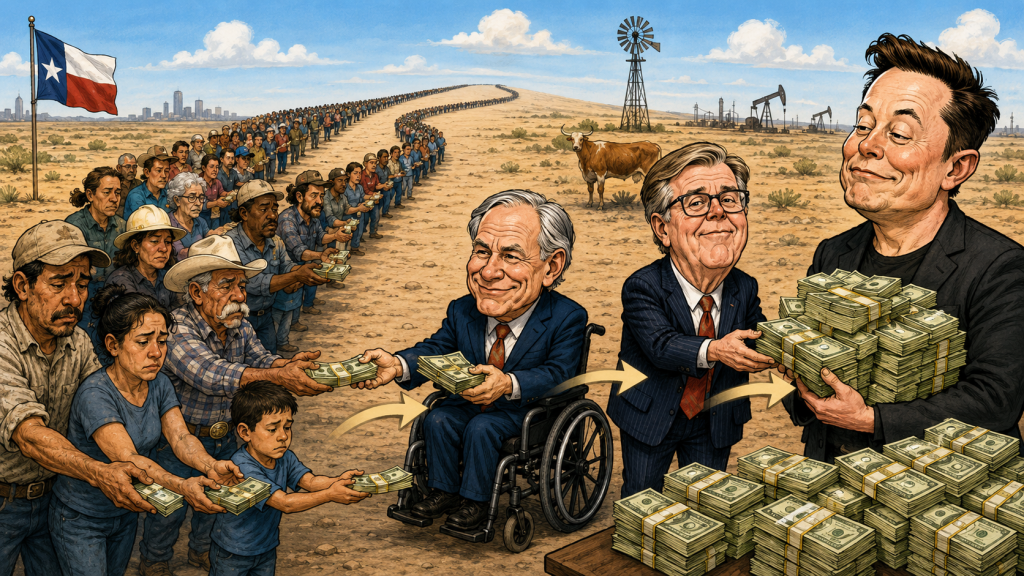
The answer is approaching $2 billion — and that is before we can put a price on every tax break his companies may receive.
Start With the Fort Bend Solar Plant
Tesla has applied for a tax-value limitation from Lamar Consolidated Independent School District for its proposed solar-cell and solar-module factory. Tesla says it would invest $10.116 billion and begin commercial operations in 2029.
The Chronicle reported that Tesla wanted the tax break and repeated Tesla’s argument that the incentive was necessary to make Fort Bend competitive with another location.
But Tesla’s own application contains enough information to estimate the value.
During the 10-year incentive period, Tesla’s eligible property would be taxed for school maintenance and operations at roughly half its otherwise taxable value. Using the values Tesla submitted and Lamar CISD’s listed M&O tax rate, the tax savings come to approximately $92.7 million.
That got my attention.
Then I looked at what Musk was receiving a little farther north.
Now add $1.66 billion
Musk’s SpaceX and Tesla are developing Terafab, a massive semiconductor manufacturing complex in Grimes County that will make chips for vehicles, robots, satellites, and data centers.
Two small rural school districts — Anderson-Shiro CISD and Iola ISD — have advanced tax agreements worth as much as $1.66 billion to SpaceX.
The estimated savings are about $1 billion from Anderson-Shiro and $644 million from Iola through 2046. Grimes County has separately agreed to waive part of SpaceX’s county property taxes.
That county tax break is additional. We cannot yet responsibly attach a final dollar value to it because it depends on how much of the enormous project is ultimately constructed and future property values and tax rates.
Then Gov. Greg Abbott announced another benefit: a $30 million Texas Enterprise Fund grant for the first phase of Terafab.
And in 2025, Abbott’s office awarded SpaceX another $17.3 million Texas Semiconductor Innovation Fund grant for expansion of its Bastrop manufacturing operation.
Put just those identifiable numbers together:
$1.66 billion — Terafab school tax incentives
$92.7 million — proposed Fort Bend solar tax savings
$30 million — Terafab state grant
$17.3 million — SpaceX Bastrop state grant
Total: about $1.8 billion.
And that still does not include the value of the Grimes County property-tax deal or any additional local incentives Tesla may obtain for the Fort Bend solar project.
So “almost $2 billion” may ultimately prove conservative.
Who Pays?
Texas likes to advertise itself as a low-tax state.
It depends on who you are.
The nonpartisan Institute on Taxation and Economic Policy ranks Texas as having the seventh-most regressive state and local tax system in America. The lowest-income 20 percent of Texans pay about 12.8 percent of their income in state and local taxes, compared with 4.6 percent for the richest 1 percent.
In other words, measured against their income, poor Texans already pay nearly three times the tax burden carried by Texas’ richest residents.
Now their government is offering enormous tax advantages to companies controlled by the world’s richest man.
A tax break is not literally a check written by a poor family to Elon Musk. But somebody bears the cost when government decides that one taxpayer does not have to pay taxes everyone else normally pays. And direct state grants really are public money.
Then Follow the Campaign Money
There is another side to this story.
While Musk’s companies seek and receive enormous public incentives, Musk has become one of the biggest political donors to Texas Republicans.
During the first six months of 2026, Musk and his revocable trust gave:
- $500,000 to Texans for Greg Abbott
- $500,000 to Dan Patrick’s campaign
- $500,000 to Patrick’s Texas Senate Leadership Fund
- $250,000 to House Speaker Dustin Burrows
- $2 million to Texans for Lawsuit Reform PAC
- $1 million to Judicial Fairness PAC
That is $4.75 million in 2026 alone, overwhelmingly benefiting Republican politicians and Republican causes.
Abbott himself received $500,000 from Musk this year. Other major Abbott donors also have interests in the exploding Texas data-center industry.
There is no document I have found saying: Musk gives campaign money, and Abbott gives Musk tax breaks.
We do not need one to report what has happened.
Elon Musk gives millions of dollars to Republican politicians and Republican political organizations.
Texas Republican leaders approve or promote tax breaks and public incentives worth vastly more to Musk’s companies.
Both statements are documented.
Readers can decide for themselves what they think about the relationship.
The Story That Was Missing
The original Chronicle story was not false. Tesla really is considering a $10 billion Fort Bend solar plant. The jobs and investment figures really do appear in Tesla’s application.
But those numbers were supplied by Tesla.
The more important question was sitting underneath them:
What does Elon Musk want from us?
Once you ask that question, a $10 billion solar-factory announcement becomes part of something much larger.
The world’s richest man is building an enormous Texas empire of solar manufacturing, semiconductor factories, satellites, artificial intelligence and data centers.
He is also putting millions into Republican politics.
And the Texas government is offering his companies roughly $1.8 billion in identifiable tax breaks and state subsidies already — with additional incentives still impossible to total.
The world’s richest man has discovered something valuable in Texas.
Our money.


