
Back in the 1990s, I had an idea.
I tried to convince some people I considered pretty smart that we needed a permanent organization whose job was to study government and politics. Not another campaign organization that disappeared after Election Day. I wanted researchers who would study laws, budgets and regulations, find the pressure points and loopholes, think several moves ahead and have ideas ready when politicians needed them.
They looked at me as if I were crazy.
Years later, I discovered that other people had already figured it out. They didn’t need every politician to be a genius. They needed the politicians to have access to people whose full-time job was doing the thinking for them.
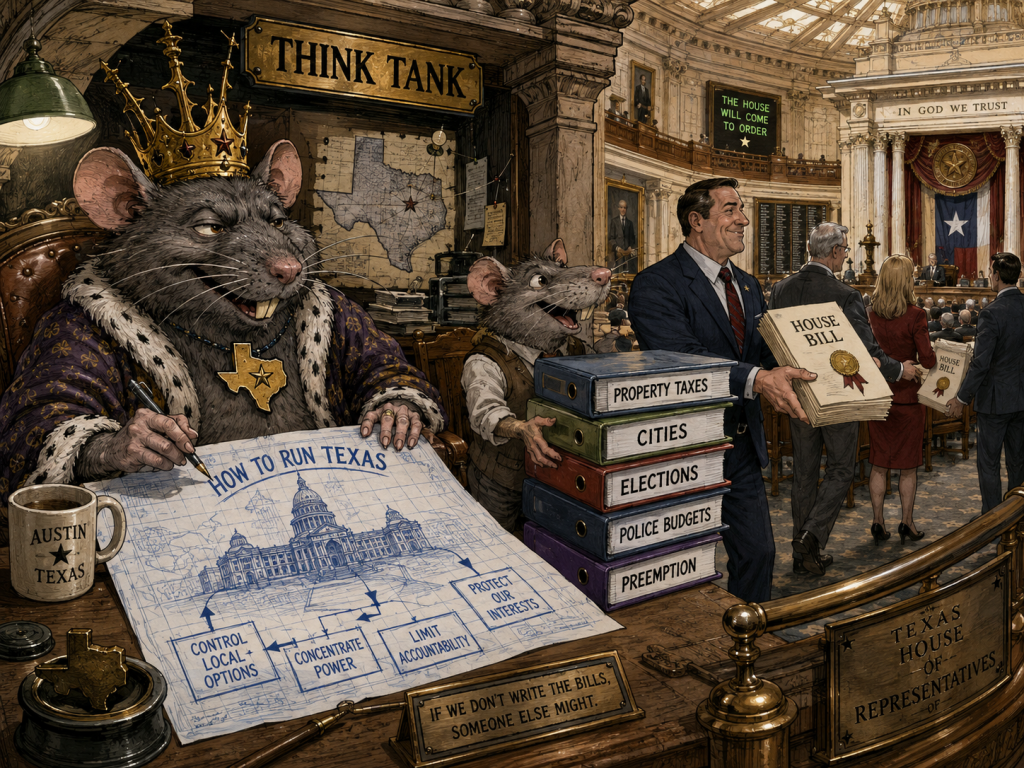
That is how I ended up thinking about Pinky and the Brain.
Somebody Else Had Already Built the Brain
The Koch political network became famous for this kind of long-range thinking. Charles Koch described a strategy that stretched from creating ideas and developing policy through education, grassroots organizing, lobbying, litigation, and finally political action. The important insight was that changing government required more than electing somebody every two or four years. It required institutions that stayed around between elections.
Texas was building its own version.
The Texas Public Policy Foundation was established in 1989. By 2003, its own annual report said its Policy Orientation had helped shape the 78th Texas Legislature. It described producing research, bringing in technical experts, promoting its ideas through the media, and working “side by side” with legislators. That same year, it closed its San Antonio office and concentrated its activities at the Capitol in Austin.
The report even carried praise from then-Attorney General Greg Abbott, who said TPPF provided important insights into the issues facing Texas. Abbott’s relationship with this organization did not begin when he became governor.
Then I Found the Fingerprint
This is what our last round of digging uncovered.
In 2004, TPPF published a paper recommending that government spending growth be limited to population growth plus inflation. More importantly for the story we started with today, the paper specifically said the limit should apply to local governments as well as the state.
In 2007, TPPF went further. It calculated what would have happened if Texas cities, including Dallas, Fort Worth, El Paso, Harlingen, and San Antonio, had been operating under a local spending limit based on population growth plus inflation. In other words, this wasn’t some new idea somebody dreamed up during the current city budget crisis. TPPF was doing the math on individual Texas cities almost twenty years ago.
Now jump forward to April 2026.
Abbott’s campaign proposed limiting local government spending to population growth plus inflation or 3.5%, whichever is lower.
That is not proof that Abbott copied a TPPF document. We don’t need to claim that. What we can prove is more interesting: the basic mechanism Abbott is proposing in 2026 had been developed and promoted by TPPF at least as far back as 2004.
And TPPF was still pushing it in January 2026, less than three months before Abbott announced his plan.
They Tell Us How the Machine Works
Normally, proving political influence is difficult because everybody denies influencing everybody else.
TPPF is unusually helpful. It has written about its successes itself.
In 2017, after Abbott called a special legislative session, TPPF announced that 12 of the governor’s 20 agenda items were longstanding TPPF priorities. It said it was aggressively campaigning for those proposals. Its agenda included property-tax reform, a cap on local spending, restrictions on local permitting, limits on local tree regulations, and municipal annexation reform.
Then came 2018.
TPPF said it worked with three other organizations during the Republican Party of Texas convention, supplied policy experts during the platform process, and helped supporters make the case for its policies. When it was over, 17 of TPPF’s 25 priority items appeared in the Texas Republican platform, along with 13 of 15 items promoted by its coalition.
One sentence in TPPF’s own account may explain the whole system better than anything I could write. It said one pension proposal was included because its policy expert was in the room when a committee member expressed interest. Property-tax reform and ending taxpayer-funded lobbying became official Republican legislative priorities, meaning the party would devote resources and political capital to them.
There is your Brain.
A politician does not have to spend ten years studying pension law, municipal finance, or property-tax formulas. The expert is already in the room.
Then the Ideas Become Law
In 2019, Texas enacted Senate Bill 2, which generally limited annual property-tax revenue growth for cities and counties to 3.5% without voter approval. TPPF had spent years arguing for tighter limits on local government revenue and spending. The Legislature did not adopt every number TPPF proposed, but it adopted the same basic philosophy: put a state-controlled brake on how quickly local governments can raise property-tax revenue.
In 2021 came HB 1900, Abbott’s anti-“defunding” law. For large cities, police appropriations generally cannot be cut by a larger percentage than the city budget as a whole without risking designation as a defunding municipality and state penalties. That is the law we were discussing when we realized cities can cut everything equally, but they have much less freedom to single out the police budget for deeper reductions.
Then in 2023 came HB 2127, the sweeping state-preemption law restricting what cities and counties can regulate in a number of areas.
Here the TPPF fingerprint is direct. TPPF’s Rod Bordelon appeared before the House State Affairs Committee and explicitly testified in support of HB 2127, arguing that Texas should be the exclusive regulatory authority in the areas covered by the bill.
And nobody needs to speculate about whether Abbott sees TPPF as a partner. At TPPF’s 2022 Policy Orientation, Abbott said major accomplishments of the previous legislative session would not have been possible without legislators, advocates, and policy leaders such as those at TPPF, and he said he looked forward to their “continued partnership.”
Now Look at the Cities
That brings us back to the story that started this investigation.
Dallas is facing a $51 million budget gap. Fort Worth faces about $94 million. San Antonio faces $158 million over two years. Austin projects a structural deficit that could eventually exceed $100 million. Cities are considering layoffs, fewer library hours, eliminated positions, higher fees and property-tax increases.
Abbott did not create all of those problems. Inflation, slower sales-tax growth, declining or slower property values and rising employee and health-care costs all matter. Any fair account has to say that.
But the state has steadily narrowed the cities’ room to maneuver.
Texas limits how quickly they can increase property-tax revenue without an election. It restricts large cities from disproportionately cutting police budgets. It has preempted broad areas of local regulation. And Abbott now wants the Legislature to impose another restriction: a ceiling on how quickly the entire local budget can grow.
Meanwhile, public safety is one of the largest drivers of city spending. Police and firefighters are receiving raises, health-care costs are increasing, and Dallas wants another 700 police officers over the next two years, even while parks, libraries, housing and other services face cuts.
That is the vise we were looking at before we got sidetracked into wondering who designs these ideas.
Now we have at least part of the answer.
This Is Not a Conspiracy Story
I cannot prove that a bunch of billionaires and think-tank executives sat around a table and designed all of this for the single purpose of keeping Republicans in power.
More importantly, I don’t have to.
What can be documented is enough.
A permanent conservative policy institution was established in Texas in 1989. By 2003, it had moved its activities to the Capitol and was boasting about helping shape a legislative session. By 2004, it was recommending population-plus-inflation spending limits that applied to local governments. It later placed policy experts inside the Republican platform process, celebrated when Abbott put 12 longstanding TPPF priorities on a special-session agenda, directly advocated major legislation restricting city authority, and was publicly described by Abbott himself as a continuing partner.
That is not a secret conspiracy.
That is an institution doing exactly what it was built to do.
Politicians come and go. Legislators serve a few terms. Governors eventually leave office.
The institution remembers.
It can work on an idea for five years, ten years, or twenty years. It can research the issue, refine the argument, put an expert in the room, get the idea into the party platform, help move it through the Legislature, and wait for the right governor and the right political moment.
The voter may see a new bill.
The Brain may have been working on it for twenty years.
Pinky and the Brain have not managed to take over the world. But America?
They are close. And Austin was lost to the think tanks decades ago.