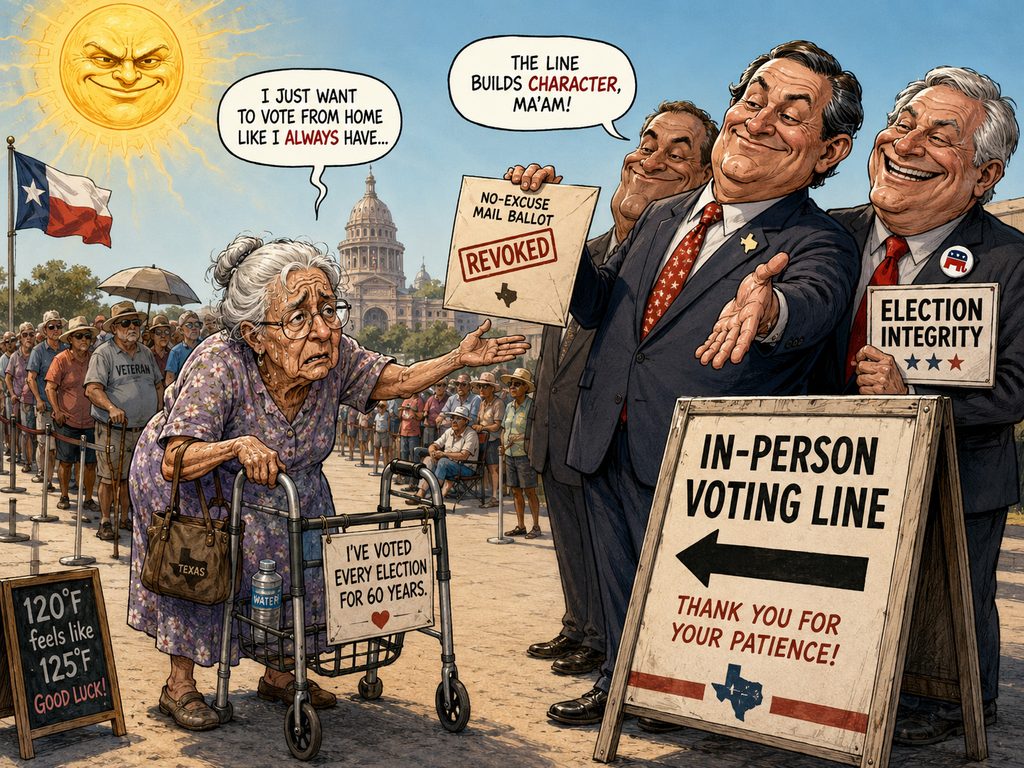
A federal appeals court has presented Texas Republicans with the sort of constitutional problem nobody in Austin was asking for:
They may eventually have to treat younger voters the same as older voters.
The Fourth Circuit ruled that South Carolina could not allow everyone 65 and older to vote absentee without an excuse while denying that same convenience to younger adults solely because of their age. The court said the distinction can violate the 26th Amendment, which prohibits denying or abridging the right to vote on account of age.
Texas has essentially the same arrangement.
If you are 65 or older, Texas lets you vote by mail simply because of your age. If you are 64, the state wants another reason.
This leaves Texas with two particularly unattractive possibilities: make mail voting available equally to younger voters, or stop giving older voters the automatic privilege.
The Miracle of Turning 65
Texas election law apparently recognizes a transformation that medical science has somehow overlooked.
At 11:59 p.m. the night before your 65th birthday, allowing you to vote by mail raises serious concerns.
At midnight, everything changes.
Your ballot becomes trustworthy.
At 64, perhaps you cannot be trusted alone at the kitchen table with a pen, a ballot, and an envelope. At 65, Texas suddenly has complete confidence in you.
Nobody has adequately explained what happens during that final minute.
Abbott Calls an Emergency Meeting
One can imagine Gov. Greg Abbott gathering Attorney General Ken Paxton, Lt. Gov. Dan Patrick, and Republican legislative leaders around a table.
An attorney explains the problem.
“We have two choices. We can let everybody vote by mail.”
Silence.
Somebody drops a coffee cup.
Abbott finally asks, “What’s the other choice?”
“We can take automatic mail voting away from people over 65.”
Longer silence.
Dan Patrick looks concerned.
Ken Paxton finally asks the sensible question:
“Can’t we sue somebody?”
Now we’re making progress.
First They Wanted Grandma to Save the Economy
There is an additional difficulty for Patrick.
During COVID, Patrick famously argued that older Americans might be willing to risk their survival to keep the economy going. He later said there were things more important than living.
Texas seniors had therefore already been assigned an important civic responsibility:
Grandma and Grandpa, sacrifice yourselves for the economy.
Now Texas may have to give them another one:
Grandma and Grandpa, get in line.
And during presidential elections in Texas, that can mean a very real line.
Voters have waited hours at polling locations. Harris County has experienced waits lasting two hours or more, and anyone who has voted in a major presidential election knows that the line does not magically disappear because the person standing in it is 75 years old.
So imagine the campaign message:
First we asked you to risk dying for the economy. Now we’re asking you to stand for three hours to protect election integrity.
Bring comfortable shoes.
Choice One: Let Younger People Vote by Mail
This is clearly the frightening option.
Imagine a 30-year-old nurse who just worked a twelve-hour shift being allowed to vote the same way as her 70-year-old father.
Or a construction worker.
Or a teacher.
Or a mother trying to get three children fed before bedtime.
They could sit at the kitchen table, mark a ballot, put it in an envelope, and mail it.
Civilization might collapse.
Worse, some of them might actually vote.
For years, Texas Republicans have managed an impressive intellectual balancing act: mail voting is perfectly acceptable when older Texans use it, but widespread mail voting elsewhere can threaten election integrity.
The 26th Amendment introduces an inconvenient question:
If voting by mail is secure when Grandpa does it, exactly what happens to the ballot when his grandson touches it?
Choice Two: Tell Grandma to Stand in Line
Texas could solve the constitutional problem in the opposite direction.
Instead of extending the privilege, eliminate it.
Tell millions of Texans over 65 that age alone no longer qualifies them to vote by mail.
That announcement should go particularly well in retirement communities.
Imagine Republican legislators visiting a senior center:
“We’re here to protect your voting rights.”
Applause.
“So we’re taking away your mail ballot.”
Silence.
“But don’t worry. The polls open at 7 a.m.”
Someone throws a bingo marker.
The campaign commercial practically writes itself:
Texas Republicans protected Grandma’s ballot by making Grandma go get it herself.
There Must Be a Third Choice
Fortunately, this is Texas.
There is always a third choice.
Sue.
Texas already fought this battle in the Fifth Circuit and won. In 2020, that court upheld the state’s age-based mail-voting system, reasoning that giving older voters an additional way to vote did not improperly abridge the rights of younger voters.
The Fourth Circuit has now taken a different view.
That disagreement gives Texas officials exactly what they need:
Years of litigation.
Nobody in Austin has to choose between young voters and Grandma just yet. The state can file briefs, hold press conferences, issue statements about federal overreach, and spend several million taxpayer dollars defending the principle that age discrimination is perfectly constitutional when Texas does it.
Eventually the Supreme Court may have to decide.
The Real Problem
Underneath the joke is a simple question.
The 26th Amendment says that citizens 18 and older cannot have their voting rights denied or abridged “on account of age.”
It doesn’t say unless they are younger than 65.
It doesn’t say unless the Legislature prefers older voters.
And it certainly doesn’t say a ballot becomes safer on somebody’s 65th birthday.
If the courts eventually decide that Texas cannot keep its present system, Republicans will face a wonderful political choice.
They can make voting by mail easier for millions of younger Texans.
Or they can tell Grandma and Grandpa that after surviving COVID for the economy, their next patriotic duty is to grab a folding chair, head down to the polling place, and get in line.
Apparently in Texas, you’re old enough to sacrifice yourself for the economy—but not old enough to be spared a three-hour wait to vote.