A few months ago I wrote about Bright Saver, a nonprofit selling small plug-in solar systems designed for ordinary people.
The idea is almost embarrassingly simple.
You put a solar panel on a balcony, patio, fence, or other sunny place. You plug it into a regular outlet. The electricity it produces is used inside your home, reducing how much power you buy from the electric company.
No rooftop installation. No giant loan. No $20,000 solar contract.
For renters and apartment dwellers, that difference is enormous.
Bright Saver says plug-in solar was designed especially for people who cannot install panels on a roof they do not own. The system can sit on a balcony or patio, and because it is portable, renters can take it with them when they move.
That makes this much more than an environmental story.
It is a working-family story.
Solar for People Who Don’t Own a Roof
Traditional residential solar has largely been built around homeowners.
You need a suitable roof. You may need permits. You may need an installer. You may need financing.
That leaves out millions of renters, apartment residents, and lower-income families.
Plug-in solar changes the equation.
EnergySage estimates that a typical 400- to 800-watt balcony system costs roughly $500 to $1,500 and might reduce an electric bill by about $15 to $50 a month, depending on sunlight, electricity rates, and how the household uses power.
That is not enough electricity to run an entire house.
It does not have to be.
Every watt coming from the panel is a watt you are not buying from the utility.
For a family counting dollars at the end of the month, that matters.
Think About a Small Apartment in Texas
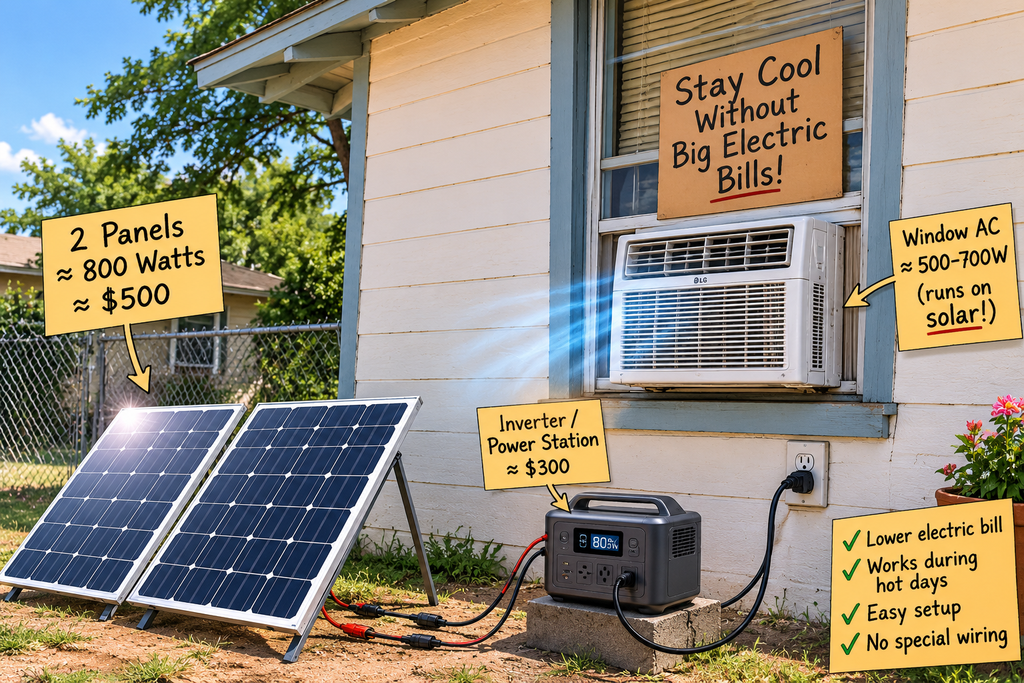
Consider a family living in an apartment without central air conditioning.
Maybe they use one or two window units because that is what they can afford.
During a Texas summer, those air conditioners may run for hours during the same part of the day when the sun is strongest.
A larger plug-in solar setup can produce several hundred watts, and systems approaching 1,200 watts are now being contemplated or authorized under laws in several states.
The solar does not have to power the air conditioner completely.
If the window unit needs 700 watts and the solar is producing 500 watts, the electric company supplies the difference.
Instead of buying 700 watts, the family is buying 200.
That is the part of this story I think politicians are missing.
People struggling to pay an electric bill do not care whether somebody calls it “distributed generation,” “balcony solar,” or “portable photovoltaic generation.”
They care about the bill.
The States Are Beginning to Figure It Out
When I first wrote about this in May, Utah was the state most often cited as having clearly legalized plug-in solar.
Then things began moving quickly.
Today eight states have signed laws specifically authorizing these small systems: Utah, Maine, Virginia, Colorado, Maryland, New Hampshire, Connecticut and Vermont. EnergySage reports that roughly 28 states and Washington, D.C., have considered legislation.
Maryland’s law illustrates how simple the concept can be.
Its Public Service Commission says qualifying residential systems can produce up to 1,200 watts. Utilities cannot require customers to obtain advance approval or charge them an interconnection fee simply for using a qualifying portable solar system.
In other words, lawmakers decided that a small solar appliance should be treated more like an appliance and less like a power plant.
That seems reasonable.
And Texas?
Texas should be an obvious place for this technology.
We have sunshine.
We have high summer electric bills.
We have apartments filled with people who cannot put solar panels on somebody else’s roof.
We have elderly residents and working families who sometimes cool only one room because cooling an entire house costs too much.
And we live in a state where people have learned, repeatedly, that electricity can disappear during extreme weather.
There is also already a Texas connection to this emerging industry. The Los Angeles Times recently reported that thousands of plug-in systems have been sold by Texas-based CraftStrom while California debates how to regulate the technology.
Yet Texas has not been among the states leading the effort to create a clear legal pathway for ordinary consumers.
That should raise a simple question:
Why not?
What About a Blackout?
There is one important limitation.
A standard plug-in solar panel does not keep working when the electrical grid goes down. For safety, ordinary grid-connected systems automatically shut off during an outage so they cannot send electricity back onto power lines while utility crews are working. Bright Saver explicitly warns consumers about that limitation.
But add the proper battery and off-grid inverter, and the picture changes.
Then solar can charge the battery during the day, and the stored electricity can be used for essential loads during an outage.
Maybe not an entire house.
But perhaps a refrigerator.
Lights.
Fans.
Phones.
Internet equipment.
Medical devices within the system’s capacity.
And with a sufficiently large battery and inverter, even a small air conditioner.
For families who cannot afford a whole-house generator or an expensive rooftop solar-and-battery installation, even several hours of emergency electricity can matter.
Who Benefits From Keeping It Complicated?
Whenever ordinary people find a cheaper way to provide something for themselves, somebody who profits from the old arrangement usually discovers reasons the new idea is complicated.
Utilities have legitimate concerns about safety and the electrical grid.
Electrical codes matter.
Proper equipment certification matters.
Nobody should be selling unsafe electrical equipment.
But eight states have already demonstrated that those issues can be addressed without forcing every consumer into the expense and bureaucracy associated with a traditional rooftop solar installation.
The technology should be made safe.
It should not be made unnecessarily difficult.
Because every unnecessary rule has an economic consequence.
A wealthy homeowner can spend tens of thousands of dollars installing rooftop solar.
A working mother renting an apartment cannot.
But she might be able to afford a small panel that knocks a few dollars off the electric bill every month.
She might eventually add another.
Maybe later she adds a battery.
That is how technology becomes useful to ordinary people.
This Isn’t Really About Solar
It is about who gets to save money.
For years we have heard politicians praise innovation, energy independence and the free market.
Here is a remarkably simple version of all three.
Let people generate a little electricity themselves.
Let renters participate.
Let apartment dwellers participate.
Let families who cannot afford central air use the sun to help operate a window unit during the hottest part of the afternoon.
Let people keep a refrigerator or fan operating during an outage if they can afford a battery.
And let them keep some of the money that otherwise goes to the electric company.
Eight states have already started down that road.
Texas should not be protecting billion-dollar energy companies from a solar panel sitting on somebody’s balcony.
It should be protecting the person inside the apartment trying to pay the electric bill.