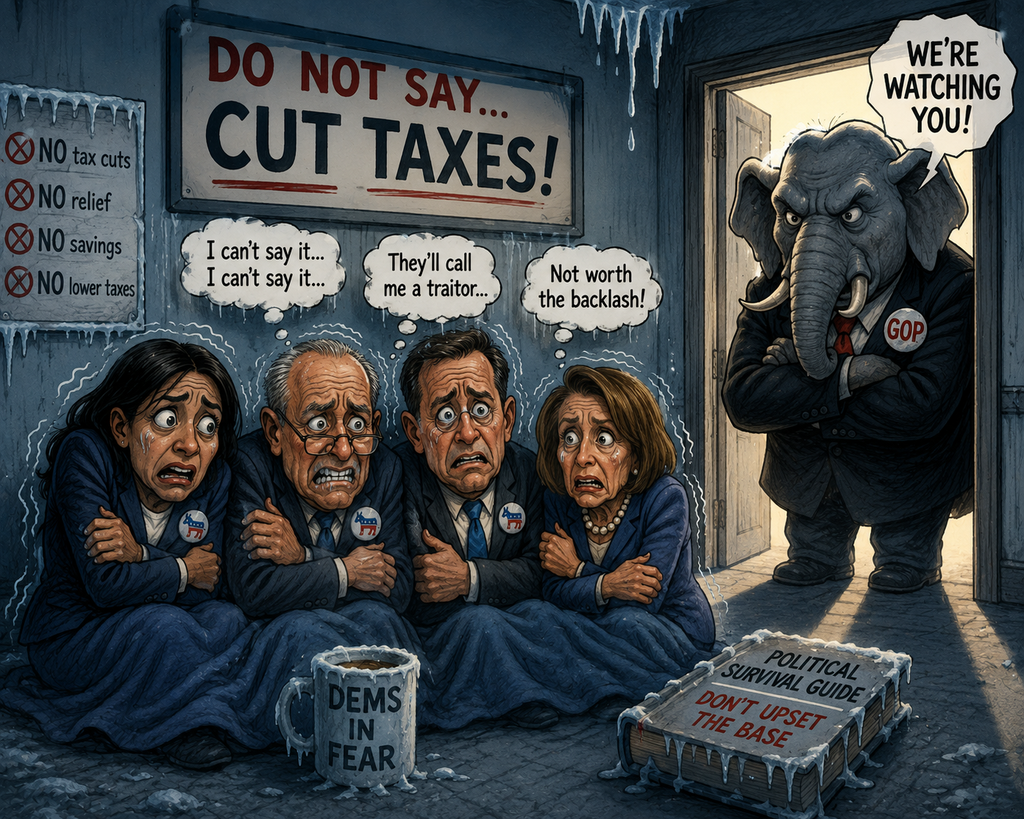
Texas Democrats know how to talk about taxes when the subject is Republicans giving tax breaks to billionaires and corporations.
They know how to complain about loopholes. They know how to demand that wealthy people pay their fair share. They know how to accuse Republicans of shifting the burden onto working families.
What they rarely seem willing to say is much simpler:
We will cut your taxes.
That may be one reason Republicans have owned the tax issue in Texas for decades.
Texas families already pay plenty to Austin
Texas likes to advertise itself as a state without an income tax. That is true.
It does not mean Texans are lightly taxed.
In fiscal year 2025, the State of Texas collected about $84.2 billion in taxes and another $7.1 billion in licenses, fees, fines and penalties, according to the Texas Comptroller.
Using the state’s average population for that year, that works out to roughly $2,900 for every Texan — about $11,600 for a family of four.
Some Texans pay more, and some pay less. Some of the burden is collected directly from individuals while other taxes are first collected from businesses and eventually become part of the prices Texans pay.
But the larger point is difficult to miss.
Austin collects a lot of money from Texans.
Abbott wants to cut taxes — just not Austin’s
Greg Abbott has suddenly discovered affordability.
He talks about reducing property taxes. He talks about insurance costs. He talks about electricity and the cost of living.
But there is something strange about his tax-cutting campaign.
The State of Texas does not levy a statewide property tax. Property taxes are primarily collected by school districts, cities, counties, and other local governments.
Abbott is therefore promising to reduce taxes collected largely by somebody else.
Meanwhile, the state government he controls continues collecting billions through its own 6.25 percent sales tax, motor vehicle taxes, gasoline taxes, insurance taxes and fees.
Texas collected about $49 billion from the state sales tax alone in fiscal 2025.
And the money is still rolling in. State sales-tax collections in July 2026 were up 10.1 percent from the previous July.
If Texans desperately need tax relief, there is an obvious question:
Why doesn’t Austin take less?
Democrats could ask that question
One would think this would be irresistible territory for Democrats.
Republicans have controlled Texas government for decades. Democrats could point at the billions flowing into Austin and say:
You say Texans are overtaxed. Fine. Let’s cut the taxes your government collects.
Instead, Democrats generally retreat to familiar ground.
They propose rebates. They propose tax credits. They propose subsidies and government programs. They promise to close corporate loopholes. They propose making billionaires and corporations pay more.
Some of those proposals may be good policy.
But none is as easy to understand as:
We are cutting your tax.
No application.
No government program.
No eligibility requirements.
No politician mailing you a check.
The cashier simply charges you less tax.
A couple of Democrats already tried it
This idea is not foreign to Texas Democrats.
In 2023, Democratic State Sen. Royce West proposed reducing the Texas sales tax from 6.25 percent to 5.75 percent.
West made an especially important argument: property-tax relief does not directly help renters the way a sales-tax cut would.
“Property tax relief can’t be everything we do for taxpayers,” West argued.
A Republican senator, Bob Hall, even joined him.
The proposal died.
Then in 2025, Democratic State Rep. Trey Martinez Fischer of San Antonio went further.
He filed HB 3437, proposing to reduce the state sales tax from 6.25 percent to 5.25 percent.
A full percentage point.
The bill was sent to committee and went nowhere.
There was no statewide Democratic campaign built around it. No army of Democratic candidates demanding that it pass. No effort to turn it into a defining difference between Democrats and Republicans.
Two Democrats had handed their party a remarkably simple political weapon.
The party left it lying on the ground.
Democrats talk themselves out of the argument
Part of the problem may be philosophical.
Texas Democrats have traditionally talked about tax fairness rather than tax reduction.
Their argument usually goes something like this: Republicans give breaks to corporations and billionaires while ordinary families pay too much. Close the loopholes, make the wealthy pay their share, and use the money for schools, healthcare, or other public needs.
There is nothing inherently wrong with that argument.
But politically, Republicans hear that language and immediately translate it for voters:
Democrats want to raise taxes.
Then Republicans respond with three words:
We’ll cut taxes.
Guess which message is easier to put on a yard sign.
Democrats surrendered the language
Republicans did not acquire ownership of the words “tax cut” through some law of nature.
Democrats surrendered them.
They have become so accustomed to defending government programs and explaining tax fairness that many seem uncomfortable saying government itself may simply be taking too much money.
Even during an affordability crisis, Texas Democrats largely talk about what government can give people.
Republicans talk about letting people keep their own money.
That distinction matters.
And Democrats should understand something else: a state sales-tax cut does not primarily belong to homeowners.
Renters pay sales tax.
Young people pay it.
Retirees pay it.
People who have never owned a house pay it.
Republicans constantly talk about property-tax relief because homeowners are an important voting bloc.
A Democrat could answer with something broader:
We want to cut a tax almost everybody pays.
The argument is sitting there
Greg Abbott says Texans need tax relief.
Agree with him.
Then ask him why Texas collected roughly $91 billion in taxes, licenses, and fees last year.
Ask why a four-person share of that collection comes to almost $12,000.
Ask why Texas sales-tax revenue continues climbing.
Ask why Abbott keeps telling counties, cities, and school districts to collect less while rarely suggesting that his own state government collect less.
And then offer voters something Democrats almost never offer them:
A tax cut.
Not a rebate.
Not a credit.
Not another program.
A tax cut.
Texas Democrats aren’t afraid to accuse Republicans of giving tax cuts to billionaires.
Maybe it is time they stopped being afraid to promise one to everybody else.