
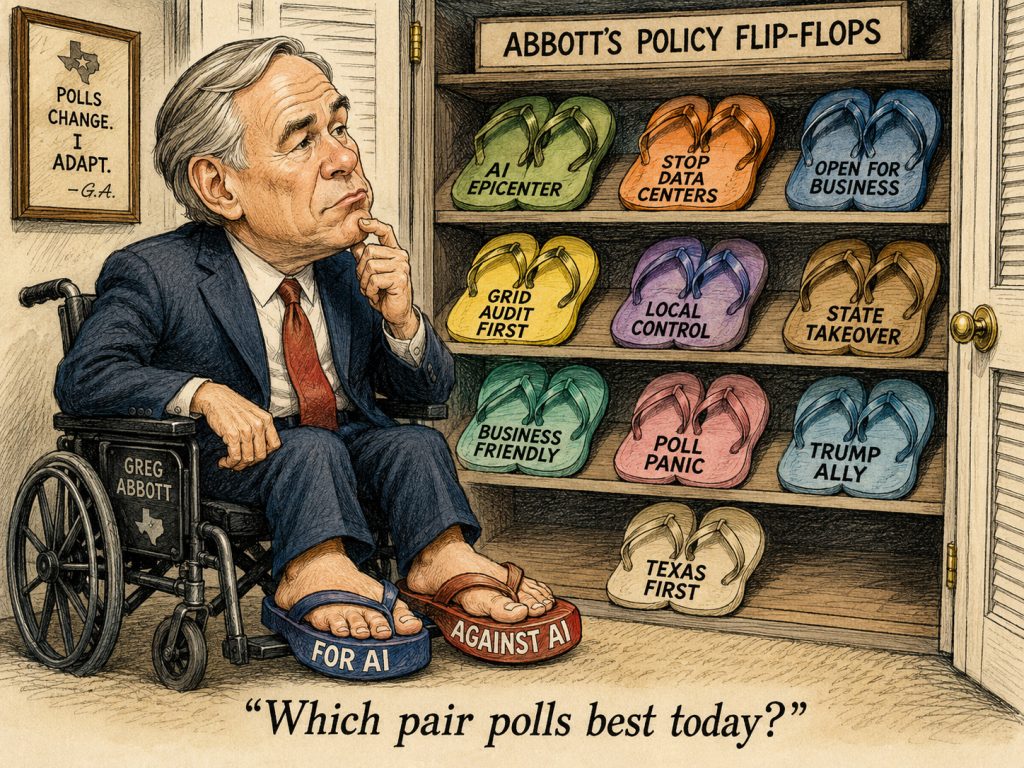
Greg Abbott has discovered that government surveillance might be a problem.
The discovery came rather late.
For three years, Texas helped finance a rapidly expanding network of artificial-intelligence cameras capable of recording license plates and identifying a vehicle by its make, model, color, dents, and bumper stickers. The network grew with millions of dollars controlled by a state authority whose board is largely appointed by Abbott.
Then, this week, the politics changed.
And Greg Abbott changed with them.
First, Texas Helped Build the Network
In 2023, Abbott signed Senate Bill 224, legislation aimed at the epidemic of catalytic-converter thefts. Among other things, it increased the annual Motor Vehicle Crime Prevention Authority fee associated with auto insurance policies from $4 to $5 per vehicle. The Legislature approved the measure overwhelmingly, and there is no evidence lawmakers intended to create a statewide surveillance system. (Texas Legislature Online)
But that money became one of the engines behind the expansion of Flock Safety cameras.
A Texas Tribune investigation found that the Motor Vehicle Crime Prevention Authority has devoted at least $30 million to Flock cameras since 2023. At least 95 grants helped local police agencies obtain roughly 2,000 cameras, while another $15.9 million financed almost 1,200 cameras for the Texas Department of Public Safety. Altogether, the state program helped put at least 3,200 Flock cameras on Texas roads. (The Texas Tribune)
This wasn’t some sleepy program that had stopped years ago.
In early August 2026—this month—the authority approved another $3 million to put 583 more cameras along Texas toll roads. (The Texas Tribune)
As recently as April, Miguel Rodriguez, chairman of the authority and Laredo’s police chief, discussed using DPS cameras even in jurisdictions where local governments did not want Flock cameras. His solution was to put them on state rights-of-way.
“And there’s nothing that they can tell us,” Rodriguez told another board member. (The Texas Tribune)
That doesn’t sound like an administration preparing to retreat from Flock.
Then Texans Started Looking at the Cameras
Flock cameras have become politically radioactive.
The problem isn’t simply that they photograph license plates. Agencies participating in Flock’s broader network can search data collected elsewhere, making it possible to reconstruct where vehicles have traveled. Police officials say the technology has helped solve crimes, recover stolen vehicles and locate missing people. (The Texas Tribune)
But the nightmare scenarios stopped being hypothetical.
A Lufkin police officer was indicted this week on 100 counts of misuse of official information, accused of using Flock data to monitor 11 people for more than a year. Officers in Baytown, Harris County, Fort Bend County, Temple and Pasadena have also been arrested, disciplined or investigated over alleged misuse. (The Texas Tribune)
Communities started revolting. Pflugerville shut down all 28 of its cameras. Kendall County voted unanimously not to renew a contract covering more than 50 cameras around Boerne. Other Texas jurisdictions have pulled out or reconsidered their participation. (MySA)
And the revolt wasn’t merely coming from Democrats.
Republican Agriculture Commissioner Sid Miller publicly called on Abbott to freeze further Flock funding, describing the system as dangerously close to a surveillance state. Republican legislators, including Mitch Little and Brian Harrison, have raised Fourth Amendment objections, while Republican Congressman Keith Self has proposed requiring federal agencies to obtain warrants before using the data. (Houston Chronicle)
Suddenly, opposing Flock was becoming bipartisan.
Then Gina Hinojosa Made an Ad
On Tuesday, August 25, Democratic gubernatorial candidate Gina Hinojosa released a 15-second digital ad attacking Abbott over Flock.
The message was simple: Abbott talks about Texas being the home of freedom from big government while thousands of cameras record Texans’ movements without warrants.
Her campaign specifically blamed Abbott for allowing the surveillance network to mushroom during his administration and pointed to the millions of dollars in state subsidies behind it. (Gina Hinojosa for Texas Governor)
Two days later, Thursday night, Abbott ordered state agencies to stop providing money for Flock cameras.
On Friday morning, Abbott was on Glenn Beck’s radio program talking about a “crackdown.”
By Friday afternoon, the Texas Tribune published its investigation showing that an Abbott-appointed state apparatus had helped finance thousands of the very cameras Abbott was suddenly cracking down on. (The Texas Tribune)
We cannot prove Hinojosa’s commercial caused Abbott’s decision.
We don’t have to.
The timeline speaks quite loudly on its own.
$30 Million Later, Abbott Finds the Brakes
The Tribune says it had been asking Abbott’s office questions about its findings before the governor issued his order.
That matters.
This was not Abbott announcing a philosophical objection to surveillance three years ago, before Texas spent the money.
It wasn’t Abbott stopping the program when the first thousand cameras appeared.
It wasn’t even Abbott stopping it earlier this month when another $3 million was approved for 583 more.
Texas helped build the network. Public opposition grew. Republicans joined the criticism. His Democratic opponent put the issue in a campaign commercial. Reporters were preparing to reveal where the money came from.
Then Abbott found the brake pedal.
And there is another reason to pay attention to the timing.
Abbott is still favored to win reelection, but this is not looking like the easy race Texas Republicans once expected. The August University of Texas/Texas Politics Project poll has Abbott ahead of Hinojosa only 45% to 40%. Emerson had him ahead 49% to 45%, while an earlier Bush School poll had the race at 46% to 45%. (The Texas Politics Project)
Five points is a lead.
It isn’t a license to ignore an angry electorate.
We Have Seen This Abbott Before
There is an emerging pattern.
Abbott welcomed enormous data-center investments. When Texans began complaining about electricity bills, water consumption, and giant industrial projects appearing near their communities, he suddenly became one of the industry’s loudest critics, saying the companies had “dug their own grave.” (Axios)
Now comes Flock.
For years, state money helped spread the cameras.
When the cameras were being sold as crime-fighting technology, Texas funded them.
When the cameras became symbols of warrantless government surveillance, Abbott became the man cracking down on them.
Perhaps Abbott genuinely changed his mind. Politicians are allowed to do that when new facts emerge, and the documented cases of police misuse provide legitimate reasons for reconsideration.
But elections have an extraordinary ability to improve a politician’s hearing.
And with Texans complaining about costs, data centers, government surveillance, and a governor seeking a fourth term, Abbott suddenly appears to be hearing things that didn’t bother him nearly as much before.
The cameras haven’t changed.
The political picture has.
And Greg Abbott has performed another flip-flop.
Gina Ad


