
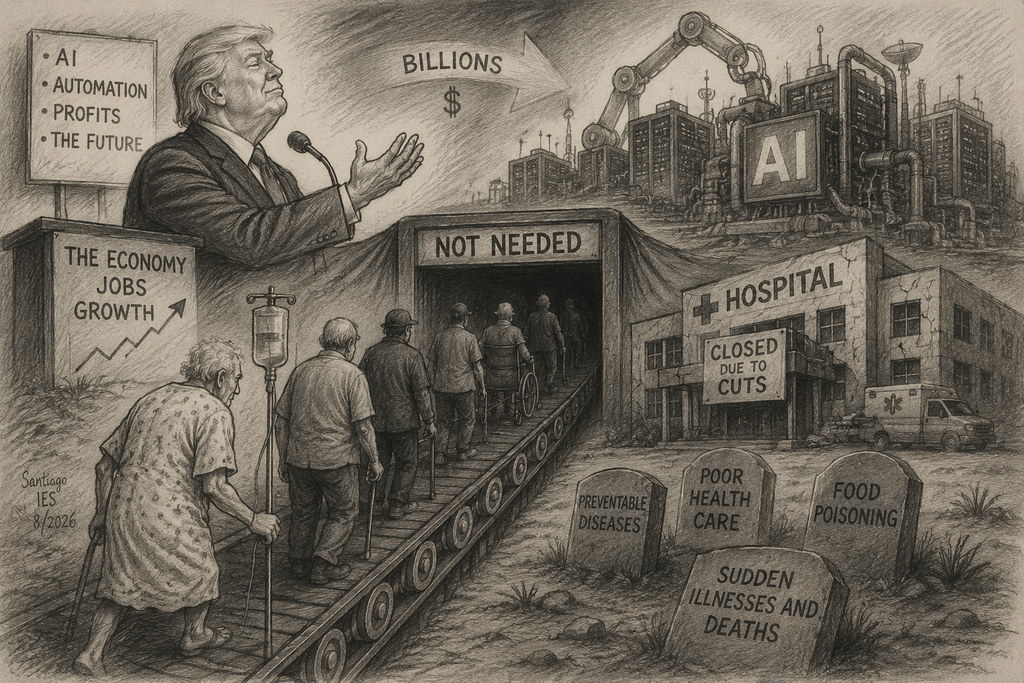
Are Trump and the Republicans trying to thin the herd to make room for AI?
That is a harsh question.
But before dismissing it as outrageous, look at what is happening.
America is dealing with a resurgence of diseases many people thought belonged to another era. As of August 6, the CDC had confirmed 2,465 measles cases in 2026 across 47 jurisdictions. (CDC)
Mumps continues to circulate.
Foodborne illness outbreaks have sickened thousands.
Baby goats at a traveling petting zoo in North Carolina recently tested positive for rabies, potentially exposing children, elderly people, and others who had handled them. (New York Post)
And New World screwworm — a flesh-eating parasite eradicated from the United States decades ago — is back. By the end of August, there were 47 confirmed cases in Texas and New Mexico. (Axios)
While Washington has spent enormous political energy warning Americans about human beings “invading” the southern border, another invader crossed it quietly.
A wall cannot stop a fly.
Then there is food safety.
We have seen recalls involving eggs, lettuce, jalapeños, beef and other everyday foods. Some outbreaks have resulted in thousands of illnesses and deaths.
At the same time, federal agencies responsible for inspecting food, tracking outbreaks and protecting public health have undergone staffing reductions and regulatory changes. Those facts do not prove that every outbreak was caused by Donald Trump.
They do raise an obvious question.
If you reduce inspection, enforcement and surveillance, what do you expect businesses to do?
Most companies will follow the law. But greed is a powerful lure. If corporate executives begin to believe there is less chance of being inspected, punished, or prosecuted, some will inevitably take greater risks.
You do not have to believe corporations suddenly became evil.
You only have to understand incentives.
When enforcement weakens, greed has more room to operate.
Then there are the hospitals.
Harris Health, the public hospital system serving Harris County, could lose at least $258 million next year because of changes affecting Medicaid supplemental payments. Hospitals across the Houston region could lose as much as $1.4 billion. (The Texas Tribune)
Four million low-income Texans depend on Medicaid, most of them children.
Hospital officials are not describing these losses as an accounting inconvenience. They warn that losing that much money will eventually affect services for everyone, including people with private insurance. (The Texas Tribune)
So think about the picture we are assembling.
Measles.
Mumps.
Foodborne disease.
Rabies exposure.
Screwworm.
Reduced public-health capacity.
Potentially hundreds of millions of dollars disappearing from a county hospital system.
And at the same time, enormous amounts of federal money are being spent identifying, detaining, and deporting immigrants.
We previously calculated that the expanded deportation machinery amounts to roughly $3,600 per taxpayer for each deportation when its enormous cost is spread across the taxpaying population.
That is a political choice.
Houston is simultaneously struggling with its own structural financial problems. Harris County faces enormous budget pressure. Hospitals are threatened with major funding losses. Transit, infrastructure, and basic public services all compete for limited resources.
Yet Washington can always find another billion dollars for immigration enforcement.
Which threat is actually more dangerous to the average Houstonian?
A Guatemalan roofer working on somebody’s house?
Or a hospital that cannot afford enough nurses?
A Mexican landscaper?
Or measles spreading through a school?
A dishwasher without papers?
Or contaminated lettuce reaching thousands of refrigerators?
An immigrant family crossing the Rio Grande?
Or screwworm crossing the Rio Grande?
Those are legitimate questions about priorities.
And Republicans themselves have occasionally made remarkably candid statements about how they weigh life against other objectives.
During the COVID pandemic, Texas Lt. Gov. Dan Patrick suggested that older Americans might have to accept greater risk in order to reopen the economy.
A month later, he said something even clearer:
“There are more important things than living.”
Patrick explained that saving the country for children and grandchildren was one of those things. (The Texas Tribune)
That does not prove that Dan Patrick wanted elderly Texans to die.
It does prove that a senior Republican leader publicly argued that some increased risk of death could be an acceptable price for achieving another political or economic objective.
That distinction matters.
And it brings us back to the title.
Are Trump and Republicans literally sitting in a room plotting to “thin the herd”?
I have seen no evidence of that.
But that is not the only question worth asking.
What happens when a government repeatedly weakens programs that prevent disease, reduces healthcare support, attacks vaccination, cuts inspection and regulatory capacity, and then spends extraordinary sums pursuing people who often pose little physical threat to anyone?
Intent is difficult to prove.
Consequences are easier to count.
Maybe A and B do not prove D.
But eventually you have A, B, C, E, F, G and H all sitting on the table.
At some point a pattern becomes worth examining.
We do not need to tell readers what conclusion they must reach.
We can simply show them what is happening.
Measles is back. Screwworm is back. Rabid animals are exposing children. Foodborne outbreaks are spreading. Hospitals are threatened with enormous losses. Public-health capacity has been weakened.
Meanwhile, much of the federal government’s attention and money is directed toward hunting down immigrants.
Perhaps Republicans are not trying to thin the herd.
Perhaps this is simply what happens when ideology, deregulation, budget cutting, and political theater become more important than maintaining the boring systems that keep millions of people healthy and alive.
Dan Patrick once told us there are more important things than living.
The question now is:
Important to whom?


