
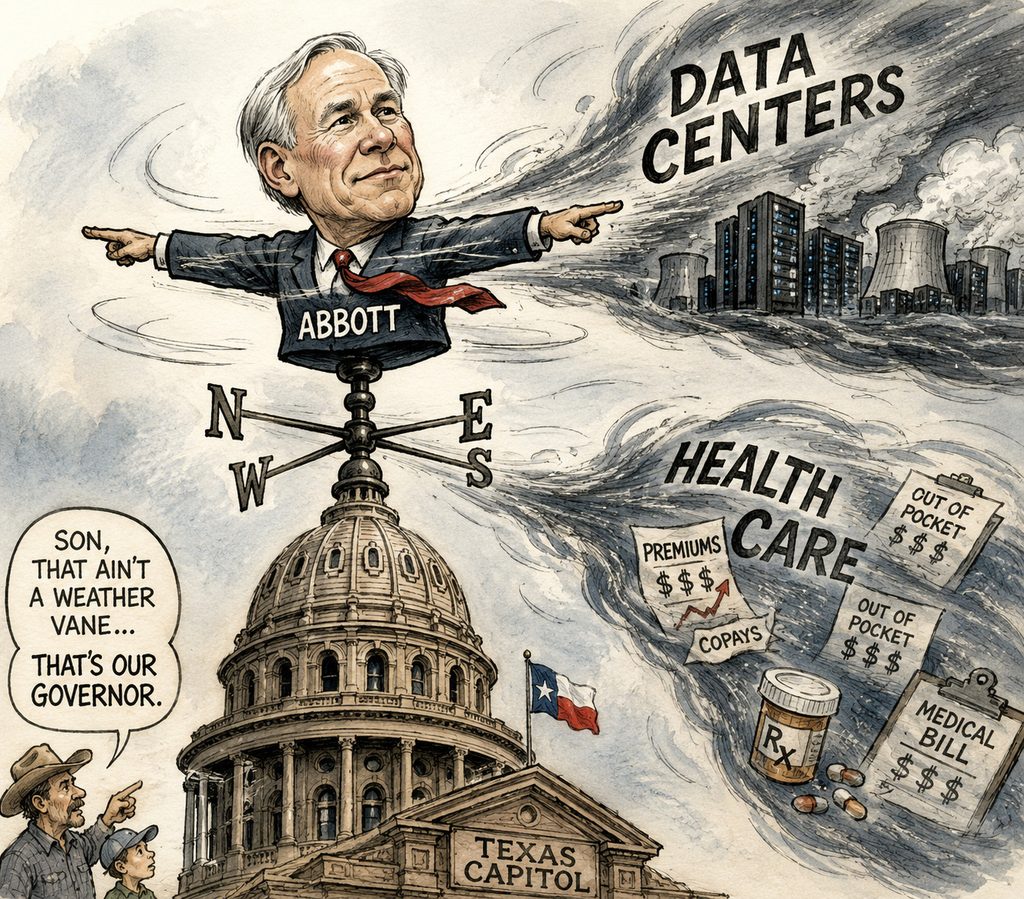
Texas spent years welcoming data centers with open arms. They brought promises of billions of dollars in investment, artificial intelligence, construction, and a new technology boom. Gov. Greg Abbott was one of the industry’s biggest cheerleaders, declaring Texas the “epicenter of AI development” and celebrating massive new projects.
Now Texas officials have discovered something rather basic: they do not even know how much water many of those data centers are using.
At a Texas Senate Water, Agriculture and Rural Affairs Committee hearing Tuesday, lawmakers again wrestled with the enormous water demands that could accompany the industry’s growth. County officials told senators that they often have little authority to force developers to disclose what they intend to build or how much water they will need. One representative of county governments described learning about projects only after the fact. (Texas Legislature Online)
This should not have come as a surprise. Earlier this summer, the Texas Water Development Board reported that only 17 percent of 341 data centers responded to its 2025 water-use survey. That survey was not merely a request for a favor. State law requires the information, although failure to respond carries only a Class C misdemeanor and a maximum $500 fine. (Houston Chronicle)
A separate Public Utility Commission survey did little better. It received information from 28 companies representing 92 data centers and cryptocurrency facilities. State officials are trying to prepare long-range plans for Texas water supplies while much of one of the fastest-growing water-consuming industries is essentially a blank space on the spreadsheet. (Kut)
Think about that for a moment. Texas is worried about future water shortages. Farmers and ranchers depend on that water. Cities are spending billions trying to secure future supplies. Yet hundreds of enormous computer facilities were allowed to spread across the state before Texas obtained reliable numbers showing how much water they were consuming.
Abbott now says enough is enough.
In June, he ordered regulators to develop new protections requiring data centers to pay their own infrastructure costs, use water-efficient cooling and provide accurate information about their water and electricity use. Then on August 3, Abbott ordered a comprehensive audit before pending data-center projects could move forward through ERCOT’s grid-connection process. The audit requires information about water sources, cooling technology, electricity consumption, public subsidies, and even who ultimately owns the projects. (Texas Governor’s Office)
Those are reasonable questions.
The more interesting question is: Why weren’t we asking them years ago?
There is another set of numbers worth looking at, and these numbers are much easier to find than the industry’s water consumption.
Campaign contributions.
During the current 2026 election cycle, campaign records compiled by Transparency USA show that real-estate billionaire Edward Roski Jr. has given Abbott $2 million. Roski’s Majestic Realty has business tied to the expanding data-center market. Energy Transfer executive Kelcy Warren has given about $1.5 million; his company has announced deals supplying natural gas to data-center projects. (Transparency USA)
Then there is Black Mountain, which is directly developing data-center projects in Texas. Black Mountain Power gave Abbott $500,000, and campaign records show another $500,000 from the company’s founder and CEO. Elon Musk, whose businesses sit squarely in the AI and enormous-computing world, gave another $500,000. (Transparency USA)
Add those contributions together, and you get just over $5 million from a small group of donors with interests connected to the data-center boom.
Does that prove Greg Abbott sold Texas water policy for $5 million? No. There is no evidence establishing a quid pro quo, and political contributions are legal.
But this isn’t a criminal trial.
Voters are allowed to look at the money, look at the timing, and make their own judgment. Five million dollars does not have to constitute a bribe before citizens are entitled to wonder whether people writing checks that large get more attention than ordinary Texans writing letters to the governor.
That brings us to a question Abbott himself should be willing to answer:
As long as the campaign coffers were being filled, did Abbott seem to care?
For years, Abbott enthusiastically promoted Texas as the place to build. In November 2025, he stood with Google executives celebrating a planned $40 billion Texas investment and again presented the state’s exploding AI industry as an economic triumph. By this summer, with rural Texans increasingly angry over data centers, Abbott was talking about protecting neighborhoods, conserving water, eliminating outdated incentives and making data centers “pay their own way.” (Houston Chronicle)
Perhaps Abbott simply learned more about the problem and changed his mind. Governors are allowed to do that, and his new restrictions could prove useful.
But the public is also allowed to notice that the concern arrived after the boom was well underway and after millions of dollars had flowed into Abbott’s political operation from people benefiting directly or indirectly from that boom.
Tuesday’s Senate hearing made the underlying failure harder to ignore. Texas has hundreds of data centers, potentially hundreds more coming, growing demands on its electric grid and serious long-term water problems. Yet government officials are still trying to answer one of the first questions that should have been asked:
How much water are these things actually using?
Abbott now wants the answer.
Texans might reasonably want to know why he didn’t demand it before. (The Texas Dispatch)