
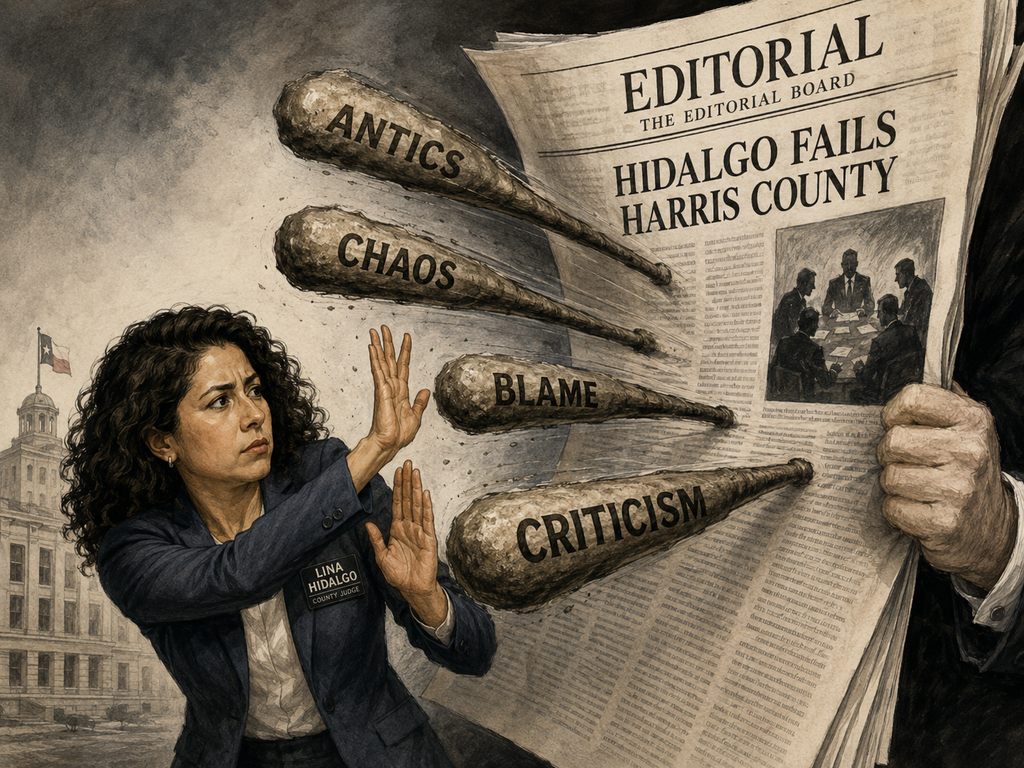
Times change, but newspapers don’t change with the times. It makes one wonder if they still think Latinos/Latinas are not as smart as white people.
There is something missing from the Houston Chronicle’s editorial this morning about Harris County’s proposed property-tax increase.
Her name is Lina Hidalgo.
The Chronicle editorial board warns that Harris County commissioners are considering the highest property-tax rate in roughly 20 years and says taxpayers deserve a serious explanation for why county spending has risen so sharply. The editorial points specifically to law-enforcement raises and employee health-care costs, saying those expenses account for roughly half of the $327 million increase in general-fund spending. (Houston Chronicle)
That sounds remarkably familiar.
More than a year ago, Hidalgo was telling anyone willing to listen that Harris County could not afford the huge permanent law-enforcement raises Commissioners Adrian Garcia, Lesley Briones and Tom Ramsey had approved without providing a permanent way to pay for them.
The Chronicle itself reported her warning. After commissioners approved the law-enforcement pay package in May 2025, the county’s projected budget deficit jumped from about $130 million to $270 million. The Chronicle reported that the raises were approved without a clear funding strategy. Hidalgo warned that the county eventually would have to cut services or raise taxes. (Houston Chronicle)
She could hardly have been clearer.
“Our hands are tied because my colleagues decided not to go to the voters on this $108 million increase for law enforcement that we couldn’t afford,” Hidalgo told the Chronicle. She warned that county leaders were putting Harris County “in the hole” and forcing cuts because they had approved the spending without asking taxpayers how they wanted to pay for it. (Houston Chronicle)
In September, she tried one more time. Hidalgo asked Commissioners Court to delay the roughly $101 million annual deputy-pay package until voters could be asked to approve the revenue needed to pay for it. She lost. Garcia, Briones and Ramsey had the votes. The Chronicle reported at the time that the law-enforcement raises accounted for roughly a third of the county’s projected deficit. (Houston Chronicle)
By later that month, the Chronicle reported that law-enforcement raises accounted for roughly $100 million of a projected $275 million deficit, even before additional raises for elected constables were included. Hidalgo again opposed increasing elected officials’ salaries while the county was already facing that enormous hole. (Houston Chronicle)
So Hidalgo did not discover this problem after the fact.
She warned them before they did it.
And while a young Latina county judge was warning that the arithmetic did not work, what was the Chronicle editorial board doing?
It was spending considerable energy telling readers about Lina Hidalgo.
In July 2025, the editorial board ran “Time to break your silence, Judge Hidalgo,” pressing her about whether she would seek reelection and pointing to her poor approval ratings. (Houston Chronicle)
Then came the August editorial on her effort to preserve early-childhood programs. The headline originally advertised the board’s attitude quite well: “Harris County kids deserve childcare. Not Lina Hidalgo’s antics.” The published headline called her behavior chaotic and said she had undermined her own cause. Inside, the board described an “ever-frantic Hidalgo,” accused her of trying to “steamroll” fellow commissioners and told her, condescendingly, “That’s how it’s done, Judge Hidalgo.” (Houston Chronicle)
A month later, after Hidalgo announced she would not seek another term, the Chronicle editorial board asked: “Lina Hidalgo was supposed to turn Texas blue. What happened?” The editorial concentrated on her political style, strained relationships, and inability to make parts of her progressive agenda last. (Houston Chronicle)
There was plenty of room to examine Hidalgo’s personality, her political mistakes, her arguments with fellow Democrats, and whether she knew how to play the political game.
Apparently there was not enough room to say:
She was right about the money.
Now we have arrived at September 2026.
Harris County is considering a tax rate of about 67 cents per $100 of taxable value, nearly an 8% increase and the highest rate in approximately two decades. The county faces a projected $180 million deficit. The Chronicle editorial board now wants commissioners to explain how Harris County got here. (Houston Chronicle)
And what does the Chronicle identify as one of the major reasons?
Law-enforcement pay.
It is worth being fair. The raises are not the entire problem. Health-insurance expenses have climbed. Federal pandemic money disappeared. State restrictions limit how quickly counties can increase property-tax revenue. Harris Health has its own serious financial pressures. Property values have softened. There are legitimate arguments over other county spending as well. (Houston Chronicle)
But nobody needs hindsight to identify the law-enforcement raises as a major part of the problem.
Lina Hidalgo identified it before the checks were written.
And there is an additional irony. Letitia Plummer, the Democrat now running to succeed Hidalgo, is criticizing those same law-enforcement raises. Plummer says sheriff and constable pay increases are contributing substantially to the deficit and could cost Harris County $292 million annually by 2030. (Houston Chronicle)
So now the candidate who wants Hidalgo’s job is saying it.
The Chronicle editorial board is saying it.
The county budget office’s numbers are saying it.
But Hidalgo said it first.
There is also an important distinction here. The Chronicle newsroom did its job. Its reporters repeatedly quoted Hidalgo’s warnings and documented the effect of the raises on the deficit. This criticism belongs primarily with the Chronicle editorial board, which is separate from the newsroom. The information was available to the editorial writers because their own newspaper had been reporting it all along. (Houston Chronicle)
That makes the omission harder to understand, not easier.
A young Latina woman stood in Commissioners Court and warned that her colleagues were approving a permanent expense Harris County could not afford without either cutting services or asking taxpayers for more money. Much of the political establishment treated her as difficult, emotional, or politically inept. The Chronicle editorial board devoted columns to her “antics,” her personality and whether she knew how to build coalitions.
A year later, taxpayers are looking at a substantial property-tax increase, and the Chronicle editorial board has discovered that permanent spending commitments—particularly law-enforcement raises—helped create the problem.
They did not have to discover it.
Lina Hidalgo already told them.
And if the Chronicle is now going to repeat her warning, the least it can do is give the Latina woman who made it first the credit she earned.


