
This is no longer some Medicaid accounting argument between bureaucrats in Austin and Washington. Houston-area hospitals could lose as much as $1.4 billion next year if the dispute is not resolved. Harris Health alone could lose at least $258 million. Across Texas, hospitals say the Trump administration’s decision to withhold approval of nearly $9.8 billion in supplemental Medicaid funding is costing them about $27 million every day. (The Texas Tribune)
That is enough money to eventually affect services, staffing and the health-care safety net—not only for Medicaid patients. Hospitals use the money to help cover the difference between what Medicaid pays and what it actually costs to treat patients. About four million low-income Texans receive Medicaid, most of them children. (The Texas Tribune)
And suddenly Gov. Greg Abbott is pleading for help from RFK Jr.
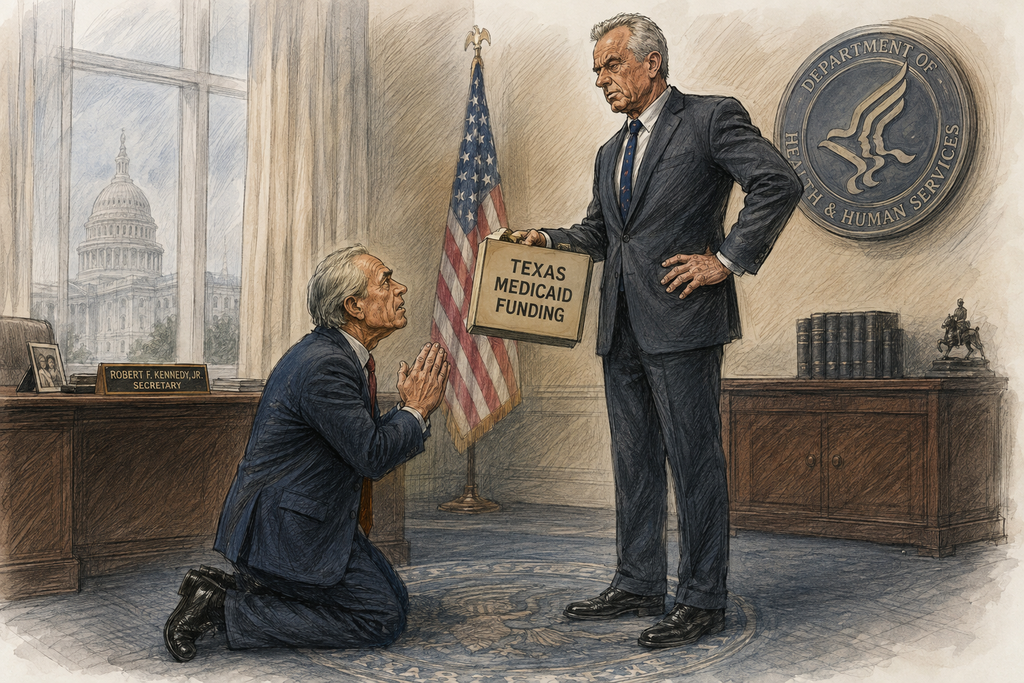
Abbott, one of Donald Trump’s closest political allies, is begging that the Trump administration release the money. He has become so afraid because of the coming election that, in an August letter to Health Secretary Robert F. Kennedy Jr., Abbott described Washington’s action as putting an economic “gun to the head” of Texas. Abbott’s office says Texas’ hospital-financing system complies with federal law and that Texas health-care providers should receive the money they are owed. (The Texas Tribune)
There is some irony here.
Under Abbott, Texas has repeatedly refused to expand Medicaid under the Affordable Care Act. Texas remains one of the small number of states that declined the expansion, walking away from billions of dollars in additional federal health-care money over the years. Yet Texas hospitals still depend heavily on federal Medicaid dollars to treat millions of poor and uninsured Texans. (The Texas Tribune)
Texas found another way to bring federal Medicaid money into the state. Hospitals pay roughly $4.2 billion annually through local taxing arrangements, and the federal government provides matching money that helps hospitals cover Medicaid costs. Now the Trump administration is questioning how those hospital taxes are calculated and whether the arrangement complies with federal rules. (The Texas Tribune)
Texas says nothing improper has changed. Washington says it wants answers before approving the nearly $10 billion. The two sides have been arguing since last December, and the money that was supposed to begin flowing with the new state fiscal year has not arrived. (The Texas Tribune)
So who should Texans blame?
Abbott helped create the political environment that made this possible. For years, Republicans—including Abbott—argued that Medicaid spending needed to be restrained and that Texas was right to reject expansion. Texas nevertheless developed a hospital system that depends upon enormous amounts of federal Medicaid money to stay financially healthy.
Then Trump came along with a Republican Congress determined to cut federal Medicaid spending and tighten the rules governing how states obtain that money. Last year’s Republican budget legislation included enormous Medicaid reductions nationally, while CMS has separately tightened scrutiny of the provider-tax arrangements states use to obtain federal matching dollars. (The Texas Tribune)
In other words, Abbott spent years supporting the political argument for less Washington Medicaid spending.
Trump is now applying that philosophy to Texas.
That does not necessarily mean Trump’s administration is right about the legality of the Texas hospital-tax system. Texas has challenged federal interpretations of these rules before and won important court fights. Abbott may be entirely justified in arguing that CMS cannot suddenly reinterpret federal requirements and hold billions of dollars hostage until Texas changes a system Washington previously accepted. (The Texas Tribune)
But politically, Abbott has a problem. He cannot spend years telling Texans that Washington spends too much money on Medicaid and then expect nobody to notice when a Republican president starts squeezing Medicaid dollars and Texas hospitals get caught in the vise.
Facebook readers certainly noticed.
When Abbott’s fight with Trump became public, one of the first reactions was simply: “Can you spell MIDTERMS ?? ” Another asked, “Can we say election year?” Others immediately called it “Election Season” and questioned whether Abbott’s sudden willingness to challenge Trump had something to do with November.
The Abbott-Trump relationship drew just as much skepticism. One reader asked, “Awwwww, does this mean the honeymoon is over?” Another wondered whether Abbott was really “standing up to President Trump,” while another asked whether the “bromance” was over.
Then came the comments that go directly to Abbott’s Medicaid record. One reader wrote: “He supported it and turned down the expansion. What did he actually think was going to happen?” Another put the contradiction more colorfully: “Bro wants Medicaid now. Yeah ok.”
Those comments do not prove Abbott’s motive. They do demonstrate that voters immediately recognized the political contradiction.
Abbott can fairly argue that refusing to expand Medicaid and defending money already owed to Texas hospitals are two different questions. Technically, they are. But elections are not decided by Medicaid accountants parsing federal regulations. They are decided by voters who tend to ask much simpler questions.
Houston could lose $1.4 billion.
Texas hospitals could lose nearly $10 billion.
Trump’s administration is withholding the money.
Abbott is demanding it back.
And both men are Republicans who spent years telling voters that federal Medicaid spending needed to be controlled.
Maybe the choice between them is a false one.
Abbott helped build the political trap. Trump sprung it.
Now Texas hospitals—and eventually Texas patients—may be the ones paying the price.


