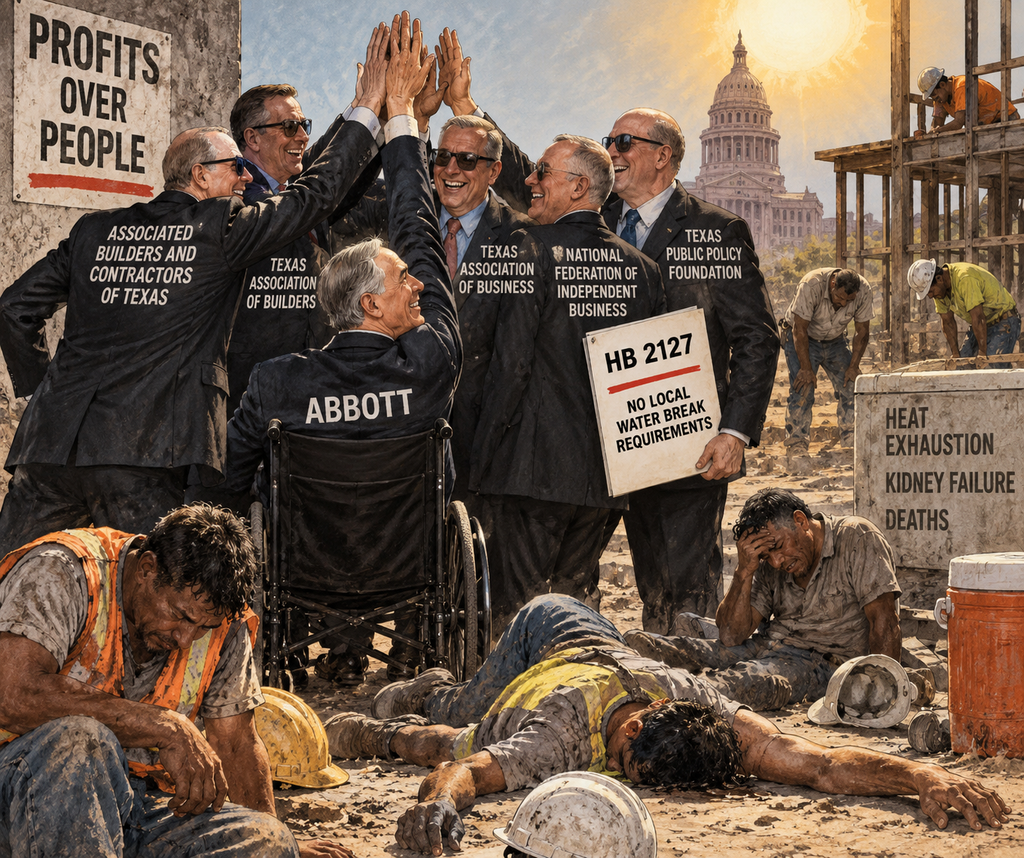
Texas took away local water-break protections. Now doctors are finding young laborers with kidney failure linked to the very conditions those breaks were meant to prevent.
A Texas Monthly story sent me down a rabbit hole. Doctors in Texas are seeing relatively young immigrant laborers with severe kidney disease even though many do not have diabetes, longstanding high blood pressure, or the other conditions normally associated with kidney failure.
The disease is often called CKDu — chronic kidney disease of unknown origin. Similar outbreaks have been studied among agricultural workers in Central America, especially men doing strenuous physical labor for hours in extreme heat. Researchers increasingly suspect that repeated heat stress, dehydration, and acute kidney injury play an important role, although pesticides and other environmental exposures are still being investigated.
Abbott Took Away Mandatory Water Breaks
In June 2023, Gov. Greg Abbott signed House Bill 2127, the so-called “Death Star” law. Among many restrictions on local governments, it specifically prevented Texas cities and counties from requiring workplace breaks beyond state law.
Austin and Dallas had ordinances requiring construction workers to receive at least a 10-minute break every four hours so they could get out of the sun and drink water. Abbott’s law wiped those requirements out and prevented other Texas cities from adopting similar protections. (The Texas Tribune)
This was not done because Texas had solved its heat problem. Federal data showed that at least 42 Texas workers died from environmental heat exposure between 2011 and 2021, more than in any other state. Worker advocates have long argued that even that number understates the problem because heat can contribute to kidney failure, heart attacks, and other deaths without being recorded as the primary cause. (The Texas Tribune)
The Business Groups Behind the Law
HB 2127 did not arrive at Abbott’s desk without organized support. According to the Texas House Research Organization’s official witness list, representatives supporting the bill included the Associated Builders and Contractors of Texas, Texas Association of Builders, Texas Association of Business, National Federation of Independent Business, Texas Apartment Association, Texas Restaurant Association, San Antonio Hispanic Chamber of Commerce, Airlines for America and the Texas Public Policy Foundation. (House Research Organization)
Others registered in support without testifying, including the Greater Houston Builders Association, AGC-Texas Building Branch, Americans for Prosperity, Texas Association of Manufacturers, Texas Oil & Gas Association, Texas REALTORS, Texas Retailers Association, Texas Hotel and Lodging Association, Texas Farm Bureau, Texas Chemical Council, Texas Construction Association, Texas Food and Fuel Association and the U.S. Hispanic Contractors Association. (House Research Organization)
Their argument was largely economic: businesses should not have to deal with different labor rules in different Texas cities. The president of the Associated Builders and Contractors of Texas later defended the law, saying local ordinances imposed one-size-fits-all solutions on businesses. (The Texas Tribune)
The human body, however, does not care whether a water break creates regulatory inconvenience.
Texas Workers Were Already Showing Kidney Damage
Researchers studying Texas construction workers found something disturbing. Seventy-five percent reported at least one symptom of heat-related illness during the two days they were observed, and every worker studied had at least one urine measurement indicating severe dehydration.
Even more concerning, 44% had blood detected in their urine, while 12% showed signs suggesting possible rhabdomyolysis, a dangerous breakdown of muscle tissue that can damage the kidneys. Researcher Bethany Alcauter said she had not expected to find problems that severe among so many workers. (UTHealth Houston School of Public Health)
These were not workers in some distant tropical country. They were Texas construction workers doing ordinary jobs in Texas heat.
The question researchers are now asking is whether repeated episodes of heat stress and dehydration, day after day and summer after summer, can eventually produce permanent kidney damage.
We Already Know Water, Shade and Rest Can Help
One of the strongest pieces of evidence comes from sugarcane workers in Nicaragua, where this mysterious kidney disease has devastated working-age men. Researchers followed more than a thousand workers as employers progressively increased access to rest, shade and hydration.
Among the burned-cane cutters doing the hardest physical labor, the percentage developing kidney injury during a harvest fell from 21% to 1% over four harvest seasons. Rates of acute kidney injury also dropped substantially. (PubMed Central (PMC))
That study does not prove that a particular Texas worker developed kidney disease because Abbott signed HB 2127. CKDu is still being studied, and researchers believe more than one factor may be involved.
But it does demonstrate something directly relevant to Texas: giving overheated workers water, shade, and rest can sharply reduce kidney injury.
Texas moved in the opposite direction.
Workers Warned Us
When Houston workers protested HB 2127 in 2023, they called it “the law that kills.” Workers described people vomiting, collapsing, and struggling through extreme heat while depending on employers to decide whether they could stop. (The Texas Tribune)
At the time, that may have sounded like political rhetoric. Three years later, doctors and researchers are studying kidney damage among the same kinds of laborers — roofers, construction workers, agricultural workers and others performing heavy physical work in extreme Texas temperatures.
Texas still has no statewide requirement guaranteeing those workers periodic heat-rest breaks to replace the local protections Abbott and the Legislature took away.
So Is Abbott’s Law Killing People?
We cannot scientifically point to a particular death and say, “HB 2127 killed this person.” The evidence does not allow that conclusion.
But Texas knew workers were dying from heat. Texas knew heat and dehydration could injure kidneys. Business organizations urged lawmakers to eliminate local rules requiring breaks anyway; the Legislature did it, and Abbott signed it into law.
Now researchers are finding severe dehydration and signs of kidney injury among Texas laborers, while research elsewhere shows that something as simple as water, shade and rest can prevent much of that damage.
The builders, business associations and lobbying groups called the local rules a burden.
For a man working on a roof in August, that “burden” may have been ten minutes, a bottle of water — and his kidneys.