
The title is from a quote by a White Tenant farmer.
They called Mexican children dirty, kept them in separate schools, spent their state school money on white children, gave them poorer teachers and buildings, held them back in the lower grades, and then used their lack of education as proof that segregation was justified.
They Took the Mexican Children’s Money Too
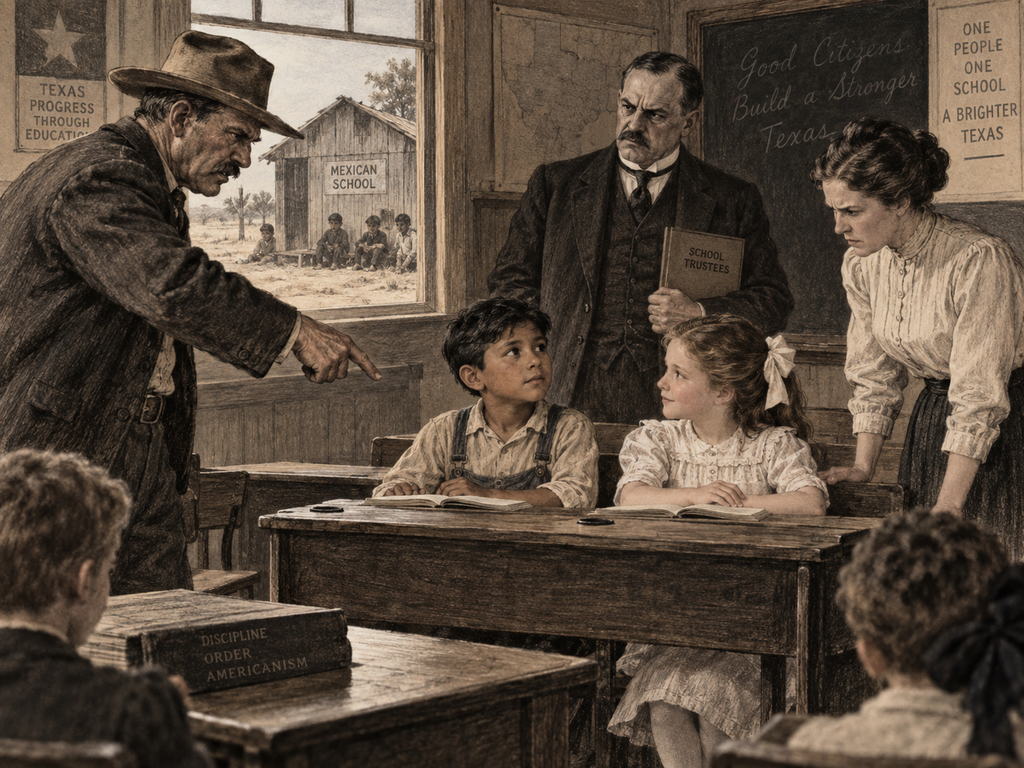
White Texans did not hide why they wanted Mexican children kept out of white schools.
John Stone told researcher Paul Taylor that Mexican children were “low morally” and that many “aren’t clean.” He said Mexican children could theoretically attend white schools because “they’re Caucasians,” but added that white children would make life hard for them.
Another Anglo tenant farmer was less careful with his words. Asked why the local school refused to admit Mexicans, he answered:
“Because a damned greaser is not fit to sit side of a white girl.”
He said a white man would rather see his daughter dead than have her marry a Mexican. Segregation, he explained, taught white children “the difference” so they would not “mix with the Mexicans.”
But separation was not only about race. It was profitable.
A Nueces County school superintendent admitted that Mexican children brought the district about $6,000 in state aid, while only about $2,000 was spent on them. He added that the district collected about $18,000 in property taxes and “that all goes to the white school.”
A Winter Garden farmer described the same practice. The school board, he said, used the state money received for “Mexican scholastics” on the white school. Without being forced to provide schooling for Mexican children, he said, officials probably would not have provided it at all. Their attitude was simply: “Oh well, they’re Mexicans.”
This was not an isolated South Texas school district. By the 1940s, more than 122 Texas school districts in 59 counties operated segregated schools for Mexican American children. Those schools generally had older buildings, inadequate equipment, less recreational space, lower spending per pupil, and less experienced teachers. (Texas State Historical Association)
The results were predictable. In 1950, Texans with Spanish surnames over age twenty-five had a median education of only 3.5 years, compared with 10.3 years for other white Texans. About 27 percent had received no schooling at all. (Texas State Historical Association)
Even after a federal court ruled in 1948 that Texas districts could not segregate Mexican American children simply because of their ancestry, some districts continued doing it. Marfa’s Blackwell School remained the separate school for Mexican American children until 1965. (National Park Service)
They called Mexican children dirty, kept them separate, took much of the state money allocated because those children existed, spent it on white schools, and then pointed to the Mexican children’s poor education as evidence that they were inferior.
They created the inequality and then blamed the children for it.