
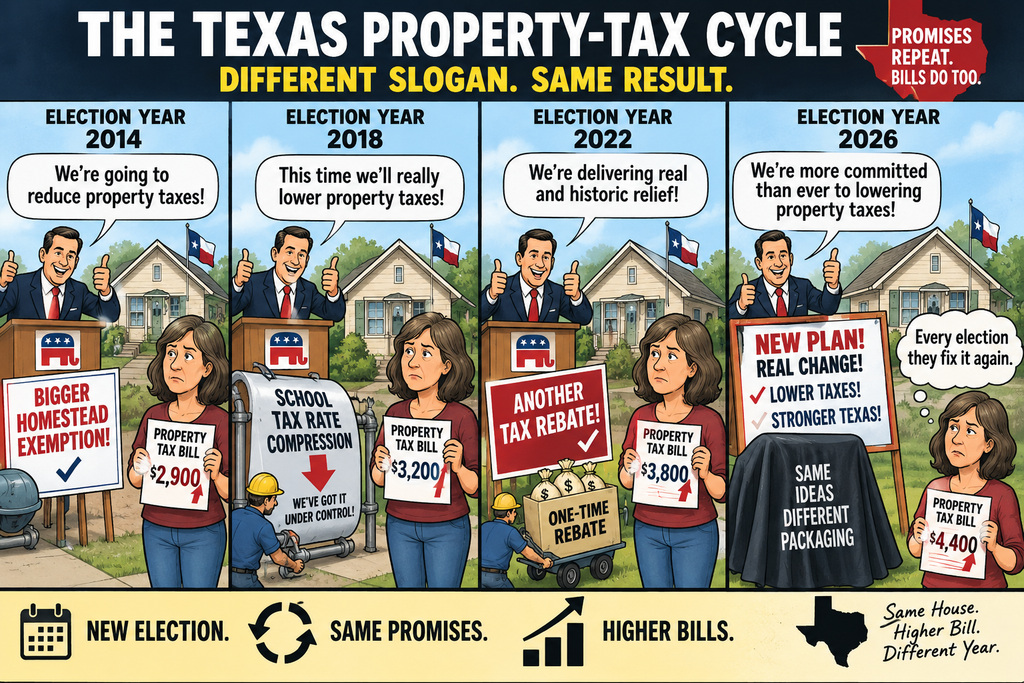
Texas politicians have spent years promising property-tax relief. They raise homestead exemptions, compress school tax rates, send money to school districts, and then return the next session promising to do it again.
But they rarely challenge the basic system that creates the problem.
A homeowner buys a house for $150,000. Twenty years later, because the neighborhood has become desirable, the appraisal district says it is worth $400,000. The owner did not receive $250,000. There was no check in the mailbox, no additional salary, and no capital gain deposited in a bank account. The homeowner simply continued living in the same house.
Yet Texas taxes that unrealized increase year after year.
We normally do not treat appreciation that way. If you buy stock for $10,000 and it grows to $30,000, the federal government generally does not send you an annual capital-gains bill on the $20,000 you have not realized. The gain normally becomes taxable when you sell.
Texas could apply a similar principle to the family home.
The state already accepted that principle more than half a century ago for farmers and ranchers. In 1966, Texas voters amended the Constitution so qualifying agricultural land could be taxed according to its agricultural productivity instead of the higher price that developers might pay for it. The reason was simple: rising land values should not force someone who was still farming the land to sell merely to pay the tax bill.
Why should the principle be different for a homeowner?
A retired couple who bought a modest house decades ago may suddenly find themselves living on property worth several times what they paid. Their income did not necessarily increase with the appraisal. Their house may not have changed at all. What changed was the market around them.
Florida already goes much further than Texas in recognizing that problem. Under Florida’s Save Our Homes system, once a homestead establishes its base assessment, its assessed value generally cannot rise by more than 3% a year or inflation, whichever is lower, regardless of how quickly its market value rises. Florida even provides limited portability so homeowners can carry some of that accumulated protection to another Florida homestead. (Florida Department of Revenue)
Texas allows a homestead appraisal to rise as much as 10% every year. At the maximum, a $200,000 taxable appraisal can become roughly $322,000 in only five years, even if the homeowner has not sold anything or received a dime from that appreciation. (Texas Comptroller)
A more fundamental Texas reform would be to establish an acquisition-value system for owner-occupied homesteads. Start with what the homeowner paid for the property. Allow a modest inflation adjustment, perhaps no more than 2% or 3% annually, and add the value of substantial new improvements. When the property is sold, establish a new base value for the new owner.
That would not eliminate property taxes. It would change what Texas taxes.
Instead of taxing a homeowner every year on a theoretical price someone else might someday pay for the property, Texas would tax the value associated with the homeowner’s actual ownership until the gain is realized through a sale.
There are legitimate objections. Two neighbors with identical houses could pay substantially different taxes because one bought thirty years ago and the other bought yesterday. Local governments and school districts would have slower growth in their tax bases, so lawmakers would have to decide how to finance services without simply shifting the burden elsewhere.
But those are questions of design, not reasons to ignore the underlying problem.
Texas already decided that a farmer should not lose his land merely because suburban development made the acreage underneath him valuable. Florida decided that homeowners deserve strong protection from rapidly rising assessments.
If Texas leaders are serious about property-tax relief, they could stop treating a homeowner’s unrealized paper gain as though it were money in the bank.
That would be property-tax reform, not another temporary rebate.