This is straight from a 1949 article on how Santiago Peak got its name. There are several stories of how it got its name. Many of Texas rivers, among various things including cities, were named long before Stephen F. Austin came here.
Marathon’s Towering Santiago
Peak That’s Not a Peak
By DOROTHY GAGE FORKER
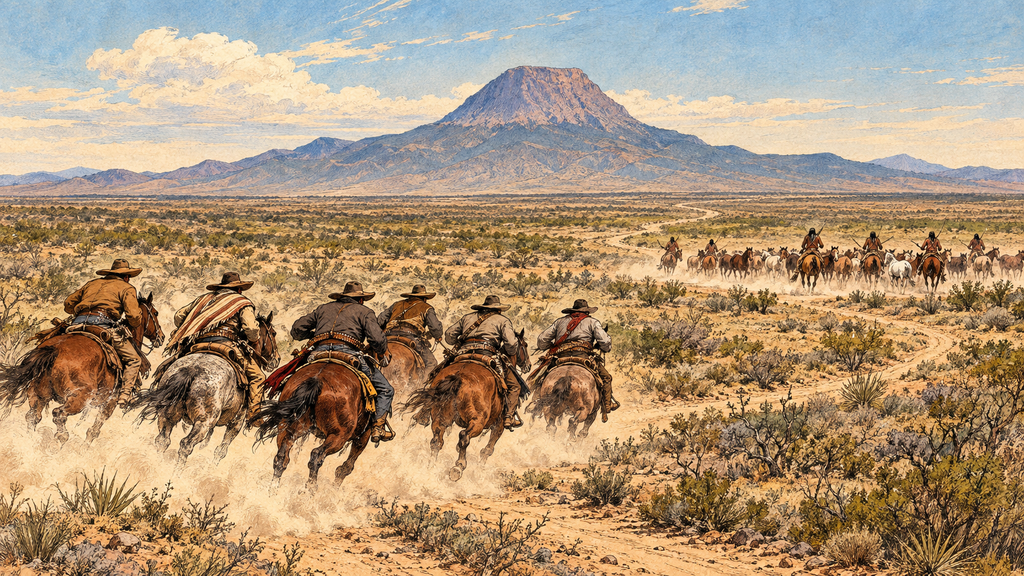
Tossing its head above the lesser, broken hills south of Marathon, dwarfing the whole tremendous view, towers Santiago, the peak that is not a peak. Although the wooded sides start steeply toward the sky, the mountain’s top is mashed down as if by a giant [flatiron?].
Such an imposing landmark which serves as a guide post for travelers anywhere within the 2000 square miles around it, must surely inspire the Mexican mind to fable. Its liquid name is less provocative than la Sierra de la Santa Cruz with its imprisoned devil; the Bewitched mountains, Pancho Villa’s hiding place; or el Monte del Noche Bueno (Christmas mountain).
Still it has its story, told in as many versions as there are survivors of the ancient day when San Carlos, a sleepy Chihuahua village near the Rio Grande, was the meeting place of all the Indian tribes. For the Texas mountain, although many miles north of the Mexican border, received its name from a fight between men of San Carlos and Comanche Indians.
Ex-Sheriff Townsend of Alpine heard the tale from Ygnacio Garc[ía?], a peon who fled from San Carlos at the beginning of the Madero revolution. Judge Williams of Fort Stockton had it from Natividad, his red-headed Mexican guide. Natividad, with customary modesty, claimed Santiago Peak was named for his uncle.
SANCTUARY FOR HOSTILE INDIANS
The Presidio of San Carlos was built as an outpost against the hostile Indians of northern Mexico, but in time it became their sanctuary instead. When a tribe was in danger from its enemies it would make a treaty with the Presidio. The Indians would pledge themselves not to make war on San Carlos in return for the privilege of living within its walls.
The pact did not include the Indians’ dealings with neighboring towns, so that war parties often sallied forth from San Carlos’ protection to raid and plunder the nearby villages of Santa Rosalia. Santa Rosalia criticized severely the isolationist attitude of San Carlos, but the latter continued to be a peaceful refuge for Indians of all tribes.
At one time there were living side by side in brief armistice bands of Kiowas, Comanches, Mescaleros Apaches, Gilenos Apaches, Pananas and Cionabas.
Tave Pete, powerful Comanche chieftainess, called out her commands from the bell tower. Her sons, Mauwe and Tave-Tuk, called “Bajo el Sol,” contended in the plaza to see who could shoot the strongest arrow.
The Mescalero Apaches would remain quietly in San Carlos for a while, then one day would disappear into the mountains for their mescal fiesta. Their wise men and warriors would eat of the thornless cactus, mescal or peyote, dream dreams and talk with spirits under the spell of the intoxicating plant. The feast finished, they would return to the safety of the Presidio.
Kiowas might go on forays, no one knew where, to come back with fine saddle horses for sale, and perhaps even a pair of silk curtains from the council hall at Santa Rosalia.
COMANCHES TRACKED THROUGH BIG BEND
There was comparative peace in San Carlos until a band of Comanches led by the great Tejano himself stole down the Comanche Trail one moonlight night and rode swiftly away with all the saddle horses of San Carlos.
A small group of the boldest inhabitants of the colony set out immediately on the trail toward the north, the direction from which all enemies came. Atanacio and Pascascio Galindo, Manuel Villa, Guillermo Valenzuela, Serbulo Granada and Natividad’s uncle, Santiago, were the fearless men who undertook to recover the remuda.
First they must swim the Rio Grande river, which was known then as the “Fierce River of the North.” The Rio Bravo behind them, they tracked the Comanches rapidly through the wild Big Bend country until they overtook them in a small canyon near Santiago Peak, 75 miles from San Carlos.
In the first clash, Serbulo swung an Indian boy, obviously a little fellow, up behind him on his pony. Soon after that, Tejano, the Comanche chief, had an opportunity to kill Serbulo, but he feared that the shot would also kill the young Indian. Instead, Tejano shot Serbulo’s horse under him, allowing the small captive to escape. Tejano fought well, wounding four of the Mexicans. Three of the Indian band had been killed. Tejano and Manuel found themselves on opposite sides of a large rock, their rifles aimed point-blank above it. Each snapped his trigger. Both guns were empty.
GREAT PILES OF STONES JUST GRAVE
Natividad of the red hair and vivid imagination reported his uncle’s part in the battle. Santiago was shooting at a charging Comanche.
“But all at once he fell from his horse, shot through the hips and at the mercy of the Indian,” Natividad said. “As the Indian rode up to give his death-wound, he called out in Spanish, ‘Santiago’ (for he must have known my uncle), ‘why do you cry, when you have killed three of our side, while you have lost only one of your own?’ With that he killed my uncle, and then rode away with the other Indians, and they never saw them again. And I feel it to explain to you, that the Indian did not put the matter fairly about my uncle. For he did not cry only because one of his side was killed, but rather because he had to be that one.
“So they buried him there, and put up over him a great pile of stones and called the peak by his name. And whenever I go by that pile of stones, I pick up one and add to it, saying as I do so, ‘Do you still weep, tio mio (uncle mine), for that one of your side who was lost in the fight?’ ”