I am tired of seeing the Republicans with transgender attack ads. How many transgender people do you know? I have worked in a job where I met thousands of people in my life; I may have met three transgender people. Transgender is a non-issue. Decades ago in Houston, women were allowed to use the men’s bathroom at the arena where the Rockets played. Women did go into men’s bathrooms, and men’s bathrooms have urinals.
Why are Republicans not talking about why it takes almost $100 to fill up my vehicle?
For years, our family has enjoyed Friday lunch at Whataburger; not too many years ago, the number one Whatameal was less than $5; now it is almost $9.
Facts:
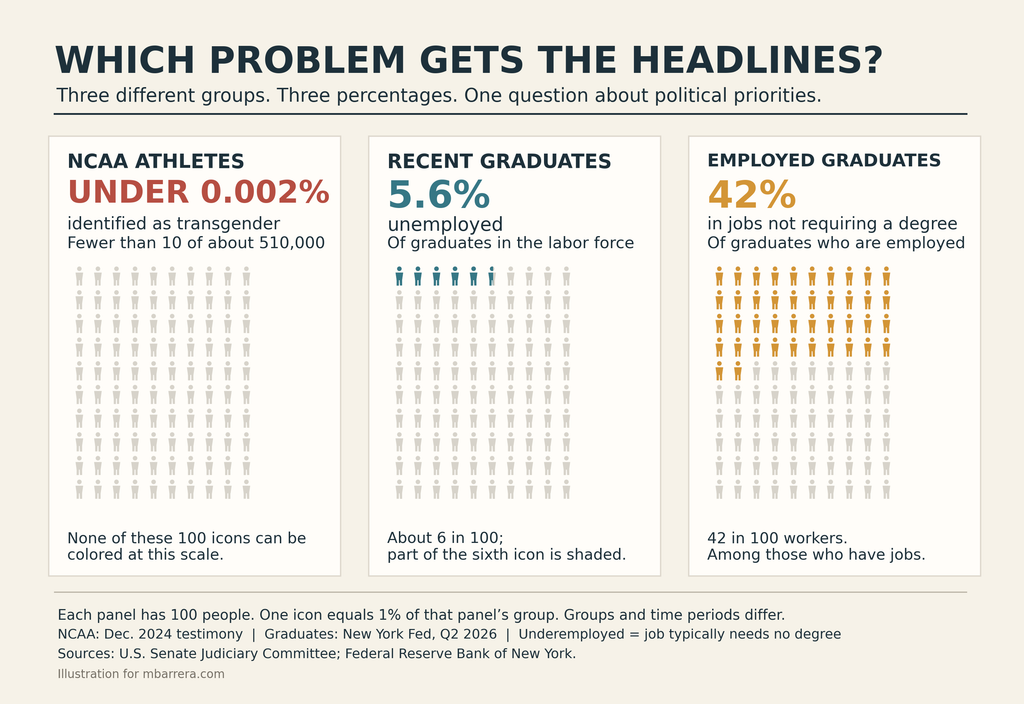
Less than one percent of Americans identify as transgender. When the NCAA president testified in December 2024, he knew of fewer than ten transgender athletes among roughly 510,000 college competitors—less than two thousandths of one percent. That figure covers NCAA sports at that time, not every competition in the country.
Now consider another figure: 42%. That is the share of working recent college graduates who, in the second quarter of 2026, held jobs that typically do not require a college degree. Another 5.6% of recent graduates were unemployed. Young people spent years earning degrees and now face a job market that often cannot put their education to use.
Yet Republicans keep making transgender participation in sports a national political fight. President Trump issued an executive order, and Congress debated legislation on the subject. Supporters raise questions about fairness in women’s sports, and those questions can be discussed. But why does this issue command so much attention while graduates struggle to find work that uses their degrees?
Families are also facing health care bills, housing costs, grocery prices, and interest rates. These problems reach into millions of homes. I think Republicans would rather keep voters arguing about transgender athletes than explain what they will do about those costs and the job market. That is my judgment; their choice of priorities is there for everyone to see.
Less than one percent makes the headlines. Forty-two percent of working recent college graduates are in jobs that typically do not require their degrees. Which problem would you rather hear Congress address?