The Mystery of the Photograph
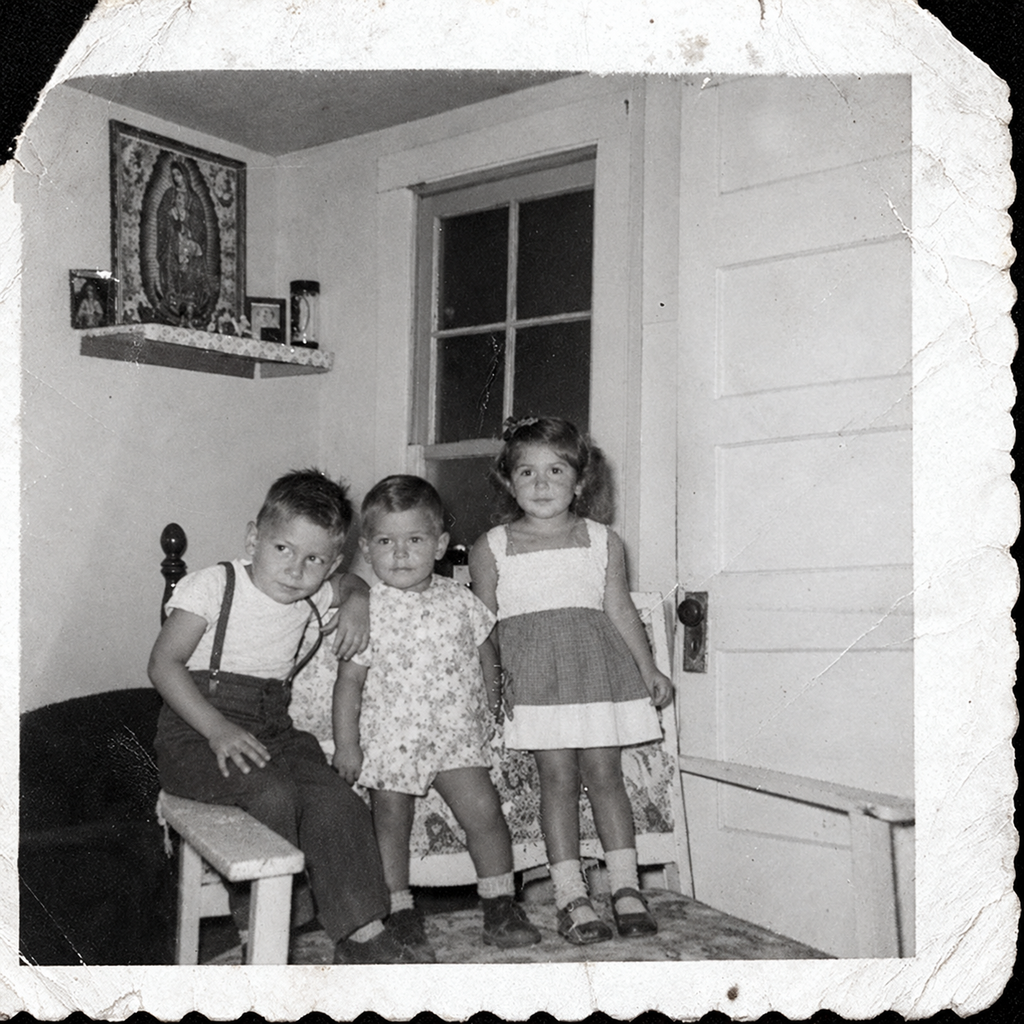
It is a photo of myself, my sister, and my brother, probably around 1954. We are standing at the corner of our house on Barrera Street, in the Molina neighborhood.
Who took the photo?
I never knew my parents had cameras or took photographs of us, but yet there we are. There are numerous such photos of all of us; there were eight of us. Who was taking the photographs?
We will probably never solve that mystery, but I know that our mother was preserving a moment of history. Because she did what she did, I can go back and see what I looked like then. There are far fewer photos of our parents during those times.
Our mother is probably the smartest person I have ever met, and I have met many people in my lifetime.
A Different Kind of Neighborhood
The more I think about it, the answer may lie in the way people lived in the 1950s and early 1960s.
People came to your house.
Today, if we want something, we get in the car, drive to a store, order it on the internet, or have it delivered. Back then, many businesses brought the product or service directly to the neighborhood.
I remember the saw sharpeners coming by. They would sharpen knives, scissors, saws, and tools. There were peddlers and salesmen of every kind. Some sold household goods. Others repaired things. Some sold books.
And some sold photographs.
Door-to-door photography was a real business. Olan Mills, which eventually became one of the largest portrait photography companies in America, began by soliciting customers door to door. The company’s founders originally took their photography business directly to families rather than waiting for families to visit a studio. Encyclopedia of Alabama
That makes me look at these old photographs differently.
Maybe a photographer came down Barrera Street carrying a camera and looking for customers. Maybe he knocked on our door and asked my mother if she wanted photographs of her children. Maybe he posed us right there in the house, took several pictures, and returned later with the finished prints.
I don’t remember him.
But why would I? I was a small child.
The Encyclopedia Salesman
There is another memory that makes this explanation seem even more possible.
My parents bought a World Book Encyclopedia and Childcraft at today’s price, which would be about $3,200, and I remember that it was purchased from a salesman who came to the house.
That was no small purchase.
Encyclopedias were expensive in those years, and they were commonly sold by commissioned salespeople who visited families in their homes. Door-to-door encyclopedia selling became an enormous business in the postwar period. World Book eventually maintained tens of thousands of sales representatives, and other encyclopedia companies relied heavily on home sales as well. Wikipedia
For a working family with eight children, buying a set of encyclopedias represented a considerable commitment of money.
My parents bought them anyway.
That tells me something about them, particularly my mother. She may not have had much formal education or much money to spend, but she understood the value of knowledge. Those books were not furniture sitting on a shelf. They were an investment in eight children.
I can still remember opening those books.
Long before Google, before the internet, and before a computer could answer almost any question in seconds, that encyclopedia was our doorway into a much larger world.
The Photographs Were Another Investment
Perhaps the photographs were much the same thing.
A photographer comes to the door. He offers to photograph the children. Money is tight. There are always groceries to buy, clothes, shoes, school supplies, and bills.
It would have been very easy to say no.
Our mother apparently did not.
Again and again, somebody photographed us.
That is the part that now interests me. We have many photographs of the children, yet comparatively few photographs of our parents during those same years.
Maybe that tells us who was making the decision.
My mother may have been standing just outside the picture.
She could have been arranging our clothes, telling us where to stand, fixing somebody’s hair, telling one child to quit moving and another to look at the camera. Then the photographer pressed the shutter.
She preserved us while leaving herself out of the photograph.
Ordinary Photographs Become History
At the time, nobody would have considered that little picture historically important.
It was simply three children standing inside a small house in Molina.
But seventy years later, I see much more.
I see the walls of our house. I see the door and window. I see the furniture. I see the clothing children wore. I see the image of Our Lady of Guadalupe on the wall. I see what our family could afford and what mattered enough to be displayed in the home.
Most importantly, I see us.
The photograph has become evidence of a world that has almost disappeared.
That may be one of the strange things about family history. The people creating the record seldom know they are creating history.
A mother buys a photograph because she wants a picture of her children.
A father buys an encyclopedia because he wants his children to learn.
A salesman knocks on a door because he wants to earn a commission.
Nobody is thinking about a man more than seventy years later sitting at a computer studying the photograph and wondering, Who took that picture?
The Mystery May Remain
I doubt I will ever learn the photographer’s name.
He may have been an independent photographer working the neighborhoods of Corpus Christi. He could have worked for a company. He may have photographed hundreds of Molina families whose descendants now have the same unexplained photographs sitting in boxes and albums.
Perhaps somebody reading this will recognize the style and solve the mystery.
But there is another part of the mystery that has already been solved.
I know why the photograph survived.
My mother kept it.
She kept that one and many others. Eight children grew up, left the house, and built lives of their own. Houses changed. Molina changed. Corpus Christi changed. The world changed.
But those little pieces of paper remained.
She could not have known that more than seventy years later one of those children would look at the photograph and use it to reconstruct the world in which we grew up.
Maybe she simply wanted photographs of her children.
Or perhaps, knowing my mother, she understood more than we realized.
Either way, Otalia García Barrera preserved our history before any of us understood that it was history.
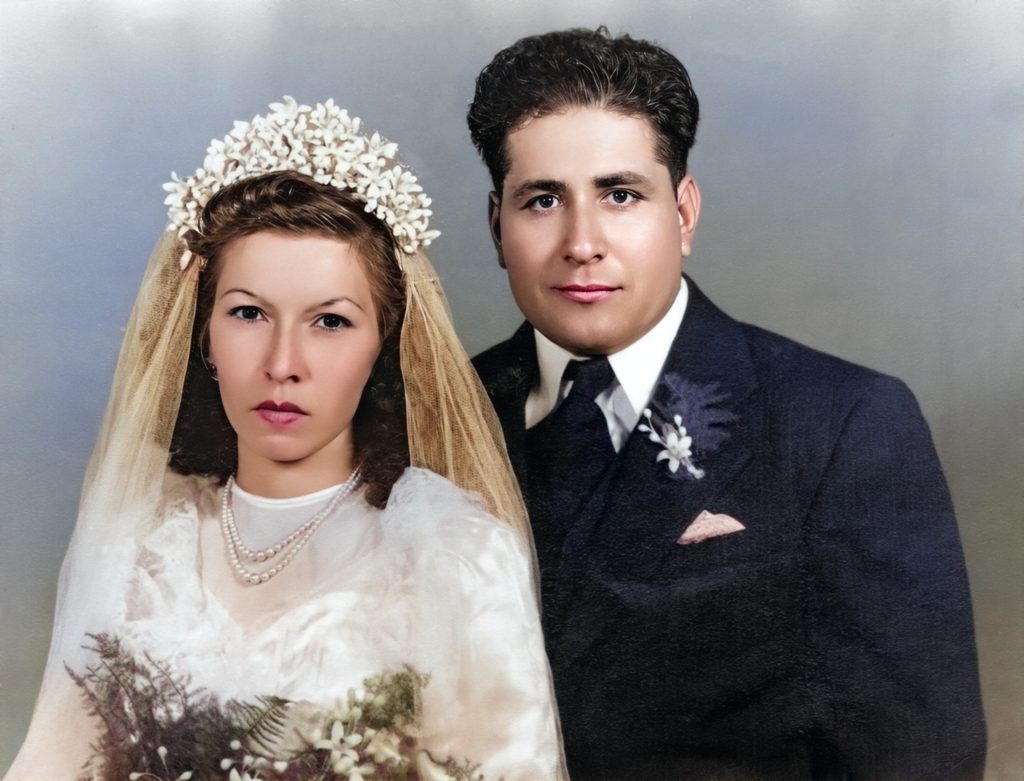
MY parents, Otalia and Manuel