
How Many Workers Must Die Before We Act?
How many people must die? How many decades must pass before a known danger produces protection that actually reaches the people doing the work? Those questions came to mind when I read about California’s proposal to prohibit work on high-silica engineered-stone countertops.
They also brought me back to my father’s working life and something I witnessed at my own home.
My Father Worked With Asbestos
My father worked at the Naval Air Station in Corpus Christi for more than forty years. For most of those years, he was a pipe-cover insulator. Asbestos was among the materials used in that work.
Much later, the public came to understand the damage asbestos could do to the lungs. But how much later did the danger become known to the people studying it? A federal occupational-health report published in 1972 cited research documenting asbestos-related lung disease in 1930. It also described elevated cancer mortality among insulation installers and pipe coverers. The warning signs existed long before many families understood their significance. stacks.cdc.gov
What concerns me is the distance between knowledge of a danger and protection of the worker who faces it. For families like mine, that is a question about the men who went to work every day trusting that their jobs would provide a living.
Cigarettes provide another lesson. The Surgeon General’s 1964 report drew on more than 7,000 existing articles about smoking and disease. A federal court later found that major tobacco companies had known about the dangers and addiction and deceived the public for decades. Evidence existed while people continued to be sold reassurance. www.cdc.gov
Then I Watched the Workers at My House
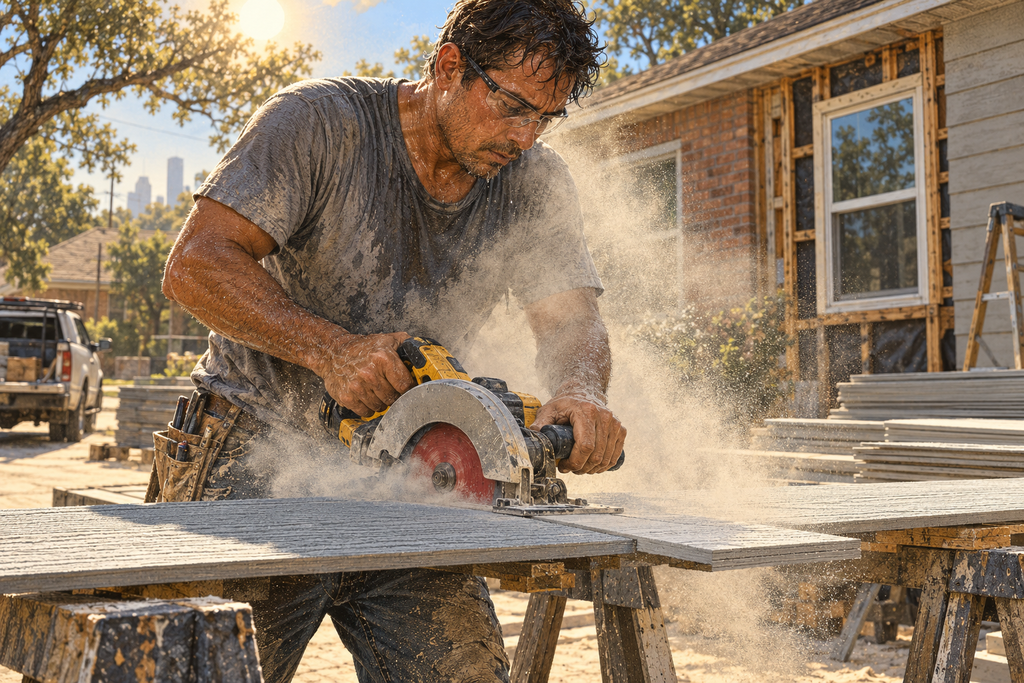
When I had the wood on my house replaced, everyone seemed to recommend Hardie board. Then I watched the workers saw it. The cutting produced clouds of dust, and the men were not wearing masks.
I looked it up. Fiber-cement products contain crystalline silica, and cutting them can release particles small enough to enter deep into the lungs. NIOSH identifies silicosis, a potentially fatal lung disease, among the consequences of breathing that dust. Its research has documented uncontrolled exposure during fiber-cement cutting above recommended limits. www.cdc.gov
I bought the workers a DeWalt saw intended for cutting Hardie board that produced less dust. A homeowner’s purchase should not have to substitute for an employer’s responsibility to provide suitable equipment, training, and protection.
The Danger Is Already Known
James Hardie publishes silica-safety guidance. California’s construction rules specify controls for cutting fiber-cement board, including outdoor cutting with qualifying saws and dust-collection systems. NIOSH field studies found that suitable saw-and-vacuum arrangements could reduce exposure below its recommended limit. Effective protections exist; they have to be used. www.jameshardie.com
That makes the question harder to excuse. Are workers receiving clear warnings in a language they understand? Are contractors supplying the right equipment and following the required practices? Are inspectors reaching the jobs where workers breathe the dust?
California’s countertop proposal shows what happens when existing protections fail to stop an occupational-health crisis. By September 2026, the state had identified more than 650 affected engineered-stone workers. Those cases concern countertop fabrication, a different industry, but they demonstrate the human consequences of hazardous silica exposure and the urgency of preventing it. www.kqed.org
How Much Longer?
We should not need a separate mountain of graves for every product before insisting that known hazards be controlled. A warning on a website does little for the worker cutting boards in a cloud of dust if nobody has explained the danger or provided the equipment to address it.
Manufacturers, contractors, and regulators each have responsibilities. If existing protections work, enforce them. If they fail in actual working conditions, strengthen them and consider safer materials or restrictions supported by the evidence. The burden of finding out should not fall on a worker’s lungs.
My father’s generation worked with asbestos. Today’s workers cut materials containing silica. How many people must lose their health, and how many years must their families wait, before what we already know becomes what we actually do?