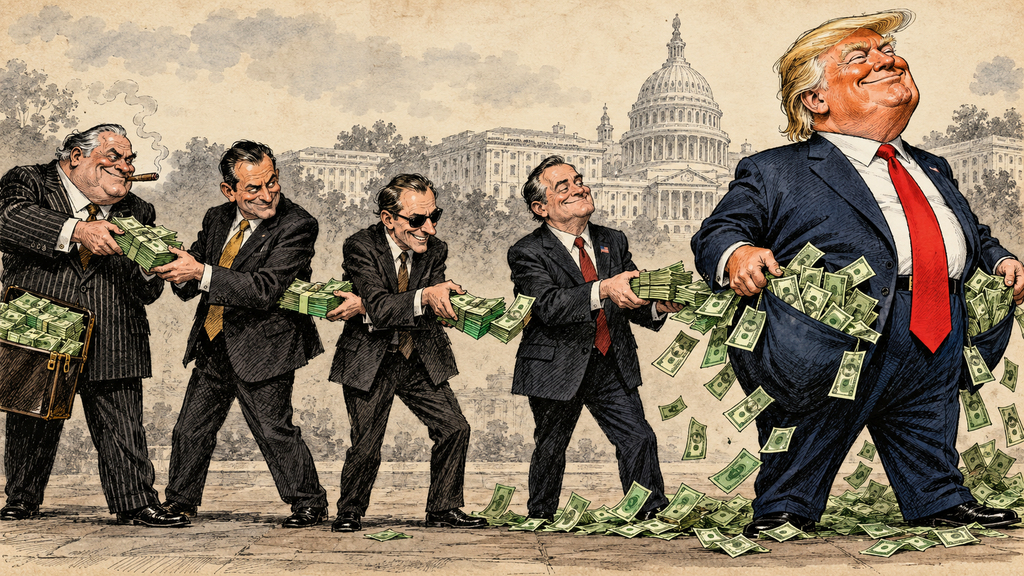
Trump’s Growing Culture of Corruption: When Loyalty Becomes Protection
Corruption grows when public officials begin to believe that consequences are negotiable. A conviction becomes something a powerful friend can rescue them from. Investigators become enemies, and political loyalty becomes a form of insurance.
That is the danger in Donald Trump’s repeated pardons of public officials: the message reaches beyond the people receiving clemency. Every other official is watching.
An October 13 Reuters investigation identified at least 85 public officials granted clemency in corruption-related cases across Trump’s two terms. Sixty-four were Republicans or Trump supporters; four were known Democrats, and 17 had undetermined affiliations. The tally includes both people convicted and people charged.
Donations for Fallen Officers, Spent Elsewhere
Consider Michele Fiore, the former Las Vegas city councilwoman. In October 2024, a federal jury convicted her of conspiracy and six counts of wire fraud in a scheme involving donations intended for memorials honoring police officers killed in the line of duty.
According to the Justice Department’s account of the trial evidence, Fiore promised that all contributions would go toward the memorials. Instead, more than $70,000 went to personal and political expenses, including rent, fundraising bills, and payments to family members. These were charitable donations entrusted to a public official for a specific purpose.
Trump pardoned her on April 23, 2025. The grant appears in the Justice Department’s own clemency records.
Fiore maintains her innocence. The White House defends Trump’s clemency as relief from politically motivated prosecutions.
But calling a prosecution political does not answer the evidence presented at trial. Donors deserve an explanation of what happened to their money. A jury’s findings deserve more than dismissal because the defendant supports the president.
The Next Official Is Watching
The broader concern is what these decisions teach.
An official considering a dishonest arrangement weighs the benefits against the possibility of getting caught. If political connections appear capable of removing the consequences, that calculation changes.
That does not mean every pardon produces another crime. It means repeated protection can weaken deterrence. Public officials should fear betraying the people who entrusted them with power. They should not feel reassured by their access to someone who can forgive federal offenses.
A culture of corruption develops when people learn that loyalty may matter more than conduct—and when honest officials see misconduct rewarded with another chance.
Fewer People Guarding the Public Trust
There is also concern about the government’s capacity to investigate wrongdoing. At a Berkeley Law event in March, former federal prosecutor Molly Gaston said the federal public-corruption prosecutorial team had shrunk from more than 30 attorneys to two. She warned that corruption affects ordinary communities, describing a kickback case that left firehouses without needed supplies.
That is what corruption looks like beyond Washington’s arguments. Someone profits, while the public receives less than it paid for. A contract costs too much. Equipment fails to arrive. A service deteriorates.
When investigative capacity shrinks while political protection becomes more visible, the public has reason to worry about both ends of accountability: whether wrongdoing will be uncovered and whether consequences will survive.
Mercy Must Serve the Public, Too
Clemency can correct injustice and recognize rehabilitation. Its credibility depends on reasons the public can examine.
The standard should apply to Republicans, Democrats, donors, friends, and strangers alike. Public office creates an obligation to the people—not an entitlement to presidential rescue.
Trump’s pattern raises a question every taxpayer should ask: What happens to honest government when officials begin to believe that the right political connection can save them from the consequences of dishonesty?
The danger is a government where corruption becomes easier to attempt, harder to investigate, and increasingly possible to escape.
The Latest Pardons: Pollution Violations Become Campaign Theater
On October 13, Trump pardoned Alaska auto shop owners Zachary Czubak and Patrick Fleming onstage at his Wasilla rally. Both had pleaded guilty in 2022 to conspiracy to violate the Clean Air Act.
Their Anchorage business, Arm Rippin Toys, removed emissions-control equipment and tampered with monitoring systems on at least 37 diesel vehicles, collecting approximately $100,000 for the illegal modifications, according to federal prosecutors. Trump defended the work as necessary to keep trucks running in Alaska’s extreme cold and called the prosecutions unfair.
Here, too, admitted lawbreaking was repackaged as persecution, and presidential forgiveness became a campaign attraction. The message to businesses following the rules is troubling: compliance costs money, while breaking the rules might earn you a presidential rescue.