
Police Discover Privacy—When the Cameras Watch Them
A Canadian software engineer has found a remarkably effective way to explain the problem with surveillance: point the camera in the other direction.
Anthony Sistilli built a license plate reader designed to track police vehicles. According to his account, two officers subsequently visited his home to ask about the project and his intentions. Suddenly, collecting information about where vehicles go had become a matter deserving serious discussion.
Privacy had arrived at the doorstep. It was wearing a badge.
The View From the Other Side of the Lens
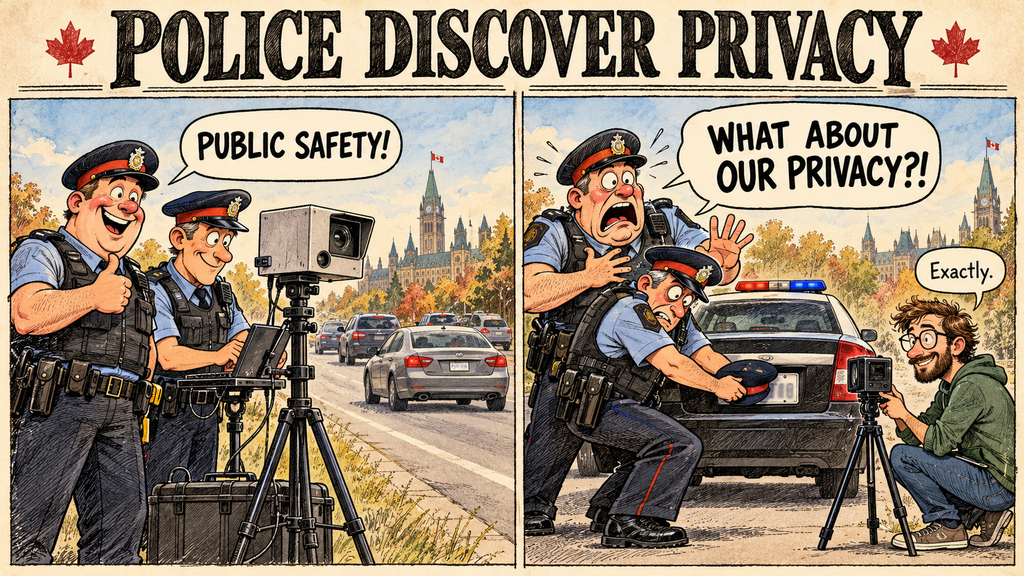
Sistilli said one officer explained how frightening it would be if people could discover where officers lived, when they began their shifts, and what they did throughout the day. His response was simple: “I think that’s the exact same concern that civilians have too.”
There it was. The entire privacy debate, delivered without a congressional hearing, a university panel, or a consultant billing $400 an hour.
Someone had finally discovered that a license plate is attached to a vehicle, a vehicle carries a person, and that person has a life.
Who knew?
Ordinary people also have homes. They have work schedules. They visit doctors, attend religious services, and occasionally go somewhere they would prefer not to explain to a stranger with access to a database.
Even buying doughnuts should not require a permanent record of your whereabouts.
A Very Educational Camera
The beauty of Sistilli’s experiment is that he did not need to persuade anyone that tracking could feel intrusive. According to his description of the visit, the officers supplied that argument themselves.
His camera appears to have doubled as


