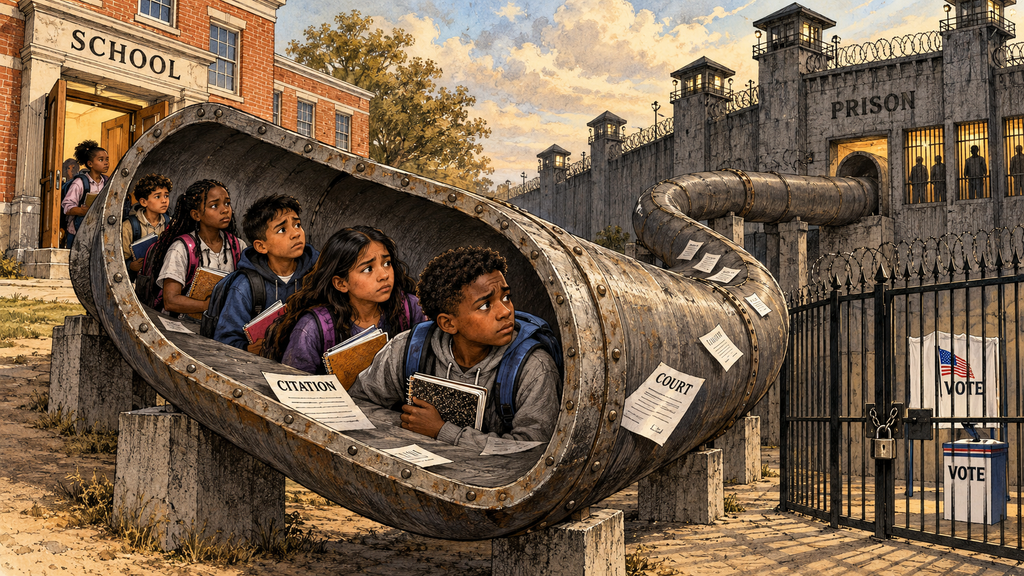
Texas Republicans Were Warned. Minority Children Are Still Paying the Price.
By Manuel Barrera — Opinion
Years ago, when school discipline increasingly became police business, I warned people where this was headed: minority children would acquire criminal cases while they were still young, adding another obstacle to lives already burdened by unequal opportunity.
The latest investigation by The New York Times and the San Antonio Express-News gives us reason to revisit that warning. It reports more than 47,000 school-related referrals for prosecution involving Texas children ages 10 through 13 since 2014. Those are referrals, not necessarily convictions or separate children. But they reveal how extensively the justice system reaches into childhood. www.expressnews.com
A misdemeanor is still a criminal case
Handcuffs are not required to turn a child’s school day into a court matter. A citation or criminal complaint can do that, too.
Before Texas restricted school ticketing in 2013, officers issued Class C misdemeanor citations for low-level misconduct. The reforms curtailed direct citations but retained a complaint process through which prosecutors could bring charges. Counting arrests alone therefore misses an important part of the problem. www.texastribune.org
School discipline and criminal prosecution carry different consequences. When a school sends a child into court, the family must navigate another institution, another set of obligations, and potentially another expense. For families already struggling, that is another burden the state has helped create.
The racial disparities were measured years ago
The 2011 Breaking Schools’ Rules study by the Council of State Governments Justice Center and Texas A&M followed nearly one million Texas students. At least one discretionary disciplinary violation was recorded for these shares of students:
| Students | Black | Hispanic | White |
|---|---|---|---|
| Boys | 83% | 74% | 59% |
| Girls | 70% | 58% | 37% |
These are discipline figures, not conviction rates. But the differences are substantial. csgjusticecenter.org
A separate 2011 study, Race Is Not Neutral, examined 364 elementary and middle schools. It found Black and Latino students more likely than White students to receive suspension outside school or expulsion for the same or similar behavior. graduate.lclark.edu
Texas Appleseed’s analysis of 2015 statewide data also found school-related juvenile-probation referral rates 2.86 times higher for Black youth and 1.87 times higher for Latino youth than for White youth. Those historical figures establish that unequal consequences were documented long before today’s headlines. report.texasappleseed.org
They were warned about the damage
In his 2011 address to the Legislature, Chief Justice Wallace Jefferson warned that minority and special-education students were disproportionately represented among those suspended and expelled. He said that “criminal records close doors to opportunities that less punitive intervention would keep open.” journals.senate.texas.gov
Research later examined those educational consequences. Emily K. Weisburst’s 2019 study of more than 2.5 million Texas students found increased discipline associated with school-police funding, with the largest increases for Black students. Exposure to a three-year policing grant was associated with approximately 2.5% lower graduation rates and 4% lower college enrollment rates. These are research estimates, not a prediction for every child. onlinelibrary.wiley.com
That is what I meant about handicapping children further. Time spent outside an ordinary classroom, involvement with courts, and lost educational opportunities can compound disadvantages rather than help children overcome them.
A Republican proposal would have put diplomas behind court penalties
In 2025, Republican Senator Brandon Creighton’s SB 1924 sought to restore school misdemeanor citations. It also proposed withholding graduation and a diploma from students convicted of, or placed on deferred adjudication for, a school offense until court-ordered community service, fines, and costs were satisfied. The bill included procedural protections, but that graduation restriction remained in the Senate-passed text. capitol.texas.gov
The Senate passed it 23–8. It stalled in the House and did not become law. That matters: the graduation restriction was a proposal, but it was a proposal that won Senate approval. journals.senate.texas.gov
During the debate, Senator Royce West explicitly warned about the earlier system’s disproportionate punishment of Black and Hispanic children. The Senate’s own account records that warning. Legislators were discussing unequal consequences while considering whether to restore citation authority. senate.texas.gov
Credit and responsibility belong with those in control
Republicans have controlled both chambers of the Texas Legislature since 2003, alongside the governorship. More than two decades of unified political control means responsibility for the policies they enact, fund, maintain, and choose to change. www.lrl.texas.gov
Some Democrats supported SB 1924, and they own their votes. The record also includes reforms: Texas restricted school ticketing in 2013, and Republican Representative Jeff Leach authored a later law providing diversion from prosecution for eligible fine-only misdemeanors. Those efforts deserve acknowledgment. They also demonstrate that lawmakers possess tools to reduce criminalization. journals.senate.texas.gov
My judgment is that Republican leadership has accepted too much damage to children already facing unequal opportunities. I cannot establish every legislator’s private racial motive. I can point to measured disparities, explicit warnings, and a Republican-led attempt to restore criminal penalties and attach them to graduation.
Teachers deserve safe classrooms. Students deserve protection from violence. State leaders also owe children discipline that helps them finish school and build a future.
When government has been warned that its approach burdens minority children disproportionately, continuing down that road is a political choice. Those in power should answer for it.