
New York Times report says man ICE was targeting in West Harris County operation had been dead for 9 years | khou.com
Does ICE Lie? Is Water Wet?
By Manuel Barrera — Opinion
ICE said its agents had been watching a wanted man. They said they saw him get into a truck. An operation followed, and an ICE agent’s SUV struck Miguel Parra-Hernandez, leaving him seriously injured.
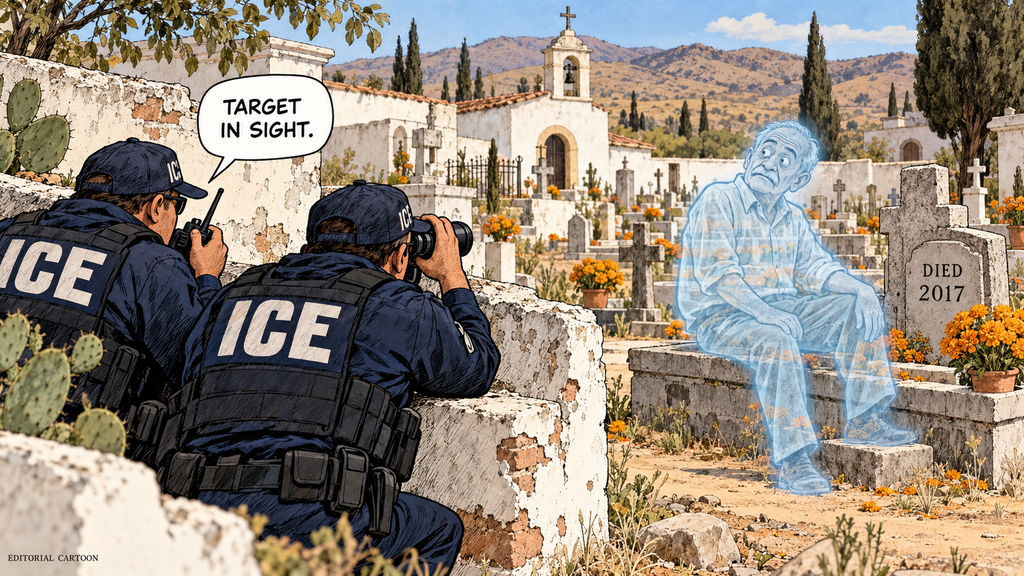
Now comes the detail that makes the agency’s account sound like a ghost story: the man pictured in its wanted bulletin reportedly died nine years ago.
An impressive feat of surveillance
According to reporting by The New York Times, summarized by KHOU and KPRC, Jamie Jimenez identified the man in ICE’s photograph as her father, José Héctor Jiménez Mendoza. She supplied a Mexican death certificate recording his death in October 2017 in Laredo, Texas. She said he had used the alias José Mendoza-Cervantes—the name ICE released. click2houston.com
KHOU reports that the Times also reviewed court records showing the same types of criminal charges ICE attributed to its target. The agency’s explanation now faces a contradiction involving the photograph, the reported alias, the criminal history, and a death certificate. KHOU report
If that identification is correct, ICE has some explaining to do. Surveillance is supposed to establish who is actually present. Seeing a man dead since 2017 would require capabilities considerably beyond anything taxpayers were told they were buying.
The agency claimed to have seen him
The distinction matters. An outdated file could explain why someone remained on a wanted list. ICE went further: according to KHOU, it claimed agents conducting surveillance saw Mendoza-Cervantes enter Parra-Hernandez’s truck before they tried to stop it.
That claim should have a factual foundation. Who made the identification? What photograph or information did the agents use? What did they record before the operation began?
Public records showing other people with similar names cannot, by themselves, explain the photograph ICE chose to publish. Nor do they establish that the person agents actually observed was the person the agency described.
Parra-Hernandez’s attorney says her client does not know Mendoza-Cervantes. FIEL says the man ICE identified was actually Parra-Hernandez’s worker. Those accounts deserve examination alongside the agency’s claims. KHOU report
A real man suffered real injuries
While the public tries to understand whom ICE was supposedly watching, Parra-Hernandez is recovering from serious injuries. Harris County District Attorney Sean Teare has said he believes the agent intentionally struck him. ICE denies that the collision was intentional, and the investigation remains ongoing. texastribune.org
That investigation must examine the SUV’s movement and the evidence surrounding the operation. The new reporting also makes the identification of its intended target a central question.
A government’s description of a dangerous suspect can shape how the public understands an injured person’s treatment. When the description is challenged by records and family identification, officials owe us a substantive answer.
Silence cannot repair the story
According to KHOU, ICE and DHS did not respond to the Times’ questions on Thursday, and KHOU also requested a response. That leaves the public with a confident initial account and unanswered questions about its foundation.
I believe this reporting gives the public ample reason to suspect that ICE’s account is false. Establishing who knew what, and when, requires the records and the investigation. The agency can begin by producing its identification evidence and cooperating fully with local investigators.
If agents made a mistake, explain it. If a public statement was wrong, correct it. If someone knowingly supplied a false account, identify who was responsible and hold that person accountable.
An agency exercising this much power should expect scrutiny at least as demanding as the scrutiny it applies to the people it stops. A badge cannot make a contradiction disappear, and repeating an official statement cannot substitute for evidence.
Does ICE lie? Is water wet?
ICE can answer the first question by explaining how its agents supposedly watched a man who, according to his daughter and the death certificate she provided, had been dead since 2017.