
Houston is among the cities included in ICE’s proposed expansion of its intelligence operations. Before anyone tells us that only undocumented immigrants need to worry, I have a few questions.
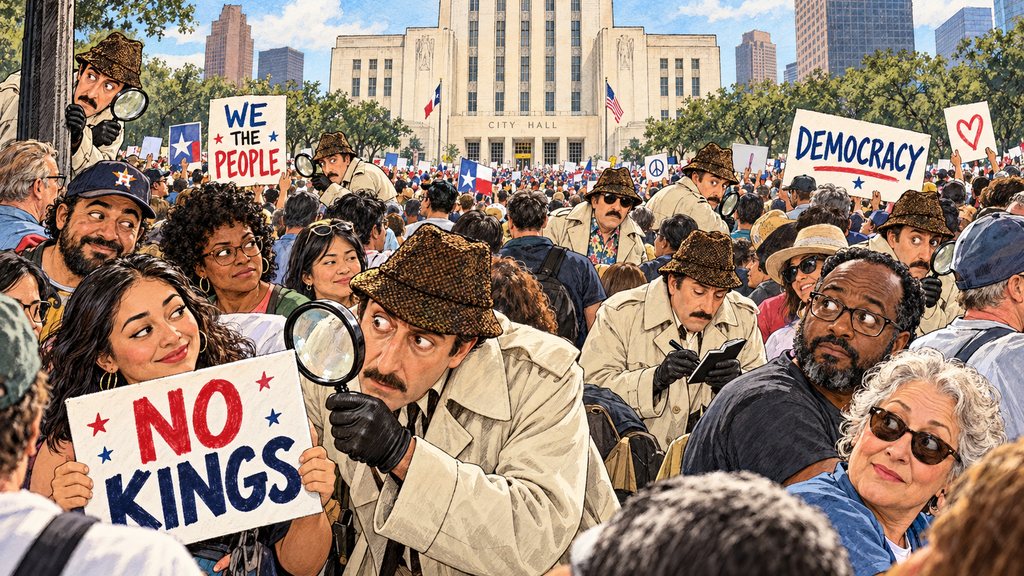
Will the government collect information about American citizens? Lawful residents? Their families, friends, employers, churches, and neighbors? Will people attending a No Kings demonstration become entries in an intelligence report because they exercised their right to disagree with the president?
Those questions deserve answers before the operation gets underway.
Houston is on the list
Whitney Curry Wimbish reports in The American Prospect that ICE plans to deploy 142 intelligence contractors across the country under a program called ERO ONE. Houston is among the locations identified in the draft statement of work. The reporting builds on earlier work by Michael Wriston and Em Chapin at Project Salt Box. The American Prospect
The government’s procurement forecast independently confirms a proposed nationwide contract valued at more than $100 million for intelligence research and analysis. Its listed duties include examining networks, relationships, trends, and threats. Personnel are expected to need Top Secret clearances with eligibility for access to Sensitive Compartmented Information. Acquisition Planning Forecast System
The timetable matters. The forecast lists December 10, 2026, for the anticipated solicitation and the second quarter of fiscal 2027—January through March—for an expected award. This is a planned expansion, not evidence that this particular contract is already operating at Houston demonstrations. Acquisition Planning Forecast System
But the time to question a surveillance capability is before it becomes routine.
Being a target and being in the files are different things
An assurance that ICE is looking for people subject to immigration enforcement would answer only part of the question. It would not explain whose information gets examined along the way.
Relationship analysis can extend beyond the person under investigation. The draft described by The American Prospect calls for examining connections among people, organizations, places, events, and activities. That raises an obvious concern: someone’s information could enter an intelligence product because of a connection to another person, even without becoming an enforcement target. The American Prospect
Consider a hypothetical Houston household with an undocumented parent, a citizen spouse, and citizen children. Add a landlord, a coworker who provides transportation, and a church that helps the family. Which connections would analysts examine? Which names would they retain? What would be deleted when it proved irrelevant?
These are questions about the proposed system’s boundaries. Citizenship alone does not answer them.
I want ICE to explain the rules for collecting, using, sharing, and deleting information about people who have done nothing wrong.
Will they be watching No Kings?
Will federal personnel attend No Kings demonstrations in Houston to identify participants? Will analysts examine organizers’ social media, map their relationships, or retain photographs of people carrying signs? Could information collected by another agency eventually reach this operation?
There is a reason to ask. In October 2025, Reuters reported that a Central California Intelligence Center alert identified No Kings protest locations and anticipated further intelligence reporting, while acknowledging the events’ stated nonviolent character. DHS did not directly answer Reuters’ question about potential surveillance of participants. ICE said it respected peaceful assembly and was taking constitutional measures to protect officers. Reuters
That reporting concerns an earlier event elsewhere. It does not establish what will happen in Houston.
It does show why “we respect the First Amendment” is an incomplete response. What specific activities are prohibited? Can peaceful participation alone justify collecting or keeping someone’s information? Who checks whether those restrictions are followed?
Protecting a demonstration from a credible threat and building files on the people attending it serve very different purposes. Officials should explain how they will keep that boundary intact.
We have seen government watch its critics before
Those of us who remember the Vietnam era have reason to be skeptical when officials ask for broad powers and offer general assurances.
The Senate Historical Office describes how an investigation exposed Army intelligence officers infiltrating civil rights organizations, posing as anti-Vietnam War protesters, and spying on members of Congress critical of American policy. It also describes the Church Committee’s exposure of an FBI effort to weaken the civil rights and antiwar movements. senate.gov
That history does not prove ERO ONE will repeat those abuses. It establishes that concern about political surveillance has a factual foundation.
The lesson is to demand enforceable limits while there is still an opportunity to establish them. Waiting until years of investigations reveal what happened is a poor way to protect people’s rights.
Computers can find connections. People decide what they mean.
The public procurement forecast does not identify a particular AI system. Whether the work uses AI, conventional databases, or a combination, the government will determine the mission and priorities. The forecast expressly reserves governmental decisions and authorities to government personnel. Acquisition Planning Forecast System
That means responsibility cannot be handed off to a contractor or a computer.
If officials ask analysts to investigate a specific threat, that sets one direction. If officials start treating criticism, immigrant advocacy, or attendance at a demonstration as suspicious, the same analytical capabilities could serve a very different purpose. That is the risk officials must address with written restrictions and independent review.
A connection is a lead to evaluate. Sharing an address, attending the same church, or appearing at the same rally does not establish wrongdoing.
Houston deserves answers in writing
Our congressional delegation should ask ICE and DHS these questions publicly:
- Who qualifies for investigation? What factual basis is required, and who approves it?
- Whose information can be retained? What protections cover citizens, lawful residents, children, and people merely connected to a subject?
- What protects peaceful dissent? Can attendance, organizing, journalism, or criticism of ICE trigger collection or analysis?
- What information will be used? Which government records, commercial databases, public posts, and other sources will analysts access?
- Who can receive the results? Which agencies and contractors may obtain them, and under what restrictions?
- How are errors corrected? Who verifies identities and relationships before information supports an enforcement action?
- Who audits the operation? Will an independent reviewer examine searches, retention, misuse, and complaints?
Houston and Harris County officials should also disclose whether local agencies will supply information, receive intelligence products, or participate in related operations—and what safeguards would govern that cooperation.
The published forecast does not resolve these questions. The American Prospect reported that DHS did not respond to its inquiry about the possibility of spying on political opponents. That silence is not proof of such a plan. It leaves an important question unanswered. Acquisition Planning Forecast System
I am not satisfied with being told that innocent people have nothing to fear. Innocent people are precisely the ones whose protection should be spelled out.
Before Washington spends more than $100 million expanding this capability nationwide, Houston deserves to know who may end up in its files—and what prevents peaceful opposition from being treated as a threat.


