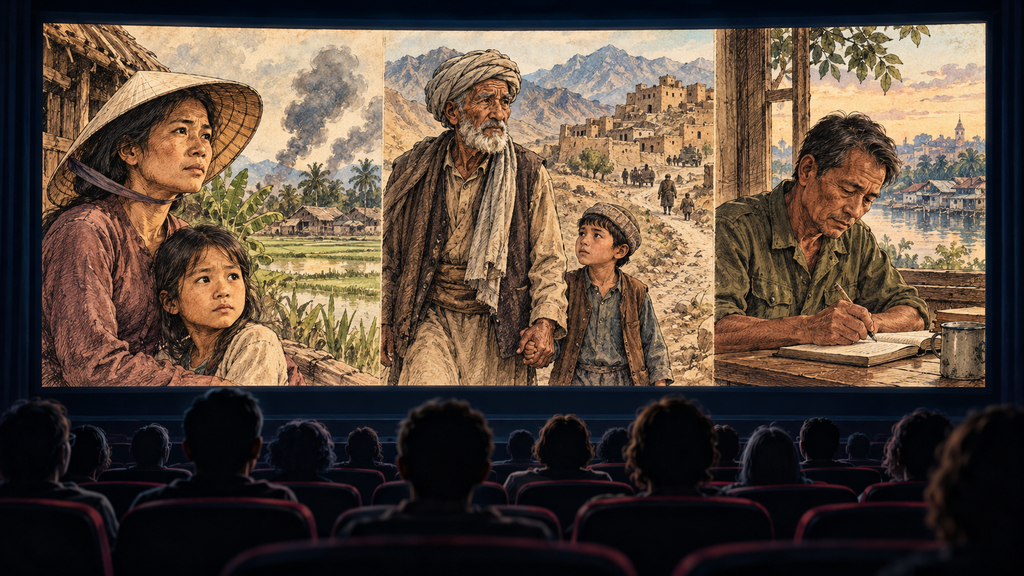
Watching Ukraine resist invasion, I found myself thinking about the books and movies that will someday tell its story. Future generations will know the ending. We are watching without knowing it.
Then I thought about Afghanistan and Vietnam. Their histories also include prolonged resistance against much larger foreign powers. I began wondering how often we encounter those struggles through the eyes of the people who lived there.
They have written books. They have made movies. Some have reached international audiences. Yet there is a difference between a story existing and a story becoming familiar to millions of people far from the country where it happened.
Who Gets to Be the Main Character?
A war movie teaches us whose life to follow. We learn a soldier’s name, meet his friends, fear for his safety, and perhaps watch him struggle after returning home. The people living in the country where he fights may receive only a few minutes on screen.
Those choices shape our understanding. We can come away knowing an American soldier’s childhood, friendships, and nightmares while knowing almost nothing about the Vietnamese family whose village appears behind him.
Viet Thanh Nguyen examines this imbalance in Nothing Ever Dies: Vietnam and the Memory of War. He argues that the United States’ economic and cultural power allowed it to export its version of the war through Hollywood on a scale Vietnam could not match. Military victory and the power to shape international memory are different things.[1]
Vietnam Has Been Telling Its Stories
Bảo Ninh served in the North Vietnamese army. His novel The Sorrow of War follows a veteran struggling with memories, loss, and the wreckage of his personal life. It became a bestseller in Vietnam and won international recognition.[2]
Its existence challenges an easy assumption: that literature from the winning side must be a celebration of victory. A soldier can survive, his side can prevail, and his life can still be devastated. The political outcome does not settle the grief.
The Little Girl of Hanoi, directed by Hải Ninh and released in 1974, follows a child searching for her soldier father after American bombing. Parts were filmed among the actual ruins of Hanoi’s Khâm Thiên street. The film later won the Golden Lotus for best feature at the Vietnam Film Festival.[3]
That choice of main character changes the story. The child has a family to find and a city to navigate. We experience the destruction through her search. The place beneath the aircraft becomes a neighborhood where people had homes.
Afghanistan Beyond the Foreign Soldier’s View
Afghan writer Atiq Rahimi’s Earth and Ashes tells of an elderly man trying to reach his son after Soviet forces bomb their village. His grandson, deafened by the attack, accompanies him. Rahimi also directed the film adaptation, which received an award at Cannes in 2004.[4]
The scale is intimate: three generations of one family, terrible news, and the difficulty of carrying it to someone who does not yet know. An entire war enters the story through what has happened to these people.
There are accounts from fighters, too. The Other Side of the Mountain, by Ali Ahmad Jalali and Lester Grau, draws on interviews with mujahideen commanders about fighting Soviet forces. Abdul Salam Zaeef’s My Life with the Taliban offers a memoir from inside that movement, translated from Pashto.[5][6]
These are distinct perspectives. Afghanistan’s rival movements, civilians, women, refugees, and people who supported different governments cannot all be represented by one fighter’s account. A fuller history requires room for their disagreements as well as their resistance.
Getting the Stories to Us
Books need translators, publishers, and readers. Films need financing, subtitles, distributors, theaters, and now streaming platforms. A work can be important in its own country without receiving the resources that make it familiar abroad.
Some of these Vietnamese and Afghan works have crossed those barriers. Their availability gives us an opportunity to widen the way we remember wars. We can follow the lives of people whose names may never appear in the military histories we usually read.
As a reader and moviegoer, I want more of those voices. I want to know what people hoped to preserve, what they lost, and what returning home meant when home itself had been changed or destroyed.
When we imagine the future books and films about Ukraine, we should also look for the stories already told by people in other war-torn countries. They have been preserving their memories for years. We can make a greater effort to hear them.
Sources
- Viet Thanh Nguyen discusses Nothing Ever Dies
- Penguin Random House: The Sorrow of War
- Hanoi International Film Festival: The Little Girl of Ha Noi
- Penguin Random House: Earth and Ashes
- U.S. Army resource listing: The Other Side of the Mountain
- Hurst Publishers: My Life with the Taliban
.