Written in the third person. This is the first year that I had no problem with my sons going to vote. Family members are taking their children to the polls to vote for the first time. Trump has managed to do something most people thought impossible: unite Hispanics from throughout the Americas.
The Hispanic Early Vote Is Growing—and Meme Is Betting It Favors Democrats
The central question in Texas’s Hispanic early-voting surge is what is bringing these voters to the polls. Manuel “Meme” Barrera is placing his bet on opposition to Republicans. His prediction is that the additional participation will favor Democrats overwhelmingly, with benefits extending beyond the candidates at the top of the ticket.
The chart accompanying Simon Rosenberg’s October 27 discussion at Hopium Chronicles supplies a striking starting point. Its TargetEarly snapshot records 1,244,917 Hispanic early voters in Texas, compared with 702,807 at the comparable point in 2022. That is an increase of 542,110 voters, or approximately 77%, calculated from the chart’s figures.
The chart’s “37%” means something different—and potentially significant. Hispanics’ share of recorded Texas early voters rose from 20.64% to 28.31%, an increase of 7.67 percentage points, or approximately 37% relative to the earlier share. Within this dataset, Hispanic participation is growing faster than the overall early vote. These are early-voting comparisons, however, and do not establish how many additional people will ultimately vote rather than simply vote earlier.
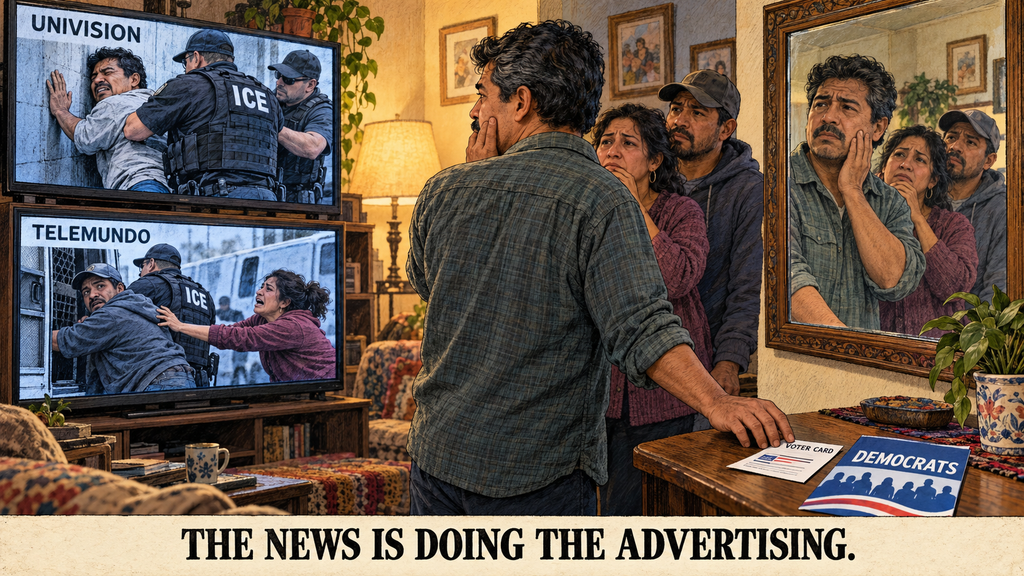
Barrera’s explanation centers on what viewers are seeing on Spanish-language television. He argues that repeated coverage of immigration raids, mistreatment allegations, and affected families can function politically like negative advertising against the administration. For people already worried about enforcement, each report may provide another reason to participate. That is his interpretation of the coverage’s cumulative effect, not a measured estimate of how many votes television reporting changes.
Polling shows that those concerns are widespread. In Univision/YouGov’s October 13–21 Texas survey, 56% of Hispanic registered voters said immigration enforcement had gone too far. Forty-three percent worried that they, a relative, or someone close could be directly affected. The same survey found that 42% considered their household finances worse than a year earlier, suggesting that enforcement concerns and economic dissatisfaction can overlap.
There is also evidence that previously absent voters favor Democrats. Pew Research Center’s national September 28–October 4 survey found that Hispanic registered voters who did not vote in 2024 preferred Democratic House candidates 47% to 18%. The remaining 35% were undecided or preferred another candidate. That finding supports the possibility of a strongly Democratic addition to the electorate, although it does not identify the preferences of Texas’s additional early voters specifically.
The enthusiasm figures point in the same direction. Pew found that 53% of Hispanic Democratic candidate supporters were extremely motivated to vote, up from 41% in 2022. Among Hispanic voters who supported Trump in 2024, 11% now backed Democratic House candidates, while another 24% preferred someone else or were undecided. Increased participation and Republican defections are separate developments that could reinforce one another.
Texas polling shows Democratic strength across several contests. Univision found Talarico leading Paxton 55%–37%, Hinojosa leading Abbott 52%–43%, and Democratic House candidates leading 52%–41% among Hispanic respondents. Those findings support an advantage extending across the ballot, without demonstrating that every additional voter will vote consistently for one party.
The size of the turnout shift remains disputed. The Texas Tribune reported Derek Ryan’s estimate that Hispanics represented 18% of early voters through Sunday, substantially below the TargetEarly chart’s 28.31%. Both indicate a higher share than in 2022, but their different snapshots and methods require explanation before the estimates can be treated as interchangeable.
Barrera is standing by his October 27 prediction that approximately 63%–72% of Texas Hispanic voters will support Democrats at the top of the ticket. An earlier Cook Political Report/TelevisaUnivision poll placed Talarico at 63%, while newer Texas surveys have put Democratic support lower. The upper end remains an ambitious forecast.
His wager rests on the reason people are showing up: that the additional voters are motivated heavily by opposition to Republican policies and will carry that opposition down the ballot. The turnout records show participation; the election results will reveal whether that interpretation was right.