
They will not whitewash our victory— Texas for everyone—women united, building a better future together.
Everyone knows that women are the backbone of the Democratic Party; let us give credit where credit is due.
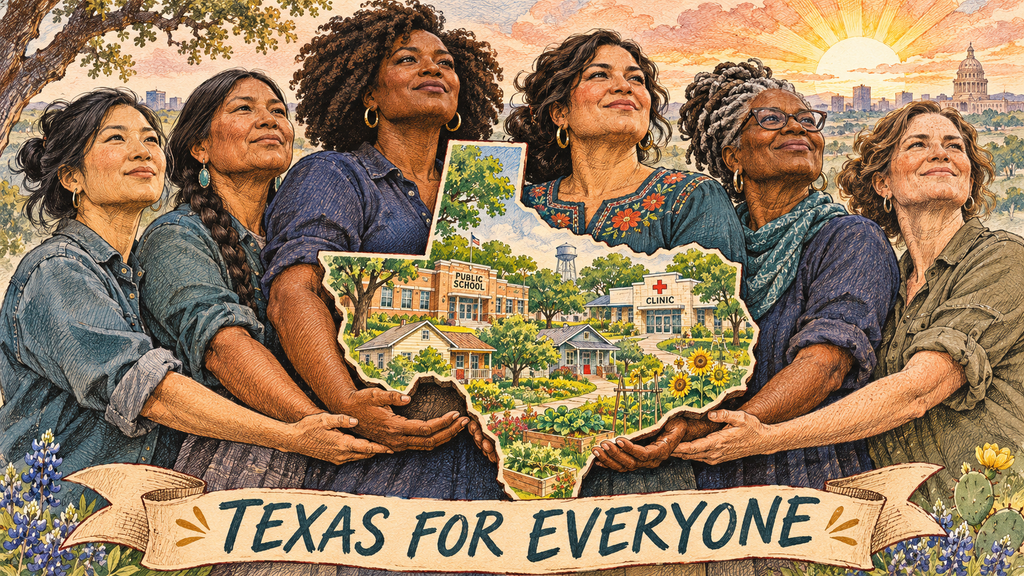
Black and Brown Texans did not turn out so someone else could take ownership of our victory. We voted, contributed, organized, and demanded change. Now that Democrats have won, I will not quietly watch our accomplishments disappear into another story about a white man who supposedly made it all happen.
I just read a white blogger quoting nothing but white people. Apparently, we can supply the votes, but somebody else gets to explain what we were thinking and why we voted. That is how an incomplete account becomes the accepted history: the people who did the work disappear, while the people with access to the microphone become the authorities.
Start with who makes up the party. A weighted calculation from the October 2026 University of Texas/Texas Politics Project survey estimates that white voters account for about 48% of Democratic identifiers and leaners in Texas. Black, Hispanic, Asian, Indigenous, and other voters collectively account for the remaining 52%. Those are survey estimates, but they put our place in this coalition into perspective. We are being described as supporting characters in a party in which we collectively make up the majority. The Texas Politics Project
The election results deserve the same attention. The Houston Chronicle’s Harris County precinct analysis found that Talarico received 86% in plurality-Black precincts and 73% in plurality-Hispanic precincts. Hinojosa received 85% and 72%, respectively. These are precinct results, not a count of individual voters by race. They nevertheless show where enormous Democratic margins were produced. houstonchronicle.com
The change extended beyond Houston. The Texas Tribune reported that border counties and the largest urban counties had the biggest turnout increases compared with 2022. Starr, Zapata, Maverick, Hidalgo, and Webb each shifted more than 38 points toward Democrats compared with 2024. Anyone writing the history of this election needs to explain what happened in those communities, rather than treating them as scenery behind a candidate’s victory speech. texastribune.org
Gina Hinojosa deserves a place at the center of that history. People like me sent $25 or $50 to her campaign because we wanted her to win and believed in what her election could mean. We were supporting a candidate with her own constituency, her own campaign, and her own claim on the future of Texas. Her supporters did not become somebody else’s accomplishment when the votes were counted.
Jasmine Crockett and Letitia Plummer belong in this account, too. Before the election, the Chronicle reported on Crockett’s support for Plummer and other Black local candidates. Texas Southern University political scientist Michael Adams described the strategy as “reverse political coattails”: local races could help generate turnout that benefited statewide candidates. That possibility was recognized before the results. It deserves examination afterward. houstonchronicle.com
James Talarico won his race. That does not give him ownership of the electorate that elected him. A voter can come out for Hinojosa, Plummer, a local judge, public schools, or a determination to stop the treatment of immigrant families—and vote for the Democratic Senate candidate along the way. Pundits who claim to understand the election should ask those voters what brought them out.
White Democrats who contributed and worked deserve credit for their contributions. So do the Black and Brown Texans whose work too often gets compressed into a percentage beneath someone else’s photograph. An honest account names the organizers, interviews the voters, follows the small donations, and examines the local campaigns. It does not stop after finding a polished candidate and a consultant willing to explain his brilliance.
This matters beyond wounded pride. Whoever gets credit today will be listened to tomorrow. If the party decides that wealthy donors and celebrated consultants delivered this victory, it will put its money and attention there. If it recognizes the communities that supplied its strength, those communities have a stronger claim on its priorities, its resources, and its governing decisions.
We are writing history now. I want the names, the neighborhoods, the candidates, and the people who worked for this victory recorded while they can speak for themselves. Our children should be able to read that history and recognize what their communities accomplished.
They will not take our votes, take the victory, and then take us out of the story.


