
Small-Town Police Departments Discover Washington’s Money. What Happens When the Checks Stop?
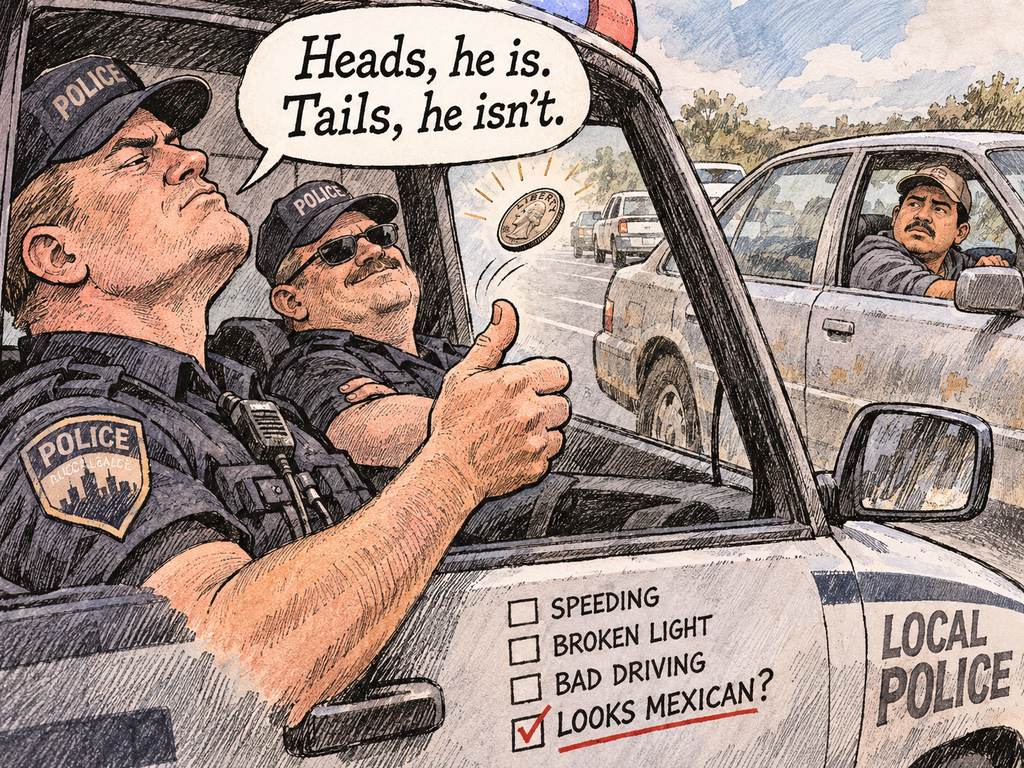
Places you may want to avoid if you are olive-skinned, Mexican-looking.
89 County grants awarded – $7.42M Total state awards
The 75 counties awarded $80,000 each:
Anderson, Archer, Atascosa, Austin, Bailey, Bee, Borden, Bowie, Brewster, Brown, Cass, Castro, Chambers, Coke, Comanche, Cooke, Crosby, Dallam, Delta, Eastland, Edwards, Falls, Fannin, Fayette, Floyd, Franklin, Freestone, Frio, Garza, Goliad, Gonzales, Gray, Hartley, Hemphill, Henderson, Hockley, Hood, Hopkins, Houston, Jack, Jackson, Jasper, Jim Wells, Kerr, Kleberg, Lamb, Lampasas, Lavaca, Lee, Liberty, Lipscomb, Milam, Mills, Moore, Morris, Nacogdoches, Ochiltree, Orange, Parmer, Polk, Presidio, Rains, Real, Runnels, San Augustine, San Jacinto, Stephens, Terrell, Trinity, Tyler, Upton, Victoria, Walker, Wheeler, Wilson, Winkler, Yoakum and Zapata.
Counties with larger awards:
Grant amount Counties $100,000 Brazoria, Comal, Ellis, Galveston, Grayson, Parker, Smith, Wichita $120,000 Fort Bend, Hidalgo $140,000 Tarrant A small Texas town made an immigration arrest and collected $100,000 from Washington. Now its police chief is looking at the possibility of collecting another $720,000. That is a pretty good payday for a town with only 2,500 residents. But what happens when Washington stops sending the checks?
According to a November 20 investigation published by the Texas Tribune, KXAN and ProPublica, police departments and county sheriffs across Texas are discovering that enforcing federal immigration laws can be financially rewarding.
The town of Pantego, near Fort Worth, is a particularly interesting example. Its police chief told the town council that participation in the federal 287(g) program could produce hundreds of thousands of dollars. The projected $820,000, including the initial payment, would amount to approximately 39% of the town’s previous annual police budget.
The problem with government money is that once a department becomes accustomed to receiving it, giving it up becomes difficult. The first check pays for equipment. The next might help cover salaries, overtime, retirement contributions, or vehicles. Eventually, money that was supposed to be supplemental can become something the department counts on.
And that is when temporary funding becomes a long-term financial problem.
Washington is already more than $40 trillion in debt. The federal government recorded a deficit of approximately $2 trillion during fiscal year 2026, according to the Congressional Budget Office. These are two different figures, but both raise questions about how long Washington can continue expanding its financial commitments.
Nobody can say exactly when the 287(g) funding might end. Congress could reduce it, a future administration could change its priorities, or the program could be substantially revised. What is certain is that federal grants are not guaranteed permanent income.
Imagine a small town purchasing vehicles, hiring personnel, and expanding operations based on money that suddenly disappears. The town still owns the vehicles, but somebody must maintain them. Employees still expect salaries and benefits. The bills don’t disappear simply because Washington changes its mind.
Who makes up the difference? The local taxpayers.
There is another question worth asking: Should the promise of federal money influence how local police officers exercise their authority? According to the investigation, Hartley County received more than $205,000 while recording 54 immigration arrests during the period examined. Most involved minor traffic or vehicle violations.
In Smith County, the sheriff’s office received nearly $2.2 million between January 2025 and June 2026. Investigators found that more than 100 of its 124 reported immigration enforcement actions during a separate period had no associated criminal charge listed.
Supporters argue that the money helps understaffed departments purchase equipment, train officers, and provide public safety without increasing local taxes. Those are legitimate budget considerations. But the financial benefits also create an incentive to continue participating, regardless of whether immigration enforcement is the most pressing local policing need.
Texans deserve to know which communities and law enforcement agencies are participating and collecting the money. The following are among the jurisdictions identified in the investigation.
| Community or jurisdiction | Federal 287(g) money |
|---|---|
| Pantego | $100,000 received; $720,000 additional projected |
| Hartley County | More than $205,000 received |
| Fayette County | Approximately $800,000 received |
| Smith County, including the Tyler area | Nearly $2.2 million received |
| Hollywood Park | Police participation promoted; payment unverified |
| Bullard | Police agreement documented; payment unverified |
These are not all the participating agencies. The investigation reported 429 Texas law enforcement agencies with ICE agreements as of mid-September 2026. It reviewed federal funding records for 93 agencies.
Texas also operates its own grant program for participating sheriff’s offices. As of November 17, the Texas Comptroller reported 89 grant awards totaling $7.42 million. Those state awards are separate from the federal payments discussed above.
For people concerned about immigration enforcement, these records provide useful information when deciding where to travel, shop, or spend their money. However, a county sheriff’s participation does not mean every town or business within that county supports the program.
Perhaps the most important question is not how much money these departments are receiving today, but how much of their future budgets will depend upon continuing to receive it.
Incoming Texas Comptroller Sarah Eckhardt has proposed auditing the program, including examining whether its costs could eventually increase local property taxes. That examination could help determine whether federal funding is producing lasting savings or merely postponing expenses.
There is an old saying about free money: Nothing is free.
Washington can send a small town a check today. Washington can stop sending it tomorrow.
But when the checks stop coming, the town’s taxpayers are still there.
And they are the ones who may be left holding the bill.


