
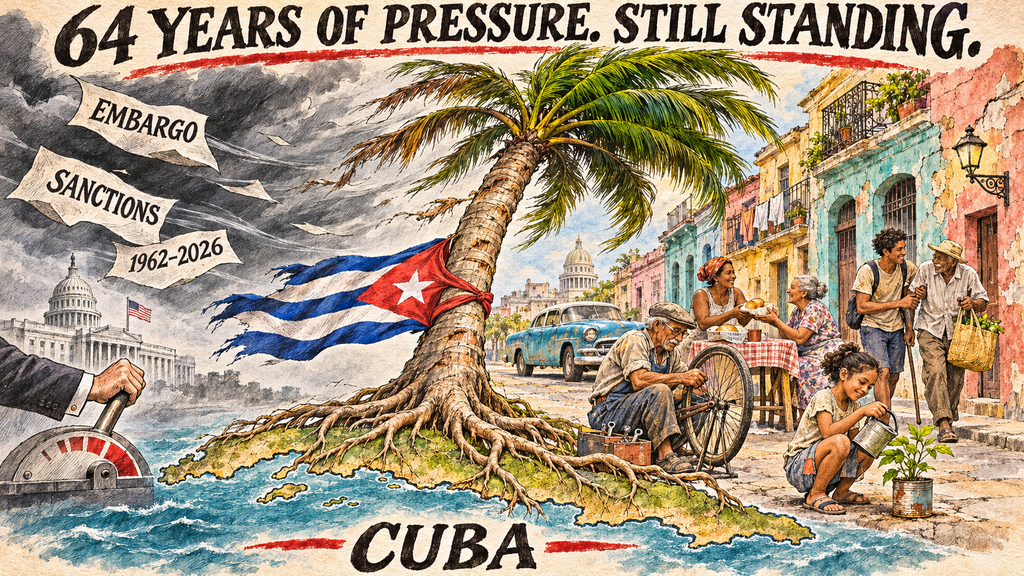
Washington keeps predicting that hardship will make its enemies surrender. Cuba has been waiting sixty-four years to prove Washington right. Now the Trump administration appears to be making another version of that bet with Iran: tighten the economic squeeze until the government gives in—or comes apart.
The administration’s confidence deserves more scrutiny than its threats receive. According to Israel Hayom’s reporting, Trump favors intensifying economic pressure after advisers weighed the dangers and uncertain outcome of renewed full-scale war. Treasury Secretary Scott Bessent supplied the hopeful theory behind the squeeze: “My guess is they will soon start turning on each other.” A guess about your opponent’s breaking point is carrying an extraordinary amount of weight. www.israelhayom.com
Cuba should make anyone cautious about predicting political collapse through economic punishment. Kennedy’s comprehensive trade embargo took effect in February 1962. Presidents have come and gone, restrictions have changed, and generations of Cubans have lived under economic pressure. The Communist government remains. www.archives.gov
Ordinary Cubans have certainly paid a price. In its October statement on the embargo, the European Union described shortages of food and medicine, daily power outages, and deteriorating public services. It identified both the embargo’s harmful effects and the Cuban authorities’ own policies as contributors to the crisis. Whatever share of responsibility belongs to each, misery has not automatically produced the political outcome Washington wanted. www.eeas.europa.eu
Ukraine demonstrates another limit to the belief that enough destruction will end resistance. In the fifth year of Russia’s full-scale invasion, Ukraine continues fighting. The International Monetary Fund credits its economic stability to sustained outside financing and prudent policy under exceptionally difficult conditions. Its survival is being maintained through decisions, institutions, outside support, and the determination to continue. www.imf.org
North Korea offers another twenty years of evidence that economic pressure does not guarantee results. The United Nations imposed nuclear-related sanctions in October 2006, demanding that Pyongyang abandon its nuclear weapons program. In November 2026, the IAEA reported that North Korea was continuing to expand its uranium-enrichment facilities. Two decades of sanctions have not secured the demanded nuclear disarmament. Security Council
Cuba’s government survived. North Korea continued its nuclear program. Ukraine continued resisting invasion. Their circumstances differ, but all three challenge the assumption that enough hardship inevitably makes a country accept someone else’s terms. Trump owes Americans more than another prediction that this time, the breaking point is just around the corner.
These examples involve different governments, causes, and sources of support. Ukraine is defending itself against invasion; Cuba’s government has survived decades of American restrictions. Neither experience guarantees Iran’s survival. Both demand an explanation from anyone who assumes economic suffering will reliably deliver surrender or regime collapse.
A country’s breaking point cannot be read from an electricity bill. The article promoting Trump’s economic approach describes the Iranian president working with the chandeliers switched off as evidence that pressure is reaching the leadership. Darkened chandeliers demonstrate neither a government’s imminent fall nor its willingness to accept Washington’s terms. Economic distress is evidence of distress; the political prediction still requires proof. nationalsecurityjournal.org
Even the reassurance about risk contradicts the administration’s own expectations. The diplomatic sources quoted by Israel Hayom describe the economic approach as carrying “almost no risk.” Yet Bessent also acknowledges the possibility of indiscriminate Iranian attacks across the Middle East. That is a remarkably large danger to tuck inside such a small reassurance. www.israelhayom.com
A policy can succeed at making people miserable and still fail at achieving its purpose. Before tightening the squeeze indefinitely, the administration owes Americans a credible account of what success means, why Iran’s leadership would change course, and what happens if it refuses.
Cuba offers sixty-four years of reasons to ask those questions. Ukraine offers another reminder that a country can endure suffering far beyond what an outside power expected.
Trump can order more economic pain. He cannot order the political result.


