
All those children above the age of eighteen who are citizens and have mixed legal and illegal families need to get their behinds to the polls and start voting; that is the only way things may get better for their families.
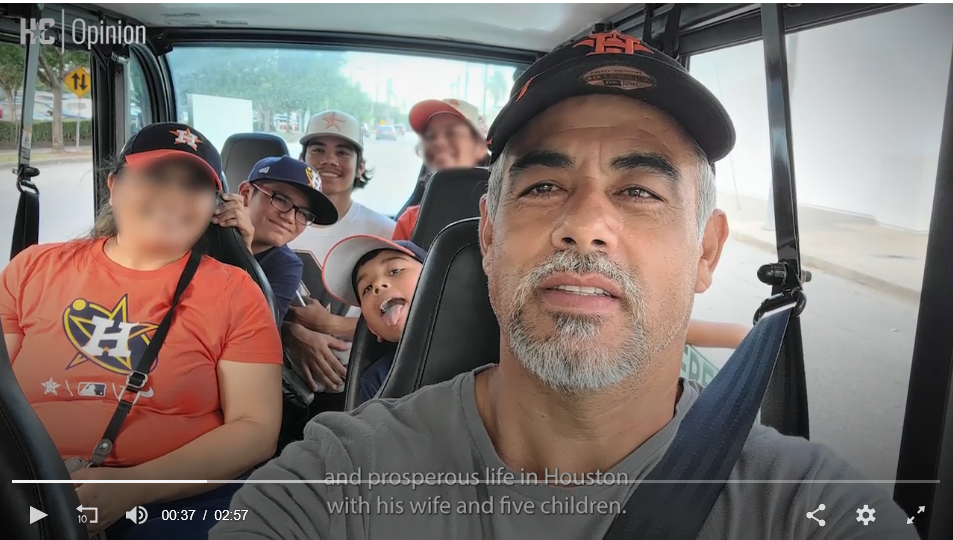
There is a video and an audio version of the story, but they are behind a paywall.
I provided a gift link, but you must agree to receive emails. You can unsubscribe at any time or mark it as spam if you no longer want to receive those emails. But news is news.
The audio will actually read the article for you; it is cool if you prefer audio over reading.
Luis crossed the border without a visa a quarter century ago, but he has no deportation order and no criminal record. Not even a traffic ticket.
Luis is treasured by his clients and neighbors. After a stroke left a neighbor in a wheelchair, Luis rushed to her home to build handrails and ramps.
He’s a loving father who attended all his 12-year-old son’s baseball games. Before Luis’ arrest, his son hit a home run at the Baseball USA field at Beltway 8 and Kempwood Drive. Luis collected the ball.
And he’s a Christian. When we spoke to him by phone, he told us that at the detention center, he prays first for his cellmates — “may God come and help them endure this difficult time” — and then “for myself and my family.”
Note that Luis was apparently stopped for driving a white cargo van, according to the first article.
This writer has been following developments in Houston and Harris County regarding ICE operations. I don’t believe the van was the sole reason he was targeted; there was likely other information that led them to his van. He also warned his family that he could be picked up.
Once Luis left home, he headed east down Bellaire Boulevard. He was headed to the home of a new client to install security cameras. Before the light at Renwick Drive, an unmarked black SUV began trailing him.
He called his wife and calmly asked her to get the kids on a conference call.
“This is it,” he said. “I want to say goodbye.”
She tried to reassure him, but then a second vehicle slowed down next to him. A third pulled in front, and with lights flashing, they boxed him in.
From what I gather from Luis’s story, he probably has two, maybe even three, Children born here who would be US citizens and eligible to vote.
I would like to know whether they are citizens and whether they voted. If they did vote, did they vote for Kamala Harris?
Too often, I have seen children who are US citizens who never bother to vote. I have written about it before. I certainly have written about it numerous times.
“Immigration is not on top of the list of probably the majority of Latinos who vote or who could be convinced to vote. If the children of parents who are here illegally cannot convince themselves to vote to help their parents, how much harder is it to persuade others who do not have a stake in immigration?” Source
Even People here illegally wanted Trump to stop them from getting here.
Remember that polls and stories told us that people here illegally wanted the flow of new illegals to cease—more competition for them, thus less money. We, humans, tend to be greedy, or as Jasmine Crockett said, “Slave Mentality. Translated, the house niggers I am using Malcolm X to describe that slave mentality.
Malcolm tells the parable of “house Negro.”
King Solomon Baptist Church, Detroit. 10 November 1963.Transcribed text from audio excerpt. [read entire speech]
To understand this, you have to go back to what the young brother here referred to as the house Negro and the field Negro back during slavery. There were two kinds of slaves, the house Negro and the field Negro. The house Negroes–they lived in the house with master, they dressed pretty good, they ate good because they ate his food–what he left. They lived in the attic or the basement, but still they lived near their master; and they loved their master more than their master loved himself. They would give their life to save their master’s house–quicker than the master would. If the master said, “We got a good house here,” the house Negro would say, “Yeah, we got a good house here.” Whenever the master said “we,” he said “we.” That’s how you can tell a house Negro.
If the master’s house caught on fire, the house Negro would fight harder to put the blaze out than the master would. If the master go sick, the house Negro would say, “What’s the matter, boss, we sick?” We sick! He identified himself with his master, more than his master identified with himself. And if you came to the house Negro and said, “Let’s run away, let’s escape, let’s separate.” The house Negro would look at you and say, “Man, you crazy. What you mean, separate? Where is there a better house than this? Where can I wear better clothes than this? Where can I eat better food than this?” That was that house Negro. In those days he was called a “house nigger.” And that’s what we call them today, because we’ve still got some house niggers running around here.
This modern house Negro loves his master. He wants to live near him. He’ll pay three times as much as the house is worth just to live near his master, and then brag about “I’m the only Negro out here.” “I’m the only one on my job.” “I’m the only one in this school.” You’re nothing but a house Negro. And if someone comes to you right now and says, “Let’s separate,” you say the same thing that the house Negro said on the plantation. “What you mean, separate? From America, this good white man? Where you going to get a better job than you get here?” I mean, this is what you say. “I ain’t left nothing in Africa,” that’s what you say. Why, you left your mind in Africa.