
The news media isn’t asking these questions, and the Mayor isn’t volunteering the answers. Are Houston taxpayers getting screwed without even knowing it?
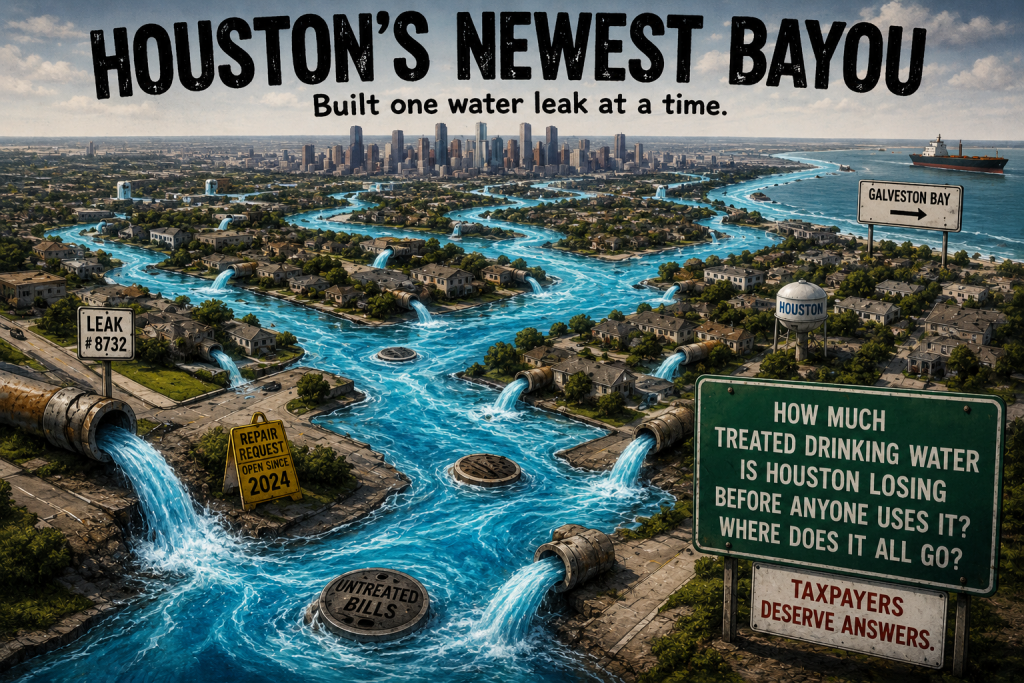
Houston is famous for its bayous.
Buffalo Bayou.
Brays Bayou.
White Oak Bayou.
Sims Bayou.
Greens Bayou.
Halls Bayou.
Hunting Bayou.
Most Houstonians assume the water flowing through them came from the sky.
But what if some of it came from your kitchen faucet?
Not literally.
But what if a surprising amount of the water reaching Houston’s bayous began its journey as treated drinking water—water taxpayers already paid to pump, purify, disinfect and deliver—only to escape from broken water lines and flow into storm drains before eventually reaching our bayous?
It sounds unbelievable.
Maybe it is.
Then again…
Maybe it isn’t.
Television stations across Houston have spent the last two years reporting one water leak after another.
A leak that flowed for months.
Another that lasted even longer.
Neighborhoods complaining that repair requests remained open while clean water continued running into the street.
Each story ended the same way.
A television camera arrived.
The city promised action.
The story disappeared.
Then another leak appeared somewhere else.
What nobody seems to have asked is the obvious question.
What happens when you add them all together?
Within two blocks of my own home, I recently found multiple water leak reports on the City’s public 311 map. One dated back to 2024. Another remained open months after its expected completion date.
One leak has flowed so long that tadpoles have appeared in the puddles collecting along nearby driveways.
That isn’t scientific proof of anything.
It is simply an observation.
The water keeps flowing.
The city knows exactly how much treated water it pumps into its distribution system each day.
It knows how much water customers pay for.
It almost certainly estimates the difference between those two numbers.
Engineers even have a name for it: non-revenue water—water that never generates a water bill because of leaks, meter inaccuracies, firefighting, flushing, or other authorized uses.
Every water system loses some.
The question is not whether Houston loses water.
The question is how much of that loss is flowing through unrepaired leaks into Houston’s streets, storm drains, and ultimately its bayous?
Thousands of gallons?
Hundreds of thousands?
Millions?
I don’t know.
Perhaps City Hall knows.
Perhaps it doesn’t.
But taxpayers deserve an answer.
This is not an accusation.
It is a question.
Houston calls itself the Bayou City.
Our bayous were carved by nature.
But has Houston quietly created another river—one made not from rainfall, but from clean drinking water escaping one broken pipe at a time?
If the answer is no, the city should have the data to prove it.
If the answer is yes, the public deserves to know just how large that unseen river has become.
Because every gallon flowing down a gutter is a gallon someone already paid to produce.
And every gallon that reaches a bayou instead of a family is a reminder that sometimes the biggest stories are hiding in plain sight.
The next time you drive past water running down a Houston street, don’t ask why that one leak hasn’t been fixed. Ask yourself a bigger question.
How many others are flowing today?
Houston Couldn’t Fix the Leaks Yesterday. What Happens After Another $200 Million Is Added to the Utility’s Debt?
Houston’s water system already struggled to repair broken water lines.
Residents complained.
Television stations documented leaks that flowed for months.
The City’s own records showed long-delayed repair requests.
Now comes another question.
If Houston had difficulty keeping up with repairs before adding nearly $200 million in additional obligations to the utility fund, what happens now?
Will repairs become faster?
Or slower?
Will more water be lost?
Will more pipes remain broken?
Will ratepayers eventually pay higher water bills?
Those are not political questions.
They are engineering questions.
Financial questions.
Taxpayer questions.
A water utility has only so many dollars.
Every dollar spent servicing debt is a dollar unavailable for something else unless revenues increase or costs are reduced elsewhere.
If the system already had a repair backlog, Houstonians deserve to know whether that backlog is expected to shrink or grow.
The city should tell us.
What assumptions were made?
How many additional repair crews are planned?
How many aging water mains will be replaced over the next five years?
Will the average repair time improve?
Or is Houston simply hoping the problem doesn’t become worse?
Again, these are not accusations.
They are questions every customer who pays a monthly water bill has the right to ask.
__________
The news media is not asking these questions, and the Mayor is not volunteering the information. Are the taxpayers getting screwed and don’t know it?