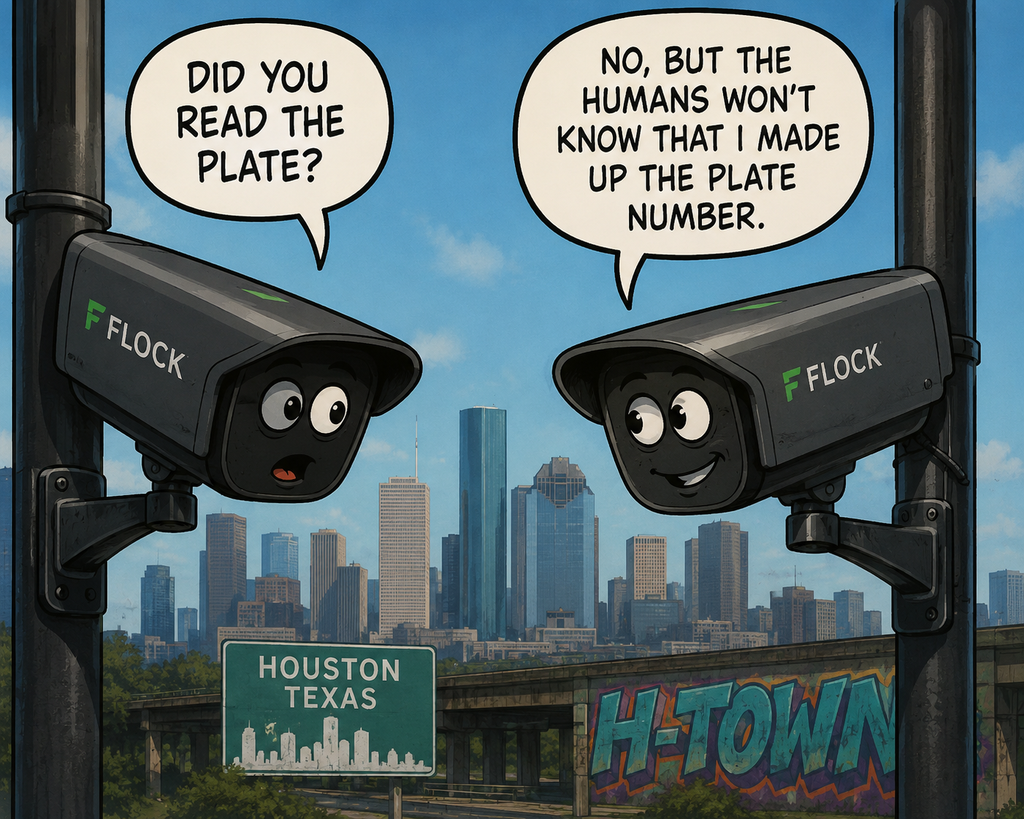
Houston has embraced Flock Safety’s artificial-intelligence license-plate cameras as another tool for fighting crime. Police can search the system for vehicles associated with suspects, stolen cars, and criminal investigations. The cameras are everywhere, quietly photographing license plates and feeding information into a searchable network.
There is only one problem Houston should be talking about much more loudly:
Artificial intelligence makes mistakes. Flock makes mistakes. And mistakes by police technology can put an innocent person in the path of armed officers.
This is no longer speculation.
Roseville, California, actually checked.
Its police department reviewed 1,427 Flock alerts involving vehicles identified as stolen or associated with felonies during 2023 and 2024. It found that 1,011 of them — 71 percent — involved a license plate that Flock had misread.
Seventy-one percent.
Roseville deserves credit for something Houston apparently has not done publicly: it measured the errors and told people what it found.
No innocent Roseville motorist was arrested because of those incorrect alerts. There is a reason. Roseville requires officers to independently verify an automated alert before taking enforcement action. Its own police department emphasizes that the camera’s conclusion is not enough.
That should reassure us about Roseville.
It should raise questions about Houston.
Flock argues that Roseville’s camera installation was unusual, involving older equipment and camera positioning that contributed to the poor results. Fair enough. A 71-percent error rate should not automatically be applied to every Flock camera in America.
But that answer creates another question Houston should be required to answer:
What is Houston’s error rate?
We don’t know.
That is remarkable because Houston isn’t merely experimenting with this technology.
The Houston Chronicle obtained records showing that Houston police conducted nearly 470,000 Flock searches during one 12-month period. The Chronicle found that officers frequently entered vague explanations — and sometimes no specific law-enforcement purpose — for those searches.
Houston police policy acknowledges that automated license-plate information can be wrong. Officers are supposed to verify information before relying upon it.
But a policy telling officers to double-check an AI system is also an admission of something important:
The computer cannot be trusted by itself.
That is true of practically every artificial-intelligence system.
Ask ChatGPT a complicated historical question, and occasionally it will confidently tell you something that isn’t true. Anyone who uses AI regularly learns the rule very quickly: verify important information.
The consequences of getting something wrong here, however, are considerably different.
If an AI assistant gives someone the wrong birth date for a great-grandfather, somebody corrects the family tree.
If police AI identifies the wrong license plate as belonging to a stolen automobile or a vehicle connected with a felony, an officer may start looking for you.
The damage doesn’t require a wrongful conviction.
It doesn’t even require an arrest.
Police can follow the wrong automobile. Investigators can spend time pursuing the wrong person. An innocent motorist can suddenly become the subject of an investigation. An officer approaching what the computer says is a stolen or felony-associated vehicle may understandably approach it very differently from an ordinary traffic stop.
And elsewhere in America, automated license-plate mistakes have already contributed to innocent motorists being detained, sometimes at gunpoint.
So Houston should be obsessed with determining how often its system gets things wrong.
Instead, much of the local debate has centered on privacy, surveillance, and whether somebody should be allowed to know where your automobile has traveled. Those are legitimate questions. Houston-area agencies have also investigated officers for potentially improper use of the system, while activists have protested the growing camera network.
But there is an even more basic question.
Does the machine work?
Roseville can tell its citizens that, during the period it examined, 71 percent of a particular category of Flock alerts contained misread plates.
Can Houston tell us the equivalent number?
How many Flock alerts did HPD receive last year?
How many were correct?
How many were false?
How many times did an officer begin investigating the wrong automobile?
How many errors were caught because an officer followed HPD’s verification procedures?
How many weren’t?
Perhaps Houston’s cameras perform wonderfully. Perhaps their error rate is tiny. Perhaps Houston police officers catch virtually every mistake before anything happens.
If so, show us the numbers.
Because the alternative is troubling.
Houston has allowed an artificial-intelligence surveillance system to become an enormous part of everyday police work, generating hundreds of thousands of searches, while another American police department discovered serious accuracy problems when it bothered to look.
The technology industry has taught us repeatedly that artificial intelligence can be astonishingly useful and astonishingly wrong.
Most of us have learned not to trust it blindly.
Houston apparently trusts it enough to help police decide where to look.
Now Houston needs to prove that someone is looking just as carefully at the AI.