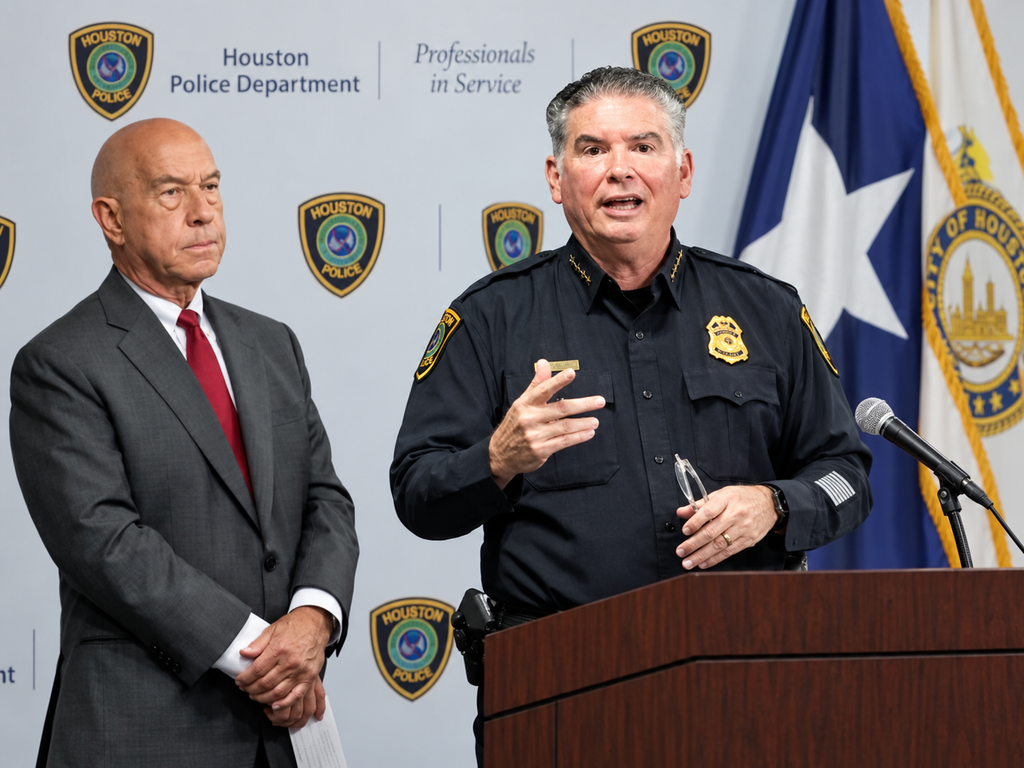
I cannot prove that Houston Mayor John Whitmire or Police Chief Noe Diaz is afraid of Donald Trump or Greg Abbott. What I can do is show you what they did when powerful Republicans applied pressure.
In April, Houston adopted an ordinance limiting how long Houston police would hold people merely because ICE had issued a civil administrative warrant. Whitmire voted for it. Then Governor Greg Abbott threatened Houston with the loss of more than $110 million in public-safety money.
Whitmire’s response was remarkable. “There’s only one opinion that matters, and that’s the governor’s,” he told reporters as he announced Houston would have to reverse course. (houstonchronicle.com)
Now we learn that long before an ICE officer shot and killed Lorenzo Salgado Araujo on a Houston street, Diaz had quietly changed another HPD policy—one that for decades had required Houston homicide investigators to investigate officer-involved shootings occurring inside the city, even when the shooter was a federal agent.
That change came around February 2025, about one month after Trump returned to the White House. Diaz says politics had nothing to do with it, and there is presently no evidence proving otherwise. But Houston residents are entitled to examine the timing and ask why the policy changed when it did.
Houston Used to Investigate the Shooting
For at least three decades, HPD’s practice was straightforward: if an officer shot somebody inside Houston, homicide investigators responded. It did not matter whether the officer worked for HPD or another law-enforcement agency.
Detectives collected shell casings, searched for surveillance video, interviewed witnesses, and attempted to interview the officer involved. In 2017, HPD even created a specialized unit assigned to investigate misconduct by HPD employees and other sworn peace officers when the alleged offense occurred inside Houston. (houstonchronicle.com)
Diaz changed that practice around February 2025. Federal-agent shootings would no longer automatically bring HPD homicide detectives to the scene; instead, HPD leadership would decide case by case whether Houston investigated a shooting that occurred inside Houston. (houstonchronicle.com)
Diaz has an explanation. He says federal agencies often refused to give HPD investigators access to officers, evidence, or scenes, making HPD’s parallel investigation frustrating and sometimes duplicative. That is a legitimate argument, but retired HPD homicide investigator Brian Harris made the obvious counterargument: even if federal authorities refuse to cooperate, Houston investigators can still photograph the scene, locate witnesses, retrieve surveillance recordings, and preserve physical evidence before it disappears. (houstonchronicle.com)
Then Lorenzo Salgado was killed.
Five Minutes
An ICE agent shot Salgado on July 7 during an immigration operation in Houston’s East End. HPD dispatchers learned about the shooting at 6:52 a.m., and by 6:57 a.m. scanner traffic recorded an HPD official telling investigators that the situation was under control, “per orders from HPD headquarters.” (houstonchronicle.com)
HPD homicide detectives did not investigate. The first local investigators from Harris County District Attorney Sean Teare’s office did not reach the scene until the following day, after federal authorities had already controlled the scene and much of the evidence. (houstonchronicle.com)
That is not simply an academic dispute over jurisdiction. Evidence can disappear, surveillance recordings can be erased, witnesses can leave, weather can alter a scene, and memories can change. The first hours of a homicide investigation matter.
“We Can’t”
Then Whitmire told Houston something that turns out to be much harder to defend. Asked about a local investigation, the mayor said, “Even if we wanted to … we can’t.”
Whitmire said Houston lacked jurisdiction because this was a federal matter. Diaz made essentially the same argument, telling federal officials HPD had “no independent jurisdiction” to investigate federal agents acting in their official capacity. (houstonchronicle.com)
Former police officials, prosecutors, and legal experts interviewed by the Houston Chronicle disagreed. Houston authorities can investigate whether Texas criminal law was violated inside Houston. What they may not be able to do is force the federal government to hand over evidence or compel federal agents to talk. (houstonchronicle.com)
Those are not the same thing, and Houston has done it before.
When an FBI agent accidentally shot and killed kidnapping victim Ulises Valladares during a 2018 rescue operation, local authorities investigated. Harris County prosecutors eventually presented the case to a grand jury, which declined to indict the agent. The point was not that the FBI agent necessarily committed a crime; the point was that someone died in Houston, so Houston conducted its own investigation.
Then There Is Abbott
If the Trump connection requires inference, the Abbott episode does not.
On April 8, Houston City Council voted 12-5 to end HPD’s requirement that officers wait 30 minutes for ICE to arrive when a person had only a civil administrative immigration warrant. The ordinance also required quarterly reports detailing HPD’s cooperation with ICE, and Whitmire voted for it. (houstonchronicle.com)
Five days later, Abbott’s office threatened Houston: revoke the policy or risk losing more than $110 million in public-safety grants and potentially having to repay money already received. (houstonchronicle.com)
Whitmire immediately changed direction. “We’ve got to correct that policy,” he said, followed by the sentence Houstonians should remember: “There’s only one opinion that matters, and that’s the governor’s.” (houstonchronicle.com)
Not the Houston City Council’s opinion. Not Houston’s lawyers’ opinion. Apparently, not even a judge’s opinion unless someone first bothered to ask one.
The governor’s.
Houston Could Have Fought
Whitmire said fighting Abbott would be a “waste of time” because any legal challenge could eventually reach the Republican-controlled Texas Supreme Court. But legal experts told the Chronicle Houston potentially had a legitimate case.
One question was whether Abbott’s grant conditions even applied to people merely detained during traffic stops rather than people legally in custody. Another was whether the state could require local police to extend a detention beyond what the Fourth Amendment permits. (houstonchronicle.com)
Nobody could guarantee Houston would win. That is why courts exist.
Council Member Alejandra Salinas urged Whitmire to seek an injunction and let a judge decide whether Abbott could legally take the money. Whitmire chose not to fight.
Eventually Houston amended the ordinance to satisfy Abbott’s demands and preserve the money. The reporting requirements survived, but the state had demonstrated something important: threaten Houston’s funding and its mayor might retreat before a court ever gets the opportunity to tell Abbott whether he is right. (texastribune.org)
And Then Trump
Now look at the timing of Diaz’s decision.
Donald Trump returned to office in January 2025 promising a massive expansion of immigration enforcement. His administration quickly began threatening or withdrawing grants from local governments and law-enforcement agencies it considered insufficiently cooperative with federal priorities.
Around February 2025, Diaz changed Houston’s decades-old practice of automatically investigating federal officers who shot people inside Houston. (houstonchronicle.com)
Diaz specifically denies that Trump’s administration or federal funding had anything to do with his decision, and we should report that clearly because there is presently no evidence proving Trump ordered Diaz to make the change. But we are also entitled to examine the chronology.
Trump arrives, federal funding increasingly becomes a weapon in immigration policy, Houston quietly stops automatically investigating federal officers, and then an ICE agent kills a Houston resident. HPD headquarters decides within minutes not to send homicide investigators, and Whitmire tells the public Houston cannot investigate.
We later discover that Houston had done exactly that for decades.
That deserves more than a shrug.
The Policy We Still Can’t See
There is another troubling detail. The Houston Chronicle requested the written HPD policy change on July 9, and HPD asked the Texas Attorney General’s Office for permission to withhold it.
According to the newspaper, HPD then missed the deadline for submitting its legal argument explaining why the document should remain secret, yet still had not produced the policy when the Chronicle published its investigation on September 9. (houstonchronicle.com)
So Houston quietly changes a decades-old homicide policy. The change becomes important after a federal officer kills someone, the mayor says Houston lacked jurisdiction, experts say that is not true, and when a newspaper asks to see the policy that actually governed HPD’s decision, the department fights to keep it secret.
That is not good transparency.
Lorenzo Salgado Wasn’t Even Their Target
The facts surrounding Salgado’s death make independent scrutiny particularly important.
Federal authorities eventually acknowledged that Salgado was not the person ICE originally intended to arrest. The operation began with agents looking for another white van and eventually pursuing Salgado’s. (houstonchronicle.com)
DHS initially said Salgado tried to use his van as a weapon against officers. The workers who were inside the van dispute that account, saying agents were beside the vehicle rather than in front of it. Available surveillance video has not clearly resolved what occurred at the instant the shot was fired, and the ICE officers were not wearing body cameras. (houstonchronicle.com)
That is precisely the kind of case where an independent local investigation has value. Not because ICE must be lying and not because the officer must be guilty, but because when one government agency kills someone, that agency should not be the only institution capable of determining what happened.
So Are They Afraid?
Maybe Whitmire and Diaz would call all of this pragmatism. Abbott controls money Houston needs, Trump controls federal agencies and federal money, Diaz says federal investigators make parallel HPD investigations difficult, and Whitmire says his first responsibility is protecting Houston’s finances and public safety.
Those arguments deserve to be heard, but leadership is easiest when nobody powerful is threatening you. The test comes when somebody with more power says: do what I want or suffer the consequences.
When Abbott threatened Houston, Whitmire first voted one way and then announced that only the governor’s opinion mattered. When an ICE agent killed a Houston resident, Diaz’s department abandoned a practice Houston had followed for decades, and Whitmire told us HPD couldn’t investigate when the evidence now shows HPD had consciously decided not to.
So I cannot tell you what Whitmire or Diaz feels when the telephone rings. I can only tell you what the record shows after powerful Republicans apply pressure.
Houstonians can decide for themselves whether that looks like leadership—or fear.