
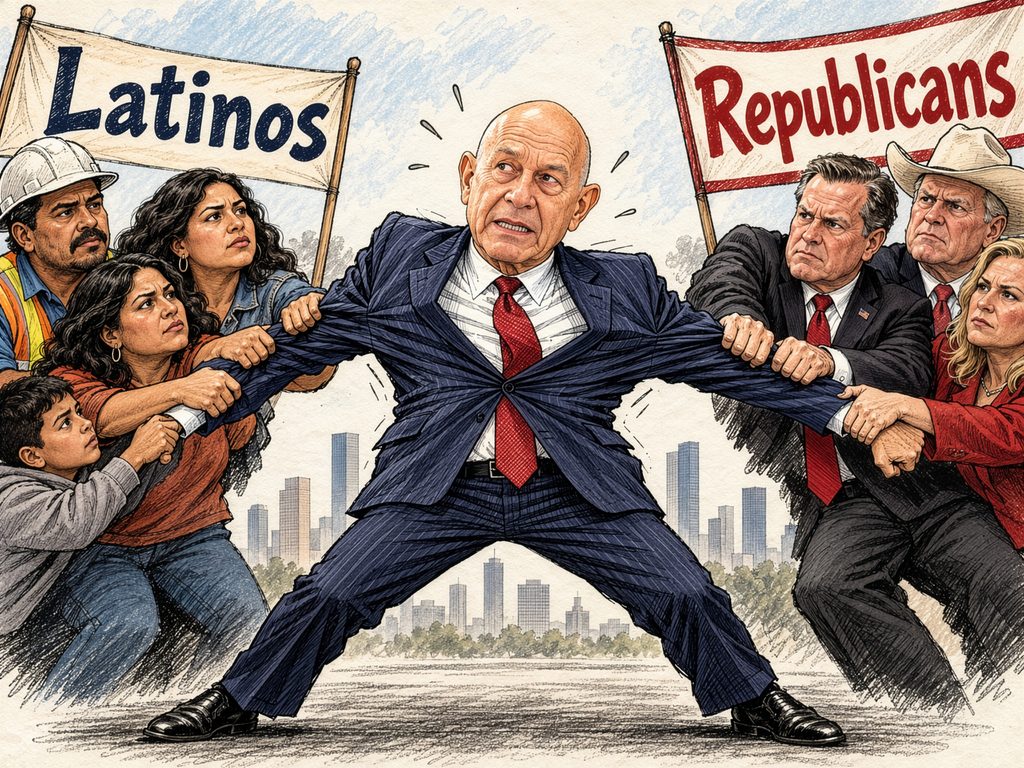
I read an article suggesting that Chris Hollins may not run for mayor because he isn’t seriously raising money. Whitmire is not well liked; he is managing to alienate both his core groups: Latinos and Republicans. He can throw money around, but you can’t take away the smell of who you are. Chris Hollins has a coalition that could easily defeat Whitmire. Annise Parker is a perfect example of what happens when people start disliking you.
Money Can Make You Viable. It can’t make voters like you.
I would not write Chris Hollins out because he is not raising a ton of money now. In fact, when Hollins won the controller’s race in 2023, he was not the biggest financial player in Houston politics. John Whitmire had roughly $10 million cash on hand for the mayor’s race while Hollins had about $1.1 million at the start of that year. Hollins later substantially outspent Orlando Sanchez in the controller contest, but his victory came from having enough money to be credible, not from being Houston’s richest candidate. He finished first in November with 44.8%, then beat Sanchez 59.1% to 40.9% in the runoff. (Houston Chronicle)
That distinction matters when people look at Edward Pollard’s fundraising and assume the money tells us where the 2027 mayoral race is headed. Money matters enormously in a Houston city election. It pays for television, mail, signs, consultants, polling, and turnout. But Houston has repeatedly shown that money cannot manufacture a political coalition.
Annise Parker learned that in 2011. As the incumbent mayor, with a huge financial advantage and no major opponent, she received only 50.8% and barely escaped a runoff. Fifteen years later, she entered the 2026 Harris County judge runoff with far more money and an apparent polling advantage over Letitia Plummer, yet Plummer defeated her. Those two races are useful reminders that being able to buy communication is not the same as persuading people to vote for you.
Pollard certainly has demonstrated that he knows how to win elections. His District J strategy has been based partly on reaching conservative and moderate voters rather than trying to become the favorite of Houston’s progressive organizations. That approach helped him win a diverse district comfortably. But a citywide Houston electorate is much larger and politically different.
He also carries political history that money cannot erase. Pollard challenged Gene Wu in the 2016 Democratic primary as a self-described conservative Democrat, and his opposition to Houston’s Equal Rights Ordinance put him directly against an issue that was especially important to LGBTQ voters and many progressives. Wu defeated him decisively. That history does not mean those voters could never support Pollard, but it does mean he would have work to do with constituencies that are important in a citywide Houston election.
His other possible routes are clearer. He could attract substantial support from Republicans, conservatives, police-oriented voters, business interests, and moderate Black voters. A large Latino vote could broaden that coalition considerably, but so far there is not much public evidence that Pollard has built a distinct citywide Latino political base.
That is why I would not assume Pollard runs for mayor simply because he is raising money. A large campaign account gives him options. It does not tell us which office he intends to seek, and it does not solve the problem of assembling more than half the voters in a runoff.
Hollins has a different political profile. As controller, he has increasingly challenged Whitmire over city finances, the firefighter settlement, utility finances and the Woodlands agreement, and this week he gave his clearest public indication yet that he may be considering a 2027 challenge. That does not mean he will run, but low fundraising today is weak evidence that he will not. Texas law also restricts when some officeholders can formally become candidates for another office, which can affect the timing of a campaign. (Houston Chronicle)
And there is another reason not to assume Hollins and Pollard are competing for the same political space. Their potential coalitions are different enough that one does not necessarily have to disappear for the other to have a future in Houston politics.
The mistake is treating campaign money like votes already deposited in the bank.
Houston has seen candidates with enormous financial advantages struggle, and candidates with less money win. Fundraising tells us whether somebody can afford to compete. It does not tell us whether voters want that person to be mayor.
Money can make you viable. It cannot make voters like you.