
I think the mayor saw the writing on the wall; Whitmire isn’t an oak that stands strong, but more like a reed that bends with the wind. I sensed he saw political problems; he needs the following constituents to get re-elected: Republicans and Latinos. A grant to help ease Houston’s money woes would have required HPD to act as ICE agents. With many Hispanics wary of his already-existing cooperation with ICE, that could have been the straw that broke Hispanic support for Whitmire.
Tough times require strong, smart leadership; Whitmire seems to be lacking both qualities.
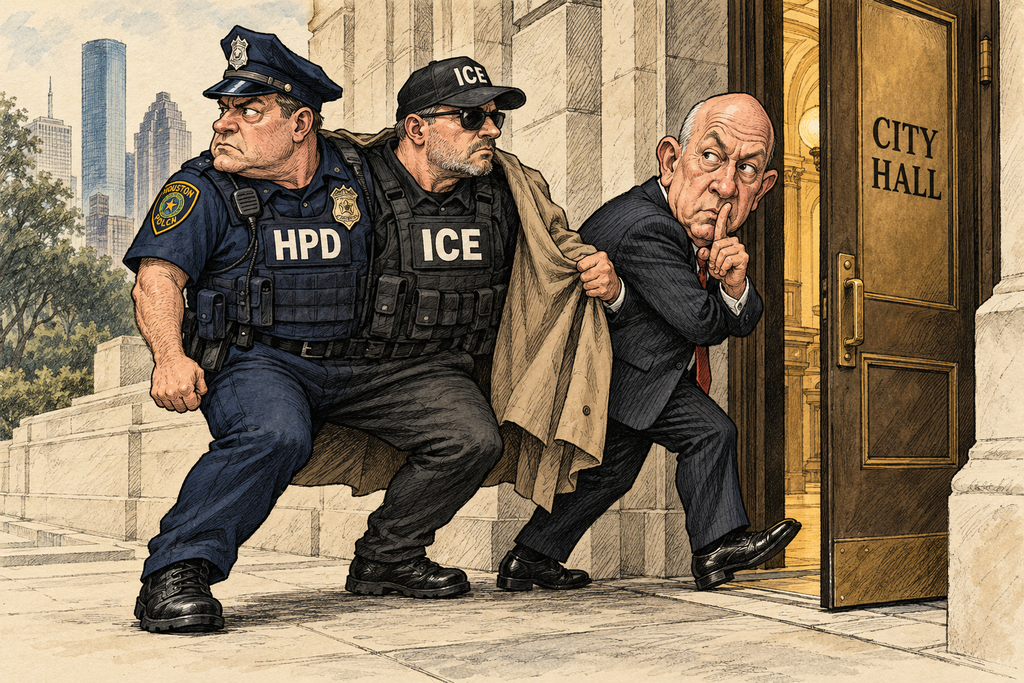
Houston needs money. Mayor John Whitmire’s administration pursued a $150 million federal grant while questions about its immigration-enforcement requirements remained unresolved. He withdrew the request on October 5, after acknowledging that staff submitted the application before securing council approval. The request is no longer pending. To me, the decision to pursue it in the first place raises a question about judgment and principles, not merely paperwork. [1]
Whitmire still cooperates with ICE. Rejecting this particular program prevented the possibility of deeper involvement; it did not reverse the existing policy. We should judge his leadership by that entire record, rather than treat the withdrawal as a fresh start.
Expensive Commitments Require Honest Answers
Whitmire inherited financial problems. My criticism is that he made those problems worse by committing Houston to expensive firefighter and police agreements without giving residents a sufficiently convincing explanation of how the city would sustain them. An existing shortage of money makes the affordability of new commitments more important.
His administration announced a $650 million firefighter settlement in March 2024, to be financed through judgment bonds, along with additional raises of up to 34% over the new contract. The settlement addressed a dispute dating back to 2017; the agreement also committed the city to higher pay going forward. Borrowing to resolve the past and increasing future expenses both require a durable means of payment. [2]
Whitmire also secured a police agreement that the Houston Chronicle reported would add nearly $1 billion in raises over five years. The city described the salary increases as totaling 36.5% over the contract. These are substantial commitments whose financing deserves the same public attention as the announcements celebrating them. [3][4]
Police officers and firefighters deserve fair compensation. But a mayor cannot judge a contract only by the applause it receives when signed. Promising higher recurring spending before establishing durable revenue resembles borrowing money you cannot comfortably repay: the deal closes today, and the obligations remain tomorrow. That is the financial judgment I am questioning.
The adopted fiscal 2027 budget moved solid waste into the combined utility system and introduced a $5 monthly administrative fee. When the proposal appeared in May, Controller Chris Hollins warned that the fee’s estimated $24 million in revenue fell far short of the roughly $100 million cost of trash services. His concern was that the remaining costs would put pressure on water-system funding. [5][6]
There is evidence of improvement: S&P changed Houston’s financial outlook from negative to stable this summer. That deserves acknowledgment. It does not settle the separate questions of whether the funding arrangements are sustainable, whether residents understand the eventual costs, or whether the mayor is making acceptable choices in pursuit of additional money. [7]
The federal grant was proposed funding for specific programs, not an unrestricted check to erase Houston’s deficit. Still, pursuing outside money in this setting demands particular care about the conditions attached to it.
The Conditions Were There to Read
The Justice Department’s Model Cities Initiative explicitly requires applicants’ initiatives to align with federal priorities that include immigration enforcement. It also anticipates substantial federal involvement in funded projects. The concern about deeper cooperation was grounded in the program’s own documents, even though the precise obligations Houston would have accepted remained unresolved. [8]
An experienced mayor should establish those limits before pursuing the money. The public deserves to know what the city proposes to accept, what it will refuse, and who has authorized the application. A deadline does not relieve an administration of those responsibilities.
This was also happening against an existing record of financial pressure shaping immigration policy. In April, Whitmire said Houston was not ICE after Abbott threatened to withdraw $110 million in public-safety grants. Later that month, his administration announced an amended ordinance and police directive, saying the change allowed Houston to recover $114 million in funding. Those are the amounts stated in the city’s respective announcements. [9][10]
The cooperation continued. According to the Chronicle, HPD contacts ICE upon encountering a civil immigration warrant and waits a reasonable amount of time for agents. From April through June, 103 such encounters led to 19 people being taken into ICE custody. [1]
That is why withdrawing this application does not restore our confidence. The underlying question remains: how much influence over Houston’s policing is the mayor willing to accept in exchange for funding?
Fifty Years Should Have Taught Him Better
Whitmire’s own biography describes ten years in the Texas House and forty in the Senate before becoming mayor. After more than half a century in elected office, he cannot reasonably ask residents to excuse poor judgment as inexperience. [11]
I cannot prove his private motive for withdrawing the application. My judgment is that this episode shows political cowardice: an administration willing to pursue controversial funding before resolving its conditions, then retreating after public opposition while leaving its existing ICE cooperation intact. That is an assessment of his conduct, not a claim that I can read his mind.
Houston deserves a mayor who explains the financial choices honestly and states clear limits before money is on the table. Our confidence depends on seeing those limits hold under pressure. Withdrawing this application does not answer for the decision to pursue it or for Houston’s continuing cooperation with ICE.
Sources
- Houston Chronicle, October 5, 2026: Grant withdrawal and existing HPD cooperation
- City of Houston, March 14, 2024: Firefighter settlement terms
- Houston Chronicle, May 31, 2026: Police raises and staffing
- City of Houston, May 2, 2025: Police contract announcement
- City of Houston, June 10, 2026: Adopted fiscal 2027 budget
- Chron, May 5, 2026: Controller’s concerns about trash funding
- Houston Chronicle editorial, July 7, 2026: Improved financial outlook and unresolved trash funding questions
- U.S. Department of Justice: Model Cities Initiative funding notice, especially pages 7–8
- City of Houston, April 13, 2026: State funding threat
- City of Houston, April 23, 2026: Amended immigration directive
- City of Houston: Mayor’s biography