John Whitmire may have found a way to change Houston’s immigration policy without changing where some immigrants end up. He can announce a break with the old approach, claim credit for easing fear, and leave open a route from an HPD arrest to the county jail and then to ICE. Whether that becomes the outcome depends on what officers do after the cameras leave City Hall.
The election gave Whitmire a reason to change course—and political protection for doing it. At his November 6 announcement, he acknowledged the connection: “I also do this knowing that elections matter.” He defended his earlier approach by citing threatened state funding and described conversations with incoming state leaders. My reading is straightforward: he saw the writing on the wall and chose what had become the safer political direction. His explanation supports that interpretation of the timing, though it cannot establish everything he intends. click2houston.com
Political cover is a better description of the concern than “false flag.” The question is whether the announcement could function as a smokescreen: a visible change that reassures the public while leaving practices underneath it largely intact. We do not need to prove a secret agreement between the mayor and the police union to ask whether the policy’s design permits that result.
The new rule leaves an important exception. HPD officers will no longer contact ICE solely over an administrative immigration warrant when an encounter ends without an arrest. But contact continues when the person has such a warrant and is arrested for a jailable offense. A citation can mean going home; an arrest can mean entering the immigration enforcement system. click2houston.com
When Obama was president a young mother got into an argument with her neighbor, they were loud but no physical alteration occurred. The police were called they decided to take the young mother to jail, where because of her undocumented status, she was promptly deported. The child was left here without a mother.
The police union’s objections make implementation especially important. Union president Douglas Griffith said the union was blindsided, questioned the directive’s compatibility with SB 4, and raised concerns about officers’ liability if someone released later commits a crime. He said officers would follow their instructions. His legal objections remain objections, rather than a court ruling, but they show that the mayor’s announcement has not produced agreement over how the department should operate. www.fox26houston.com
Union opposition does not establish that the reform will be effective. It can also give Whitmire the appearance of standing up to the police while the practical test remains ahead. The union gets to object, the mayor gets to point to his order, and residents must wait to learn what changes during an actual encounter.
An announcement from headquarters does not convince me that every officer will comply or that violations will bring meaningful discipline. Diaz says the department reviews body-camera footage and will repeat the directive at roll calls. Those steps need an answer to the question that matters: what happens to an officer who disregards it? click2houston.com
There is also a way for the route to ICE to remain open without an officer violating the restriction on calls. Where an officer has lawful discretion to issue a citation instead of making an arrest, choosing arrest can put someone into the county jail. The concern is whether suspected immigration status influences that choice. An arrest without lawful grounds is a separate abuse; either possibility deserves scrutiny.
The county jail connection is documented. Recent reporting explains that Harris County receives bookings from multiple police agencies and transfers people to ICE under applicable immigration detainers. Sheriff Ed Gonzalez has distinguished those jail obligations from proactive immigration enforcement. That distinction matters administratively, but a person delivered into ICE custody still experiences the consequences of the original arrest. www.fox26houston.com
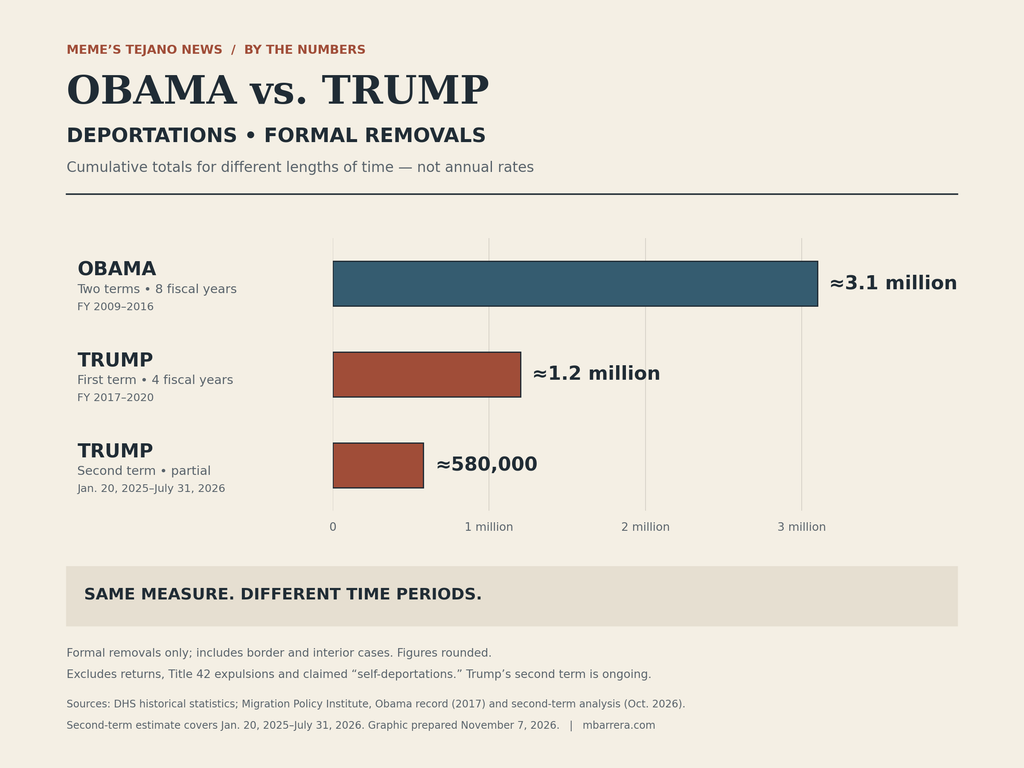
The Obama years show how consequential that machinery can be. His administration recorded roughly 3.1 million formal removals, establishing a presidential record in that category. That is the precise comparison: counting removals and returns together produces higher totals under Clinton and George W. Bush. Obama also increasingly narrowed enforcement priorities, so his record should not be presented as an unchanged policy across eight years. Migration Policy Institute
The older campaigns against Mexicans belong in this history too. The Library of Congress describes coercion and the expulsion of U.S. citizens during the 1930s, while federal historical records document the 1954 operation officially named with the slur “Operation Wetback.” Those episodes should not be reduced to a casual numerical comparison with modern removal statistics. Library of Congress
The relevant Obama-era lesson is how a local arrest could activate federal immigration enforcement. Secure Communities, launched under Bush and expanded under Obama, connected booking fingerprints to immigration databases. A 2011 DHS document describes that process and monitoring for questionable arrest patterns. The American Immigration Council warned that same year that officers could use pretextual arrests to get suspected undocumented immigrants screened through those databases. The concern is documented; proving particular HPD incidents requires particular evidence. Migration Policy Institute
Houston therefore needs to measure more than calls to ICE. It needs to examine arrests where citations were available, the charges used, differences among officers and neighborhoods, subsequent dismissals, and transfers from those bookings into ICE custody. It also needs public accounting of violations and discipline.
Whitmire deserves credit if his order produces real protection. But a decline in roadside calls will prove little if discretionary arrests keep delivering people to ICE through the county jail. Until Houston examines both routes, the mayor’s political protection may be easier to demonstrate than the protection he has promised residents.