
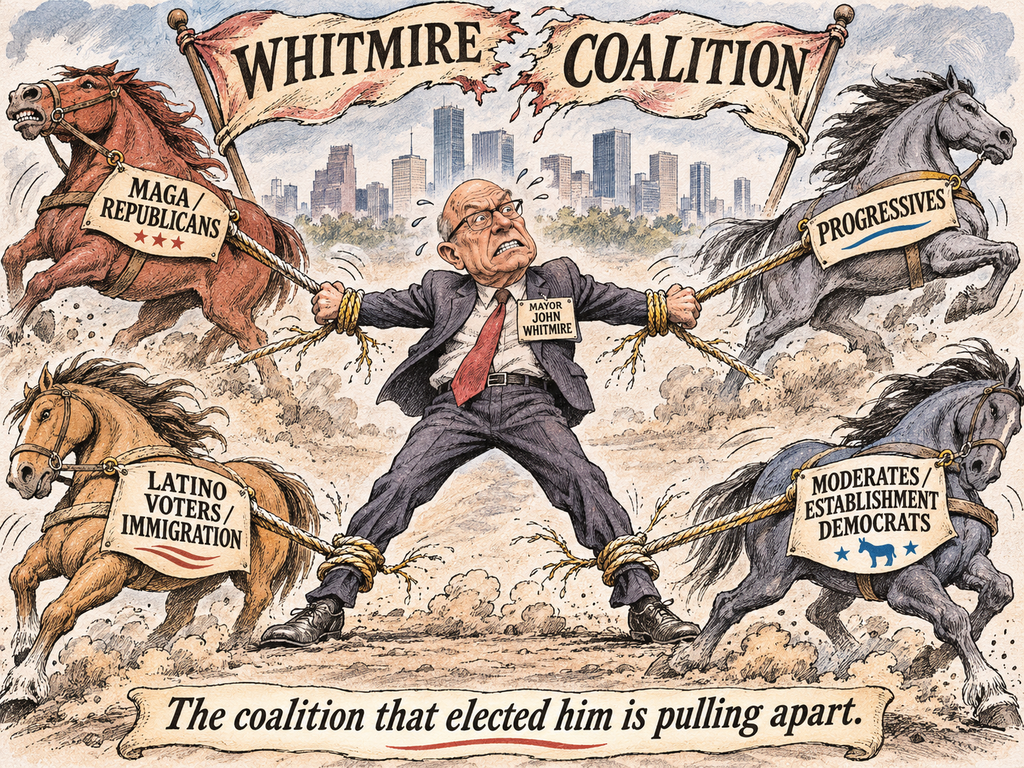
John Whitmire won the Houston mayor’s race in 2023 by putting together a coalition of Republicans, conservative Democrats, moderate voters, and a substantial number of Latino voters. It was an impressive political accomplishment. But the coalition that elected Whitmire is not necessarily the coalition that will show up for him in 2027. And there is mounting evidence that the political alliances that once held it together are coming apart.
In a November 23 article, political blogger Charles Kuffner questioned whether progressive organizations could assemble a coalition capable of challenging Whitmire. He also observed that there was no evidence yet that Whitmire’s original support had diminished. That is a cautious conclusion, but it overlooks the political developments taking place right before our eyes.
Whitmire’s original coalition was built on political compatibility, not ideological agreement. Republicans supported him because they saw him as a Democrat they could work with. Moderate Democrats liked his experience and reputation for compromise. Some progressives were willing to give him a chance, while Latino voters helped provide the additional support that made his victory possible.
The problem with such a coalition is that its members may have very different expectations. Keeping them together requires more than winning an election. It requires convincing each group that the mayor continues to represent its interests.
Immigration may be the issue that finally exposed the contradictions within Whitmire’s coalition. For months, immigrant-rights advocates demanded that Houston limit cooperation between the Houston Police Department and Immigration and Customs Enforcement. Whitmire initially resisted stronger restrictions, warning about state law and the possibility of losing more than $110 million in state public safety funding.
In April, after City Council adopted restrictions on HPD cooperation with ICE, Governor Greg Abbott threatened Houston’s funding. Whitmire led the effort to reverse course rather than defend the original ordinance in court. Immigrant families were left watching their mayor retreat while advocates continued demanding protection.
The Houston Chronicle reported in July that some prominent Latino politicians and community leaders defended Whitmire, citing his long legislative record and the legal restrictions imposed by the Republican-controlled state government.
Among those publicly defending him were State Senator Carol Alvarado and LULAC leader Sergio Lira. Other Latino elected officials had previously opposed efforts by Harris County Democrats to condemn the mayor.
But defending Whitmire’s political record was not the same thing as standing alongside immigrant families demanding immediate action. While these leaders explained the mayor’s position, activists were organizing demonstrations, appearing before City Council, and demanding changes to HPD policy. The distinction matters because political leaders ultimately answer to the people they represent, not merely to the politicians with whom they have longstanding relationships.
Those who previously defended Whitmire now face a different political environment. Will they continue standing with him, or will they reconsider as 2027 approaches? Their future decisions may reveal whether their earlier support was durable political loyalty or a temporary alliance.
Meanwhile, a new generation of Latino leadership is emerging, and it is not waiting for the mayor’s permission. Council Member Alejandra Salinas has become one of the most visible advocates for limiting HPD cooperation with ICE. Alongside Council Members Edward Pollard and Tiffany Thomas, she has sought to turn Whitmire’s November executive order into a permanent city ordinance.
That effort has exposed another contradiction.
On November 6, just days after Democrats swept Texas’ statewide elections, Whitmire issued an executive order sharply restricting when HPD officers could contact ICE. The timing was unmistakable, although the mayor maintains that his actions reflected changing circumstances and his responsibilities to the city.
If the mayor could issue an executive order restricting cooperation with ICE, why couldn’t City Council adopt an ordinance containing essentially the same restrictions?
Whitmire opposed the ordinance. City Attorney Arturo Michel subsequently declared the proposal unlawful, even though its sponsors said it mirrored the mayor’s own executive order.
Salinas, Pollard, and Thomas challenged that position, correctly identifying an important legal distinction: the city attorney advises the city, but a court ultimately determines whether an ordinance violates state law.
As Houston Public Media reported November 18, Attorney General Ken Paxton has renewed his legal challenge to Houston’s restrictions. Whitmire has pledged to defend his executive order, but the administration has resisted making those protections part of the city code.
The dispute leaves immigrant-rights advocates questioning why the mayor is willing to establish protections through an executive order that a future mayor could revoke, yet opposes legislative action designed to make them more durable.
Whitmire’s difficulties are not confined to Latino voters and progressive Democrats. His relationship with conservatives has also become more complicated.
The Republicans who supported Whitmire in 2023 did not suddenly become Democrats. Many supported his approach to public safety and believed he would maintain a cooperative relationship with Republican leaders in Austin.
His November immigration reversal directly challenges those expectations.
Lieutenant Governor Dan Patrick has accused Whitmire of moving Houston toward sanctuary-city policies. Attorney General Paxton is taking the city to court. Conservative commentators have criticized the mayor’s changing approach to immigration enforcement.
Those developments do not establish that Republican voters have abandoned Whitmire. But they demonstrate that the political accommodation that once made him attractive to conservatives is being tested.
Whitmire now faces criticism from both sides of the immigration debate. Progressive critics question why he waited so long to change HPD policy. Conservatives question why he changed it at all.
That is the danger of trying to maintain two constituencies whose positions on a defining issue have become increasingly difficult to reconcile.
And immigration is hardly the only source of opposition.
Transportation advocates have criticized Whitmire’s decisions involving bicycle infrastructure and transit priorities. Progressive organizations concerned with housing, affordability, labor rights, and city services are preparing for the 2027 municipal elections. The Houston Chronicle reported November 18 that several organizations are actively discussing how to translate the recent Democratic electoral victories into greater influence at City Hall.
The mayor has also lost formal political support within his own party. In December 2025, Harris County Democratic precinct chairs voted 186–80 to deny Whitmire future party endorsements.
That decision did not establish that ordinary Democratic voters had abandoned him. It did establish that a significant portion of the party’s organized leadership was no longer willing to support him.
Then there is Houston’s Black electorate, another important part of the 2027 political equation. Sheila Jackson Lee’s strongest support in 2023 came from Black voters, although Whitmire also attracted support across racial and ethnic lines. A future challenger capable of mobilizing Black voters, progressive Democrats, and dissatisfied moderates would present a different political contest from the one Whitmire faced in 2023.
There is not yet sufficient current polling to determine how much Black support Whitmire retains. But there is equally little justification for assuming that his 2023 electoral coalition will automatically reassemble.
Controller Chris Hollins has already publicly criticized the mayor and signaled interest in challenging him. Other potential candidates could emerge, including candidates appealing to the conservative and moderate voters who helped Whitmire win.
A conservative challenger would present a particular complication. Such a candidate would not need to win over progressive Democrats to affect the race. Simply competing for voters who supported Whitmire in 2023 could change the composition of the mayoral electorate.
The November 2026 election added another element that Kuffner’s analysis does not fully address. Democrats won statewide in Texas, demonstrating that the political environment has changed considerably since Whitmire’s 2023 victory.
That does not mean Houston’s 2027 municipal electorate will resemble the statewide electorate of 2026. Municipal turnout can be dramatically different, and political enthusiasm does not necessarily translate into votes.
But it does mean that Whitmire will be running in a political environment where organizations previously accustomed to Republican statewide dominance may be more willing to challenge established political arrangements.
Even Latino leaders who once defended Whitmire will have to consider whether their constituencies still support the mayor’s approach. Endorsements made in 2025 or early 2026 cannot be treated as guaranteed commitments for 2027.
This is where Kuffner’s argument deserves closer examination. He is correct that there is no definitive polling establishing how much of Whitmire’s original voter support has disappeared. But political coalitions are not maintained by polling numbers alone. They depend on relationships, public confidence, endorsements, organizations, and the willingness of supporters to defend a candidate when that candidate faces criticism.
We already have evidence of important changes in several of those relationships.
Progressive organizations are preparing for the next election. The Harris County Democratic Party has formally denied Whitmire future endorsements. Immigrant-rights advocates are challenging his administration. Latino elected officials are publicly pressing for stronger protections. And conservative Republican leaders are attacking his new immigration policies.
These are not hypothetical developments. They are happening.
What remains uncertain is how those developments will translate into votes in November 2027.
Whitmire’s greatest political problem may not be that his opponents are uniting. It may be that the groups that once supported him increasingly disagree about what kind of mayor they thought they were electing.
Republicans expected cooperation with Austin. Progressives expected an administration willing to defend vulnerable communities. Moderate Democrats expected pragmatic leadership. Latino voters concerned about immigration expected their city government to protect residents without turning local police into an extension of federal immigration enforcement.
Trying to satisfy all of them has become increasingly difficult.
And the mayor’s political maneuvering may have created a new problem: when he changes direction, he risks disappointing those who supported the previous position without necessarily regaining the trust of those who opposed it.
The Whitmire coalition has not yet been proven dead at the ballot box. But its internal fractures are now visible, its former allies are being forced to reconsider their positions, and the political circumstances that produced his 2023 victory no longer exist unchanged.
The question is no longer simply whether progressives can build a coalition to defeat Whitmire.
It is whether Whitmire can put his own coalition back together.
And perhaps the greatest irony is that the very skill Whitmire used to build his political career — accommodating people on opposite sides of an issue — may now be the thing pulling his coalition apart.